
NIMCET 2021 Question Paper and Solutions
NIMCET Previous Year Papers!
The NIMCET 2021 paper was of moderate difficulty level. Students are advised to attempt the questions on their own and avoid checking the solutions immediately to get maximum benefit from this paper. Step-by-step solutions are provided for guidance, along with the topic and difficulty level of each question. Students can also use filters to practice questions from specific topics.
NIMCET 2021 QUESTION PAPER AND SOLUTION
If \(\theta\) is the acute angle between the lines \(x^2 - 7xy + 12y^2 = 0\), then \(\dfrac{2\cos \theta + 3\sin \theta}{4\sin \theta + 5\cos \theta}\) is:
We know that \(\tan \theta = \dfrac{2\sqrt{h^2 - ab}}{a + b} = \dfrac{2\sqrt{\dfrac{49}{4} - 12}}{1 + 12} = \dfrac{1}{13}\)
Now \(\dfrac{2\cos \theta + 3\sin \theta}{4\sin \theta + 5\cos \theta} = \dfrac{2 + 3\tan \theta}{4\tan \theta + 5}\)
\(= \dfrac{2 + 3 \times \dfrac{1}{13}}{4 \times \dfrac{1}{13} + 5} = \dfrac{29}{69}\)
The function \(f(x) = \dfrac{x}{1 + x\tan x}\), \(0 \le x \le \dfrac{\pi}{2}\) is maximum when:
\(f'(x) = \dfrac{(1 + x\tan x) - x(x\sec^2 x + \tan x)}{(1 + x\tan x)^2}\)
\(= \dfrac{1 - x^2\sec^2 x}{(1 + x\tan x)^2}\)
Here we see that when \(x^2\sec^2 x < 1\), \(f'(x) > 0\) and when \(x^2\sec^2 x > 1\), \(f'(x) < 0\).
Hence the function is maximum at \(x\sec x = 1\).
\(\Rightarrow \cos x = x\)
If \(\dfrac{n!}{2!(n - 2)!}\) and \(\dfrac{n!}{4!(n - 4)!}\) are in the ratio 2 : 1, then the value of \(n\) is:
The numbers are \(^nC_2\) and \(^nC_4\), clearly \(n \ge 4\).
From the options, \(n = 5\) gives the correct ratio.
There are 50 questions in a paper. Find the number of ways in which a student can attempt one or more questions:
Each question can be attempted or not attempted. So there are two choices for each question. So total number of ways of attempting the paper is \(2^{50}\), but there will be a case when no question is attempted.
Except this case all other cases are to be counted.
Hence the number of ways = \(2^{50} - 1\).
If \(p\) is the probability that a man aged \(x\) will die in a year, then the probability that out of \(n\) men \(A_1, A_2, ..., A_n\) each aged \(x\), \(A_1\) will die in a year and be first to die, is:
Probability that none of them will die is \((1 - p)^n\).
Hence probability that at least one of them will die is \(1 - (1 - p)^n\).
Now if we consider order, probability that \(A_1\) is the first to die among \(n\) men is:
\(\dfrac{1}{n}(1 - (1 - p)^n)\)
If a variable takes values \(0, 1, 2, 3, ..., 50\) with frequency \(1, ^{50}C_1, ^{50}C_2, \ldots, ^{50}C_{50}\) then the A.M. is:
The mean will be \( \dfrac{\sum fx}{\sum f} \).
\(=\dfrac{\sum \limits_{n=0}^{50} n \binom{50}{n}} {\sum \limits_{n=0}^{50} \binom{50}{n}}\) \(=\dfrac{\sum\limits_{n=0}^{50} n \binom{50}{n}}{2^{50}}\) … (1)
We know that \((1+x)^{50}= \binom{50}{0}+ \binom{50}{1}x+ \binom{50}{2}x^{2} + \cdots + \binom{50}{50}x^{50}\)
Differentiating w.r.t \(x\), we have
\(50(1+x)^{49} = \binom{50}{1} + 2\binom{50}{2}x + \cdots + 50\binom{50}{50}x^{49}\)
Now put \(x = 1\) in the above equation,
\(50 \times 2^{49} = \binom{50}{1} + 2\binom{50}{2} + \cdots + 50\binom{50}{50}\)
Put this value in equation (1),
Mean \(= \dfrac{50 \times 2^{49}}{2^{50}} = 25\)
In \(\Delta ABC\) if \(\tan^2 \dfrac{A}{2} + \tan^2 \dfrac{B}{2} + \tan^2 \dfrac{C}{2} = k\), then \(k\) is always:
We can put values of the angles A, B and C to get an idea about the value of \(k\).
Put A = B = C = 60°,
\(k = \tan^2 30 + \tan^2 30 + \tan^2 30 = 1\)
Put another set of values A = B = 30° and C = 120°,
\(k = \tan^2 15 + \tan^2 15 + \tan^2 60 > 1\)
Hence \(k \ge 1\)
If \(|k| = 5\), \(0° \le \alpha \le 360°\), then total number of different solutions of \(3\cos \alpha + 4\sin \alpha = k\) is:
The maximum and minimum value of \(a\cos \alpha + b\sin \alpha = \pm\sqrt{a^2 + b^2}\)
Hence maximum and minimum value of \(3\cos \alpha + 4\sin \alpha = \pm 5\)
Given that \(|k| = 5 \Rightarrow k = \pm 5\)
Taking \(k = 5\), \(3\cos \alpha + 4\sin \alpha = 5\)
or \(\dfrac{3}{5}\cos \alpha + \dfrac{4}{5}\sin \alpha = 1\), this is possible only when \(\cos \alpha = \dfrac{3}{5}\) and \(\sin \alpha = \dfrac{4}{5}\)
Similarly when \(3\cos \alpha + 4\sin \alpha = -5\) or \(\dfrac{3}{5}\cos \alpha + \dfrac{4}{5}\sin \alpha = -1\), this is possible only when \(\cos \alpha = -\dfrac{3}{5}\) and \(\sin \alpha = -\dfrac{4}{5}\).
Hence there are two possible values of \(\alpha\), so there are two solutions.
In a \(\Delta ABC\), \(a\cos^2 \dfrac{C}{2} + c\cos^2 \dfrac{A}{2} = \dfrac{3b}{2}\), then the sides of the triangle are in:
Using the half angle formula,
\(a \cdot \left(\dfrac{s(s - c)}{ab}\right) + c \cdot \left(\dfrac{s(s - a)}{bc}\right) = \dfrac{3b}{2}\)
\(\Rightarrow s(s - c) + s(s - a) = \dfrac{3b^2}{2}\)
\(\Rightarrow s(2s - a - c) = \dfrac{3b^2}{2}\)
Or \(\dfrac{b(a + b + c)}{2} = \dfrac{3b}{2} \Rightarrow a + c = 2b\)
The sides are in A.P.
Let \(\vec{a} = 2\hat{i} + \hat{j} + 2\hat{k}\) and \(\vec{b} = \hat{i} - \hat{j} + 2\hat{k}\) and \(\vec{c} = \hat{i} + \hat{j} - 2\hat{k}\) are three vectors. Then a vector in the plane of \(\vec{a}\) and \(\vec{c}\) whose projection on \(\vec{b}\) is of magnitude \(\dfrac{1}{\sqrt{6}}\) is:
Any vector that is coplanar with \(\vec{a}\) and \(\vec{c}\) is, \(\vec{a} + \lambda\vec{c} = (2 + \lambda)\hat{i} + (1 + \lambda)\hat{j} + (2 - 2\lambda)\hat{k}\)
Projection on \(\vec{b}\) is: \((\vec{a} + \lambda\vec{c}) \cdot \hat{b} = \dfrac{(2 + \lambda) - (1 + \lambda) + 2(2 - 2\lambda)}{\sqrt{1^2 + (-1)^2 + 2^2}} = \dfrac{5 - 4\lambda}{\sqrt{6}}\)
Given that projection on \(\vec{b}\) is of magnitude \(\dfrac{1}{\sqrt{6}}\), hence \(5 - 4\lambda = 1 \Rightarrow \lambda = 1\)
The vector is: \(\vec{a} + \lambda\vec{c} = (2 + \lambda)\hat{i} + (1 + \lambda)\hat{j} + (2 - 2\lambda)\hat{k} = 3\hat{i} + 2\hat{j}\)
The standard deviation of 20 numbers is \(30\). If each of the numbers is increased by \(4\), then the new standard deviation will be:
Standard deviation does not change when the same constant is added to or subtracted from each observation. Since each number is increased by \(4\), the standard deviation remains unchanged.
Hence, the new standard deviation is \(30\).
If \(a\cos\theta + b\sin\theta = 2\) and \(a\sin\theta - b\cos\theta = 3\), then \(a^2 + b^2\) is:
Squaring and adding the given equations,
\(a^2(\sin^2\theta+\cos^2\theta)+b^2(\sin^2\theta+\cos^2\theta)=2^2+3^2\)
\(\Rightarrow a^2+b^2=13\)
If \(\log(1-x+x^2)=a_1x+a_2x^2+a_3x^3+\cdots+a_nx^n\), then \(a_3+a_6+a_9+\cdots\) is equal to:
Given that \(\log(1-x+x^2)=a_1x+a_2x^2+a_3x^3+\cdots+a_nx^n\).
Put \(x=1,\ \omega,\ \omega^2\) respectively, where \(\omega\) is a cube root of unity.
\(\log(1)=a_1+a_2+a_3+\cdots+a_n\)
\(\log(1-\omega+\omega^2) =a_1\omega+a_2\omega^2+a_3\omega^3+\cdots+a_n\omega^n\)
\(\log(1-\omega^2+\omega^4) =a_1\omega^2+a_2\omega^4+a_3\omega^6+\cdots+a_n\omega^{2n}\)
Adding the above three equations, we get
\(\log(-2\omega)+\log(-2\omega^2) =a_1(1+\omega+\omega^2)+a_2(1+\omega^2+\omega^4) +a_3(1+\omega^3+\omega^6)+\cdots\)
Now, except the terms containing \(a_3,a_6,a_9,\ldots\), all other coefficients become zero.
\(\log(-2\omega\times -2\omega^2)=3(a_3+a_6+a_9+\cdots)\)
\(\Rightarrow \log 4=3(a_3+a_6+a_9+\cdots)\)
\(\Rightarrow a_3+a_6+a_9+\cdots=\dfrac{2}{3}\log 2\)
The area of the region bounded by the x-axis and the curves \(y=\tan x\), \(-\dfrac{\pi}{3}\le x\le\dfrac{\pi}{3}\) and \(y=\cot x\), \(\dfrac{\pi}{6}\le x\le\dfrac{\pi}{2}\) is:
The curves intersect at \(x=\dfrac{\pi}{4}\) and the enclosed region is ACBDA.
Hence its area is: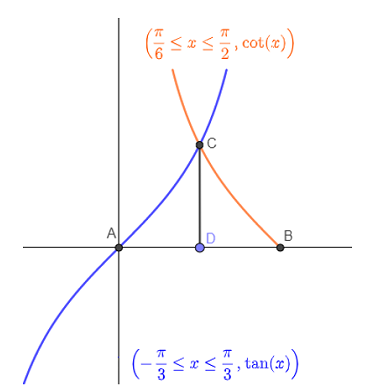
\(\int\limits_0^{\frac{\pi }{4}} {\tan x\,dx} + \int\limits_{\frac{\pi }{4}}^{\frac{\pi }{2}} {\cot x\,dx} \) \( = \left[ {\log \sec x} \right]_0^{\pi /4} + \left[ {\log \sin x} \right]_{\pi /4}^{\pi /2}\)
\( = \left[ {\log \sqrt
2 - \log 1} \right] + \left[ {\log 1 - \log \frac{1}{{\sqrt 2 }}} \right] = \log 2\)
A number \(x\) is chosen from the natural numbers \(1,2,\ldots,100\). The probability that \(x+\dfrac{100}{x}>29\) is:
\(x+\dfrac{100}{x}>29 \Rightarrow x^2-29x+100>0\)
\((x-4)(x-25)>0\Rightarrow x<4\text{ or }x>25\)
Favourable values = 78
Probability \(=\dfrac{78}{100}=\dfrac{39}{50}\)
If \(n\) is an integer between \(0\) and \(21\), then find the value of \(n\) for which the value of \(n!(21-n)!\) is minimum.
We know that \(^{21}C_n=\frac{21!}{n!(21-n)!}\).
Also, \(^{21}C_n\) is maximum when \(n=10\) or \(11\).
Therefore, \(n!(21-n)!\) is minimum when \(n=10,11\).
The general value of \(\theta\), satisfying the equations \(\tan \theta = \dfrac{1}{\sqrt{3}}\) and \(\sin \theta = -\dfrac{1}{2}\), is:
The first value of \(\theta\) satisfying \(\tan \theta = \dfrac{1}{\sqrt{3}}\) and \(\sin \theta = -\dfrac{1}{2}\) lies in the third quadrant, and the value is \(\pi + \dfrac{\pi}{6} = \dfrac{7\pi}{6}\).
The general value of \(\theta\) is obtained by adding multiples of \(2\pi\).
Hence, the general value is \(2n\pi + \dfrac{7\pi}{6}\).
A polygon has \(44\) diagonals. The number of sides is:
Number of diagonals in a polygon is \(^{n}C_2 - n = 44\).
\(\Rightarrow \dfrac{n(n-3)}{2} = 44\)
Solving, we get \(n = 11\).
The probability of occurrence of two events \(E\) and \(F\) are \(0.25\) and \(0.50\) respectively. The probability of their simultaneous occurrence is \(0.14\). The probability that neither \(E\) nor \(F\) occurs is:
We know that \(P(E \cup F) = P(E) + P(F) - P(E \cap F)\).
\(\Rightarrow P(E \cup F) = 0.25 + 0.50 - 0.14 = 0.61\).
Now, the probability that neither \(E\) nor \(F\) occurs is \(1 - P(E \cup F) = 1 - 0.61 = 0.39\).
\(\mathop{\lim}\limits_{x \to \infty} \left(\dfrac{x + 7}{x + 2}\right)^{x + 5}\) is equal to:
\(\mathop{\lim}\limits_{x \to \infty} \left(\dfrac{x + 7}{x + 2}\right)^{x + 5} = \mathop{\lim}\limits_{x \to \infty} \left(\left(1 + \dfrac{5}{x + 2}\right)^{x + 2}\right)^{\dfrac{x + 5}{x + 2}}\)
\(= \mathop{\lim}\limits_{x \to \infty} \left(e^5\right)^{\dfrac{x + 5}{x + 2}} = e^5\)
If A = {1, 2, 3, 4} and B = {3, 4, 5}, then the number of elements in \((A \cup B) \times (A \cap B) \times (A \Delta B)\) is:
\(A \cup B = \{1, 2, 3, 4, 5\}\) has 5 elements
\(A \cap B = \{3, 4\}\) has 2 elements
\(A \Delta B = (A - B) \cup (B - A) = \{1, 2, 5\}\) has 3 elements
Hence number of elements in \((A \cup B) \times (A \cap B) \times (A \Delta B)\) is \(5 \times 2 \times 3 = 30\)
Consider the following frequency distribution table:
| Class Interval | 10-20 | 20-30 | 30-40 | 40-50 | 50-60 | 60-70 | 70-80 |
| Frequency | 180 | F₁ | 34 | 180 | 136 | F₂ | 50 |
Since total frequency is 686, hence F₁ + F₂ = 686 – sum of all other frequencies
Or F₁ + F₂ = 106.
Given that median is 42.6, hence the median class is 40–50. The formula for median is:
\(\ell_1 + \dfrac{\dfrac{n}{2} - C}{f}(\ell_2 - \ell_1)\)
Where \(\ell_1, \ell_2\) are the lower and upper limit of the class interval, \(n\) is the total frequency, \(C\) is the cumulative frequency of the pre-median class and \(f\) is the frequency of the median class.
\(\Rightarrow 42.6 = 40 + \dfrac{343 - C}{180} \times 10\) or \(C = 296\)
Hence 180 + 34 + F₁ = 296 or F₁ = 82. So F₂ = 24.
For what value of \(p\), the polynomial \(x^4 - 3x^3 + 2px^2 - 6\) is exactly divisible by \((x - 1)\):
We know that when \(f(x)\) is divided by \((x - a)\) the remainder is \(f(a)\).
Here to be exactly divisible by \((x - 1)\), the value of polynomial at \(x = 1\) must be 0.
Hence \(1^4 - 3(1^3) + 2p(1^2) - 6 = 0 \Rightarrow p = 4\)
The lines \(px + qy = 1\) and \(qx + py - 1 = 0\) are respectively the sides AB, AC of the triangle ABC and the base BC is bisected at \((p, q)\). The equation of the median of the triangle through the vertex A is:
The median will pass through A and the midpoint of the opposite side i.e. \((p, q)\).
General equation of the line that passes through the intersection point of the lines AC and AB is:
\((px + qy - 1) + \lambda(qx + py - 1) = 0\)
As this line passes through the point \((p, q)\), hence
\((p^2 + q^2 - 1) + \lambda(2pq - 1) = 0 \Rightarrow \lambda = -\dfrac{(p^2 + q^2 - 1)}{(2pq - 1)}\)
Putting this value of \(\lambda\), we get the desired equation,
\((px + qy - 1) - \left(\dfrac{p^2 + q^2 - 1}{2pq - 1}\right)(qx + py - 1) = 0\)
Or \((px + qy - 1)(2pq - 1) - (p^2 + q^2 - 1)(qx + py - 1) = 0\)
Or \((2pq - 1)(px + qy - 1) = (p^2 + q^2 - 1)(qx + py - 1)\)
Which can be written as: \((2pq - 1)(qx + py - 1) + (p^2 + q^2 - 1)(px + qy - 1) = 0\)
If P(1, 2), Q(4, 6), R(5, 7) and S(a, b) are the vertices of a parallelogram PQRS, then:
The midpoints of the diagonals in a parallelogram coincide, hence \(\dfrac{P + R}{2} = \dfrac{Q + S}{2}\)
\(\Rightarrow \left(\dfrac{1 + 5}{2}, \dfrac{2 + 7}{2}\right) = \left(\dfrac{4 + a}{2}, \dfrac{6 + b}{2}\right)\)
Or \(a = 2, b = 3\)
The area of the triangle formed by the vertices whose position vectors are \(3\hat{i} + \hat{j}\), \(5\hat{i} + 2\hat{j} + \hat{k}\), \(\hat{i} - 2\hat{j} + 3\hat{k}\) is:
Suppose the three vertices are
\(A = 3\hat{i} + \hat{j}\), \(B = 5\hat{i} + 2\hat{j} + \hat{k}\) and \(C = \hat{i} - 2\hat{j} + 3\hat{k}\)
The side \(\vec{AB} = 2\hat{i} + \hat{j} + \hat{k}\), \(\vec{AC} = -2\hat{i} - 3\hat{j} + 3\hat{k}\)
Area of the triangle = \(\dfrac{1}{2}\left|\vec{AB} \times \vec{AC}\right| = \dfrac{1}{2}\left|6\hat{i} - 8\hat{j} - 4\hat{k}\right| = \sqrt{29}\)
Angle between \(\vec{a}\) and \(\vec{b}\) is 120°. If \(|\vec{b}| = 2|\vec{a}|\) and the vectors \(\vec{a} + x\vec{b}\), \(\vec{a} - \vec{b}\) are at right angles, then \(x\) is:
Suppose \(|\vec{a}| = k\) and \(|\vec{b}| = 2k\)
Since the vectors are at right angles: \((\vec{a} + x\vec{b}) \cdot (\vec{a} - \vec{b}) = 0\)
\(|\vec{a}|^2 - \vec{a} \cdot \vec{b} + x\vec{a} \cdot \vec{b} - x|\vec{b}|^2 = 0\)
\(k^2 - k(2k)\cos 120° + xk(2k)\cos 120° - x(2k)^2 = 0\)
\(k^2 + k^2 - xk^2 - 4xk^2 = 0\)
\(2k^2 = 5xk^2\)
\(x = \dfrac{2}{5}\)
If \(32\tan^2 \theta = 2\cos^2 \alpha - 3\cos \alpha\) and \(3\cos 2\theta = 1\), then the general value of \(\alpha\) for \(n \in \mathbb{Z}\) is:
We know that \(\cos 2\theta = \dfrac{1 - \tan^2 \theta}{1 + \tan^2 \theta}\)
Given that \(\cos 2\theta = \dfrac{1}{3} \Rightarrow \tan^2 \theta = \dfrac{1}{2}\)
Putting this value in the equation, we have,
\(32 \times \left(\dfrac{1}{2}\right)^4 = 2\cos^2 \alpha - 3\cos \alpha\)
\(\Rightarrow (2\cos \alpha + 1)(\cos \alpha - 2) = 0\)
Or \(\cos \alpha = -\dfrac{1}{2} \Rightarrow \alpha = 2n\pi \pm \dfrac{2\pi}{3}\)
If the vectors \(a\hat{i} + \hat{j} + \hat{k}\), \(\hat{i} + b\hat{j} + \hat{k}\), \(\hat{i} + \hat{j} + c\hat{k}\) \((a, b, c \ne 1)\) are coplanar then \(\dfrac{1}{1 - a} + \dfrac{1}{1 - b} + \dfrac{1}{1 - c} =\)
Given that the three vectors \(a\hat{i} + \hat{j} + \hat{k}\), \(\hat{i} + b\hat{j} + \hat{k}\), \(\hat{i} + \hat{j} + c\hat{k}\) are coplanar, hence
\(\begin{vmatrix} a & 1 & 1 \\ 1 & b & 1 \\ 1 & 1 & c \end{vmatrix} = 0\)
Putting \(C_1 = C_1 - C_2\), \(C_2 = C_2 - C_3\),
\(\begin{vmatrix} a-1 & 0 & 1 \\ 1-b & b-1 & 1 \\ 0 & 1-c & c \end{vmatrix} = 0\)
\(\Rightarrow c(a-1)(b-1) - (a-1)(c-1) + (1-b)(1-c) = 0\)
\(\Rightarrow \dfrac{c}{1-c} + \dfrac{1}{1-b} + \dfrac{1}{1-a} = 0\)
\(\Rightarrow \dfrac{c-1+1}{1-c} + \dfrac{1}{1-b} + \dfrac{1}{1-a} = 0\)
Or \(\dfrac{1}{1-c} + \dfrac{1}{1-b} + \dfrac{1}{1-a} = 1\)
The four geometric means between 2 and 64 are:
Including the 4 geometric means, there are 6 terms in the GP, where the first term is 2 and the last term is 64.
\(\Rightarrow 2(r^5) = 64\) or \(r = 2\)
The four geometric means are 4, 8, 16, 32.
If \(\alpha \ne \beta\) and \(\alpha^2 = 5\alpha - 3\) & \(\beta^2 = 5\beta - 3\), then find the equation whose roots are \(\dfrac{\alpha}{\beta}\), \(\dfrac{\beta}{\alpha}\):
The equation that is satisfied by both \(\alpha\) and \(\beta\) is \(x^2 = 5x - 3\) or \(x^2 - 5x + 3 = 0\)
Now sum of the roots is:
\(\dfrac{\alpha}{\beta} + \dfrac{\beta}{\alpha} = \dfrac{\alpha^2 + \beta^2}{\alpha\beta} = \dfrac{(\alpha + \beta)^2 - 2\alpha\beta}{\alpha\beta}\)
\(= \dfrac{25 - 2 \times 3}{3} = \dfrac{19}{3}\)
Product of the roots is 1, so the equation is: \(x^2 - \dfrac{19}{3}x + 1 = 0\) or \(3x^2 - 19x + 3 = 0\)
If the system of equations \(3x - y + 4z = 3\), \(x + 2y - 3z = -2\), \(6x + 5y + \lambda z = -3\) has at least one solution then \(\lambda\) is:
Let us eliminate \(y\) from the first two equations, we have
\(7x + 5z = 4\) ……(i)
Also eliminate \(y\) from second and third equations,
\(21x + (20 + \lambda)z = 12\)……(ii)
There will be many solutions if equations (i) and (ii) are identical.
Hence \(20 + \lambda = 5 \Rightarrow \lambda = -5\)
If three throws of three dice, the probability of throwing a triplet not more than twice is:
Probability of throwing a triplet is \(\left(\dfrac{1}{6}\right)^3 \times 6 = \dfrac{1}{36}\)
Probability that in all the three throws a triplet is thrown = \(\dfrac{1}{36} \times \dfrac{1}{36} \times \dfrac{1}{36} = \left(\dfrac{1}{36}\right)^3\)
Probability that a triplet is not thrown more than twice = \(1 - \left(\dfrac{1}{36}\right)^3\)
Suppose that \(A_1, A_2, A_3, \ldots, A_{30}\) are thirty sets each with five elements and \(B_1, B_2, B_3, \ldots, B_n\) are \(n\) sets each with three elements such that \(\bigcup \limits_{i=1}^{30} A_i = \bigcup \limits_{i=1}^{n} B_i = S\). If each element of \(S\) belongs to exactly ten of the \(A_i\)'s and exactly 9 of the \(B_i\)'s, then the value of \(n\) is:
Since each \(A_i\) has 5 elements, then \(\sum \limits_{i=1}^{30} A_i = 30 \times 5 = 150\)
Let set \(S\) consists of \(m\) elements and given that each element in \(S\) belongs to exactly 10 of \(A_i\)'s, so \(10m = 150 \Rightarrow m = 15\)
Now, since each \(B_i\)'s has 3 elements and each element of \(S\) belongs to exactly 9 of \(B_i\)'s
\(\Rightarrow \sum \limits_{i=1}^{n} B_i = 3 \times n = 3n = 9m = 135\)
Or \(n = 45\)
\(\int e^x(\sinh x + \cosh x) \, dx =\)
We know that
\(\sinh x = \dfrac{e^x - e^{-x}}{2}\) and \(\cosh x = \dfrac{e^x + e^{-x}}{2}\)
\(\int e^x(\sinh x + \cosh x) \, dx = \int e^x(e^x) \, dx = \dfrac{e^{2x}}{2} + C\)
The choice \(e^x(\cosh x) = e^x\left(\dfrac{e^x + e^{-x}}{2}\right) = \dfrac{e^{2x}}{2} + C\)
Hence the answer is \(e^x \cosh x + C\)
The eccentric angle of the extremities of latus rectum of the ellipse \(\dfrac{x^2}{a^2} + \dfrac{y^2}{b^2} = 1\) are given by:
We know that length of the latus rectum = \(\dfrac{2b^2}{a}\) and Latus Rectum is perpendicular to the major axis and passes through the focus.
Hence coordinates of one of its end are \(\left(ae, \dfrac{b^2}{a}\right)\).
If the eccentric angle is \(\theta\), then coordinate of the one end of Latus Rectum are \((a\cos\theta, b\sin\theta)\).
Hence \(a\cos\theta = ae\), \(b\sin\theta = \dfrac{b^2}{a}\)
Or \(\tan\theta = \dfrac{b}{ae}\).
As there are two ends of Latus Rectum, hence \(\theta = \tan^{-1}\left(\pm\dfrac{b}{ae}\right)\)
If \(y = \sin^{-1}\left(\dfrac{x^2 + 1}{\sqrt{x^4 + 3x^2 + 1}}\right)\) \((x > 0)\), then \(\dfrac{dy}{dx} =\)
\(y = \sin^{-1}\left(\dfrac{x + \dfrac{1}{x}}{\sqrt{x^2 + 3 + \dfrac{1}{x^2}}}\right) = \sin^{-1}\left(\dfrac{x + \dfrac{1}{x}}{\sqrt{\left(x + \dfrac{1}{x}\right)^2 + 1}}\right)\)
Let \(x + \dfrac{1}{x} = \tan\theta \Rightarrow \sec^2\theta \dfrac{d\theta}{dx} = 1 - \dfrac{1}{x^2}\)
Also \(y = \sin^{-1}\left(\dfrac{\tan\theta}{\sec\theta}\right) = \theta\)
So \(\dfrac{dy}{dx} = \dfrac{dy}{d\theta} \times \dfrac{d\theta}{dx} = 1 \times \dfrac{1 - \dfrac{1}{x^2}}{\sec^2\theta} = \dfrac{1 - \dfrac{1}{x^2}}{\left(x + \dfrac{1}{x}\right)^2 + 1}\)
\(= \dfrac{x^2 - 1}{x^4 + 3x^2 + 1}\)
Let \(\vec{a} = \hat{i} + \hat{j}\) and \(\vec{b} = 2\hat{i} - \hat{k}\). Then the point of intersection of the lines \(\vec{r} \times \vec{a} = \vec{b} \times \vec{a}\) and \(\vec{r} \times \vec{b} = \vec{a} \times \vec{b}\) is:
Given that \(\vec{r} \times \vec{a} = \vec{b} \times \vec{a}\) or \(\vec{r} \times \vec{a} - \vec{b} \times \vec{a} = 0 \Rightarrow (\vec{r} - \vec{b}) \times \vec{a} = 0\)
So the line passes through \(\vec{b}\) and parallel to \(\vec{a}\)
\(\Rightarrow \vec{r} = \vec{b} + \alpha\vec{a}\)
Again given that \(\vec{r} \times \vec{b} = \vec{a} \times \vec{b}\)
\(\Rightarrow \vec{r} = \vec{a} + \beta\vec{b}\)
For intersection of both the lines, \(\vec{b} + \alpha\vec{a} = \vec{a} + \beta\vec{b}\)
By comparing coefficients, \(\alpha = \beta = 1\)
Hence point of intersection is \(\vec{a} + \vec{b} = 3\hat{i} + \hat{j} - \hat{k}\)
If the position vector of A and B relative to O be \(\hat{i} - 4\hat{j} + 3\hat{k}\) and \(-\hat{i} + 2\hat{j} - \hat{k}\) respectively then find median through O of triangle ABC is:
The midpoint of A and B, M is \(\left(\dfrac{1-1}{2}, \dfrac{-4+2}{2}, \dfrac{3-1}{2}\right) = (0, -1, 1)\)
Hence the vector \(\vec{OM} = -\hat{j} + \hat{k}\)
The number of common tangents to the circles \(x^2 + y^2 = 4\) and \(x^2 + y^2 - 6x - 8y = 24\) is:
Centre and radius of the first circle are (0, 0) and 2.
Centre and radius of the second circle are (3, 4) and 7.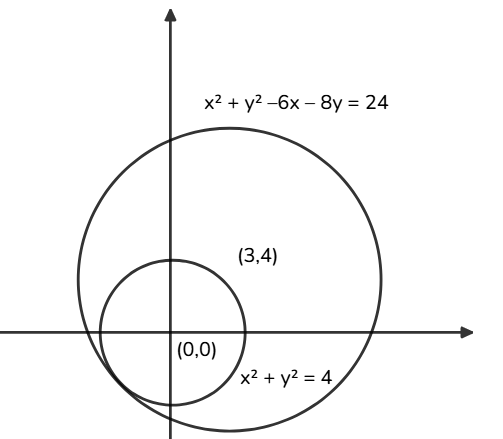
Distance between centres = \(\sqrt{3^2 + 4^2} = 5\)
Since \(|r_1 - r_2| = |2 - 7| = 5\) equals the distance between centres, both circles touch internally.
Hence there will be only one common tangent.
If X and Y are two sets, then \(X \cap Y' \cap (X \cup Y)'\) is:
We know that \((X \cup Y)' = X' \cap Y'\)
So \(X \cap Y' \cap (X \cup Y)' = X \cap Y' \cap X' \cap Y' = \phi\)
If \(e_1 = (1, 1, 1)\) and \(e_2 = (1, 1, -1)\) and \(\vec{a}\) and \(\vec{b}\) are two vectors such that \(e_1 = 2\vec{a} + \vec{b}\) and \(e_2 = \vec{a} + 2\vec{b}\). Then the angle between \(\vec{a}\) and \(\vec{b}\) is:
Given that \(e_1 = 2\vec{a} + \vec{b}\) and \(e_2 = \vec{a} + 2\vec{b}\), hence
\(\vec{b} = \dfrac{2e_2 - e_1}{3} = \dfrac{\hat{i} + \hat{j} - 3\hat{k}}{3}\)
\(\vec{a} = \dfrac{2e_1 - e_2}{3} = \dfrac{\hat{i} + \hat{j} + 3\hat{k}}{3}\)
Now \(\vec{a} \cdot \vec{b} = |\vec{a}| |\vec{b}| \cos\theta\)
or \(\dfrac{1 + 1 - 9}{9} = \dfrac{\sqrt{11}}{3} \times \dfrac{\sqrt{11}}{3} \times \cos\theta\)
\(\Rightarrow \cos\theta = \dfrac{-7}{11}\)
The locus of the point of intersection of tangents to the ellipse \(\dfrac{x^2}{a^2} + \dfrac{y^2}{b^2} = 1\) which meet at right angles is:
This is a standard result. The locus will be a circle. This is known as the director circle.
\(H_1, H_2, H_3, \ldots, H_n\) be \(n\) Harmonic means between \(a, b\) then \(\dfrac{H_1 + a}{H_1 - a} + \dfrac{H_n + b}{H_n - b} =\)
We can write, \(\dfrac{1}{a} + d = \dfrac{1}{H_1}\) and \(\dfrac{1}{b} - d = \dfrac{1}{H_n}\)
Now \(\dfrac{H_1 + a}{H_1 - a} + \dfrac{H_n + b}{H_n - b} = \dfrac{\dfrac{1}{a} + \dfrac{1}{H_1}}{\dfrac{1}{a} - \dfrac{1}{H_1}} + \dfrac{\dfrac{1}{b} + \dfrac{1}{H_n}}{\dfrac{1}{b} - \dfrac{1}{H_n}}\)
\(= \dfrac{\dfrac{1}{a} + \dfrac{1}{a} + d}{-d} + \dfrac{\dfrac{1}{b} + \dfrac{1}{b} - d}{d}\)
\(= \dfrac{2\left(\dfrac{1}{b} - \dfrac{1}{a}\right) - 2d}{d}\)
\(= \dfrac{2(n+1)d - 2d}{d} = 2n\)
The value of \(\tan 9° - \tan 27° - \tan 63° + \tan 81°\) is equal to:
\(\tan 9° - \tan 27° - \tan 63° + \tan 81°\)
\(= \dfrac{\sin 9°}{\cos 9°} - \dfrac{\sin 27°}{\cos 27°} - \left[\dfrac{\sin 63°}{\cos 63°} - \dfrac{\sin 81°}{\cos 81°}\right] = A - B\)
Where \(A = \left(\dfrac{\sin 9° \cos 27° - \cos 9° \sin 27°}{\cos 9° \cos 27°}\right) = \dfrac{-\sin 18°}{\cos 9° \cos 27°} = \dfrac{-2\sin 9°}{\cos 27°}\)
\(B = \dfrac{\sin 63° \cos 81° - \sin 81° \cos 63°}{\cos 63° \cos 81°} = \dfrac{-\sin 18°}{\sin 27° \sin 9°} = \dfrac{-2\cos 9°}{\sin 27°}\)
Hence \(A - B = \dfrac{2\cos 9°}{\sin 27°} - \dfrac{2\sin 9°}{\cos 27°}\)
\(= \dfrac{2(\cos 9° \cos 27° - \sin 9° \sin 27°)}{\sin 27° \cos 27°}\)
\(= \dfrac{2\cos 36°}{\left(\dfrac{\sin 54°}{2}\right)} = \dfrac{4\cos 36°}{\sin 54°} = 4\)
If \(y = \tan^{-1}\left(\dfrac{3x - x^3}{1 - 3x^2}\right)\), \(-\dfrac{1}{\sqrt{3}} \le x \le \dfrac{1}{\sqrt{3}}\) then \(\dfrac{dy}{dx}\) is:
Put \(\tan\theta = x\)
\(y = \tan^{-1}\left(\dfrac{3\tan\theta - \tan^3\theta}{1 - 3\tan^2\theta}\right) = \tan^{-1}(\tan 3\theta) = 3\theta\)
\(\dfrac{dy}{dx} = \dfrac{dy}{d\theta} \times \dfrac{d\theta}{dx} = 3 \times \dfrac{1}{\sec^2\theta} = \dfrac{3}{1 + x^2}\)
\(\int 3^{3^{3^x}} \cdot 3^{3^x} \cdot 3^x \, dx =\)
Let \(3^{3^{3^x}} = t\)
\(\Rightarrow 3^{3^{3^x}} \log 3 \cdot 3^{3^x} \log 3 \cdot 3^x \log 3 \, dx = dt\)
\(\Rightarrow 3^{3^{3^x}} \cdot 3^{3^x} \cdot 3^x \, dx = \dfrac{dt}{(\log 3)^3}\)
Hence the integration becomes,
\(\int \dfrac{dt}{(\log 3)^3} = \dfrac{t}{(\log 3)^3} = \dfrac{3^{3^{3^x}}}{(\log 3)^3} + C\)
If \(f(\theta) = \begin{bmatrix} \cos\theta & -\sin\theta & 0 \\ \sin\theta & \cos\theta & 0 \\ 0 & 0 & 1 \end{bmatrix}\) then find \(f(\theta) \cdot f(\alpha)\) is equal to:
Let us multiply the two matrices
\(f(\theta)f(\alpha) = \begin{bmatrix} \cos\theta & -\sin\theta & 0 \\ \sin\theta & \cos\theta & 0 \\ 0 & 0 & 1 \end{bmatrix} \begin{bmatrix} \cos\alpha & -\sin\alpha & 0 \\ \sin\alpha & \cos\alpha & 0 \\ 0 & 0 & 1 \end{bmatrix}\)
\(= \begin{bmatrix} \cos(\theta + \alpha) & -\sin(\theta + \alpha) & 0 \\ \sin(\theta + \alpha) & \cos(\theta + \alpha) & 0 \\ 0 & 0 & 1 \end{bmatrix} = f(\theta + \alpha)\)
If \(f: \mathbb{R} \to \mathbb{R}\) is defined by \(f(x) = \begin{cases} \dfrac{x+2}{x^2+3x+2} & \text{if } x \in \mathbb{R} - \{-1, -2\} \\ -1 & \text{if } x = -2 \\ 0 & \text{if } x = -1 \end{cases}\) Then \(f(x)\) is continuous on the set:
\(\lim_{x \to -2} \dfrac{x+2}{x^2+3x+2} = \dfrac{(x+2)}{(x+2)(x+1)} = \dfrac{1}{(x+1)} = -1\)
Also \(f(-2) = -1\)
So the function is continuous at \(x = -2\)
When \(x \to -1\), the limit of the function does not exist.
Hence the function is not continuous at \(x = -1\).
Correct answer is \(\mathbb{R} - \{-1\}\)
In a triangle, if the sum of two sides is \(x\) and their product is \(y\) such that \((x + z)(x - z) = y\), where \(z\) is the third side of the triangle, then the triangle is:
Let the three sides be \(a, b, c\), then
\(x = a + b\), \(y = ab\)
Given that \((a + b + c)(a + b - c) = ab\)
Using \(2s = a + b + c\), we have \(2s(2s - 2c) = ab\)
\(\Rightarrow \left(\dfrac{s(s-c)}{ab}\right) = \dfrac{1}{4}\)
Or \(\cos^2 \dfrac{C}{2} = \dfrac{1}{4} \Rightarrow \cos \dfrac{C}{2} = \dfrac{1}{2}\)
Thus \(\angle C = 120°\) and the triangle is an obtuse angled triangle.