Reading Comprehension - An Inroduction
| Site: | KINGS EDUCATION - Best MCA coaching, NIMCET coaching in Jaipur |
| Course: | CAT Prep Course |
| Book: | Reading Comprehension - An Inroduction |
| Printed by: | Guest user |
| Date: | Monday, 14 September 2026, 5:09 AM |
1. Introduction
In the corporate sector, a manager is expected to deal efficiently with copious volumes of unfamiliar and dense information in a limited time span, in order to arrive at the right decision. This is precisely the reason why Reading & comprehension (RC) passages are a recurrent feature in CAT and other MBA entrance examinations. The unending importance of RC can also be gauged from the fact that more than half the number of questions in the verbal section of CAT are from the reading & comprehension component.
However, some of the aspirants are not very certain about how to prepare for these questions. As a result, this area is often over looked during the preparatory stage and many find themselves in troubled waters when they open the CAT question paper and find 4-5 RC passages questions based on them without having the required knowledge and expertise of how to deal with it.
Tackling RC questions in any entrance exam is a skill. Like any other skill it requires a smart strategy, a systematic approach and loads of practice. All this will go a long way in managing this section effectively and in achieving the score that one intends to get.
There are hundreds of subject areas form which a RC passage can be picked. That is why the aspirants are often advised to infuse variety into their readings. One must try to read as diverse topics as one can lay one’s hands on.
A few of such subject areas are:
2. What is reading comprehension?
We have mentioned earlier that all of us are constantly engaged in the process of reading information from our surroundings, but we do not do it skillfully and in the right direction. This is what a student has to practice - to read everything rightly. HOW? Even an apparently simple process of reading involves many factors that affect the output of reading. How intelligently can you mould these factors will, in turn, improve the quality of reading. These factors are:
- Subject of data:
It has been proved by research that our brains do not respond to different kinds of data in a similar manner. We all have our area of expertise, I might know a lot about space science while your knowledge of automobiles may be quite vast. On the other hand, my idea of latest cars, engines and their power may be limited and you may find yourself fumbling if questioned about planetary movements, composition of stars etc. This is a reflection of reading habits. Ordinarily, we do selective reading, e.g. while reading a newspaper many students skip the business news and jump straight to sports page while many others simply refuse to look at the editorial page and drool all over the page 3 or the entertainment section. It is neither feasible nor advisable for a student to read everything available on all topics under the sun. But it is important, nevertheless, for you to have some basic knowledge about most subjects. This will (1) Improve your general awareness, (2) Boost your confidence, (3) Sharpen your analytical skills - Interest areas of the reader:
This factor is closely connected to the first factor. In fact, it is this factor that chiefly decides the subjects we choose to read about. Just like all fingers in a hand are not of the same size, our interest in every field cannot be of the same level. This is why we choose certain fields and eliminate others, e.g.; while walking on the road, if there is a large poster of a bike newly launched in market, it is more likely that a teenage or a young boy would stop by to read the details about the bike rather than a girl who would probably stop by to read information on jewellery or garments ranges. This is just difference of interests. This is the difference that decides the store of one's knowledge. Ordinarily, it is alright for a person to seek information about one feels drawn to the area of his/her interest. But a student should develop a habit of arousing an interest in different kind of fields equally. - Concentration span of the reader:
Not only in reading but any task to be executed requires concentration. But reading requires it more. So, most students from primary to senior level are heard complaining about lack of concentration as the reason for their poor performance. It has become a popular belief that concentration is naturally endowed on people and so some students have great concentration while others remain restless and cannot concentrate properly. Contrary to the popular belief, the truth is that even concentration can be achieved through effort. Let us understand it further. Scientifically a human brain is not tuned to keep itself associated with a particular object for long time and that is why many of us face concentration problems. But these problems are easy to handle also. From usual experience you would know that while reading data of your interest, your mind exhibits more concentration. Why can you sit through a movie with complete concentration but not your math book or even a newspaper for that matter? Because things that you find entertaining, stimulate your brain in a manner, which is positive and, hence, you achieve higher level of concentration. Here again we see the first two factors affecting the third: If you develop interest in many subjects, your concentration will automatically increase. But there is a hitch, you can improve concentration by increasing interest and you can increase interest by reading more. But if you have poor concentration then you cannot read more. It is, therefore, a vicious circle. - Reading speed:
From a competitive point of view, 'Time is money' The faster you read, the more time you will have for comprehension and analysis. If you have followed the first three factors carefully then you will realize that your reading speed will improve greatly itself. But you must keep in mind certain points while trying to read fast. Often what students do is, in their attempt to read fast, they increase the speed of reading words without trying to either understand or retain the information. Remember Reading Comprehension = Reading + Comprehension. You must read at a fast speed but not at the cost of comprehension because in that case you'll have to read the passage again and, therefore, the time you saved by reading fast will be consumed in re-reading. - Retaining capacity:
This is the most important part of Reading. If a student is able to read well, read with concentration, read fast but is not able to retain useful information of the data - then all is lost. A good reader need not come back to the passage again and again to look for answers. The first reading of this passage should, therefore, be done with much care and attention so that the reader retains most of the matter. You can follow some simple steps to improve your retaining capability. Every time you read a passage, made a mental note of the following:
1. Title of the passage
2. Basic theme of the passage
3. The positions that the passage take or the points that the passage makes 4. Conclusion of the passage. - Reading aptitude:
Reading Aptitude is different from reading skills. The points and factors discussed up till now, constitute reading skill and are regarding the manner you read. Reading aptitude is what gives an upper edge to a student in the RC section or even otherwise if developed properly. What is Reading Aptitude? By reading aptitude, we mean the approach that you take while reading a passage or reading anything. The mindset with which you read it and what is your motive or expectation from the passage. Simply put, reading aptitude is what you want from reading. If you approach a reading piece only for the purpose of reading it to collect facts to add to your existing store of knowledge or only as a practice to improve your reading speed or merely as an examination exercise you would not receive the same results as you will if you read the passage with a different attitude.
Consider every piece of written information as a prospective useful draft. Begin with the rule of WIIFM - what's in it for me. Once you have used your wisdom to decide if the passage is worth reading. Approach the passage as a mystery novel. There are hidden clues you must look for. From the beginning stay a careful, clever reader. Remember the first reading itself should give you all you may need to have from a passage.
If there are facts in the passage, quickly decide, as you read, which of these are important enough to be memorized and memorize them.
If there is an argument in the passage, keep trail of how the argument proceeds and what are the different evidences offered.
In such a passage, as you read, involve your mind with the passage and form an opinion about the argument.
If a passage is about philosophy offering a philosophical perspective as you read, form a short summary of the philosophical theory in simple words.
If the essay describes a process or an event, then as you read on, form a chain of events in your mind.
Keeping these points, in mind, will improve your reading and retaining efficiency greatly. What we have to target and achieve is not good reading instead what we must try and attain is effective reading. A good reader may or may not be just as good at comprehension and analysis but an Effective Reader would definitely perform in comprehension and Analysis of data just as well. So, try and be an EFFECTIVE READER.
3. Comprehension
Comprehension follows reading and simply put-means understanding the passage. But there are different categories of compositions and the time of comprehension for each would principally vary. Nevertheless, there are some basic principles one must keep in mind while attempting to comprehend a passage.
- To make comprehension easy, follow the paragraph division of the passage.
- As you read each paragraph, mark the important points stated in the paragraph.
- When you have read the passage once, decide onto the basic theme of the passage.
- Quickly Re-read the marked section of each paragraph and form a basic argument skeleton of the passage in your mind.
- Do not make reading a one-way process; rather treat it as a dialogue.
- Keep your brain actively involved in reading. Treat the passage as if its writer is talking to you. Make it more like a discussion; respond to what is being said in the passage. In this manner your comprehension level will increase greatly.
- If you do not understand a word, do not panic, you can make out the meaning of the word by fitting it into the larger sense of the sentence, similarly, if you don't understand a phrase, try to fit it into the argument of the paragraph to ascertain its meaning.
- In case the subject of the paragraph is completely new to you, you must proceed with more care and cleverness. Approach the passage with confidence and an open mind. Do not get taken aback by field-specific jargon, these big and difficult sounding words would not affect your understanding of the composition much. The different type of passages that one can come across while attempting RC exercise are:
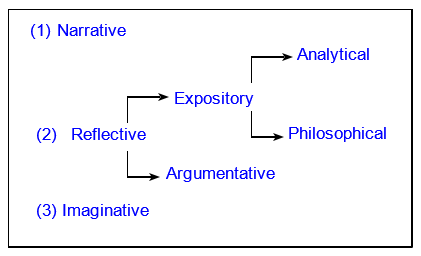
1. NARRATIVE PASSAGE:
A narrative passage usually tells a story which means a sequence of events. Thus, a narrative passage gives an orderly account of a series of related events or the successive particulars of an event. A narrative passage could be of various kind. (1) Biographies (2) History (3) Fiction (4) Execution of a process. In a narrative passage, the questions asked are chiefly about the main ideas discussed in the narration, some opinions of the narrator or about the general factual information provided through the passage and student must, therefore, concentrate on the main points of the narrative and select them as important.
2. REFLECTIVE PASSAGE:
(a) Expository Passage: An expository passage is the most rigid and restricted form of composition. It is also the most common kind of writing. Exposition means to set forth a subject. So, an exposition composition would mean an orderly setting forth of facts and ideas. Its purpose is to explain its language in clear and direct way. Its appeal is to the intellect. What you would mostly come across in an exposition essay will be definition, comparisons and contradictions. Exposition is defined in the dictionary as Explanation. Thus a student can expect a straight statement like tone in the passage. These are easier to deal with and can be mastered with practice and relatively less effort.
(b) Argumentative Passage: An argumentative passage includes an argument and an argument is possible only about a subject that invites argument, conflicting opinions. Such an essay admits difference of opinions and, therefore, the purpose of an argumentative essay is to persuade the readers to adopt a certain idea, attitude or course of action and if possible to resolve the conflict implicit in the subject.
(c, d) Analytical and Philosophical passages: A student should follow the same method as for the expository passage and keep similar factors in mind.
3. IMAGINATIVE PASSAGE:
Such types of passages are based on fiction or imaginations of the author.4. Types of Questions
1. THE MAIN IDEA OR THEME BASED QUESTIONS:
In this type of questions the passage will be followed by a question with certain statements which may or may not be the central idea of the given passage, you have to choose the statement that will best qualify as the central idea discussed in the passage. The question can also ask for the most suitable title for the passage. Which will also correspond to the central theme in the passage. Another form in which this type of question can by asked is 'which of the following statement is best supported by the passage'. In this question you may be given statements more than one of which can be inferred from the passage but only one statement will be best supported by the passage, which will be the central theme of the passage.
2. VIEW OF THE AUTHOR TYPE OF QUESTIONS:
The second types of questions are the View of the Author type of questions regarding the main point discussed in the passage. In this type of questions, the questions will test your understanding of the author's view and opinion stated in passage about the central and even subordinate issue. The question may be about a specific point that author makes or a general stand that author takes. It can question you about writer's attitude towards the central idea whether or not he agrees with it, the question can also be about more than one opinion of the author, the following are the examples of this type of questions.
3. CHOOSING THE CORRECT OR WRONG STATEMENT ON THE BASIS OF THE GIVEN PASSAGE:
This type of question demands the students to derive conclusions and inferences from the given passage. This type of question will have four statements and of the four options you be asked to choose the correct or the incorrect statement in the context of the passage.
4. SUPPORTING IDEA QUESTION:
These types of questions are aimed at measuring a student's capacity to distinguish the main idea from the supporting idea. Also, this type of a question will test your ability to differentiate ideas. That is implicitly stated in a passage from the ideas that are implied by the author. These types of questions usually focus on a specific paragraph and their meaning as a contribution to the whole passage. The question may ask you about facts mentioned in the passage or ideas stated or implied in the passage. It may even demand you to draw conclusion from a specific passage.
5. INFERENCE BASED QUESTION:
By inference, it is meant reaching a logical conclusion after analysis. In questions such as these, the answer would not be available directly in the passage.
6. STYLE AND TONE QUESTIONS:
These questions are about the language of the passage and mostly aimed at testing your language skills. The different type of style and Tone questions are
- Synonym and Antonym questions: In these you may be given a word from the passage and asked for a synonym or antonym of the given world.
- Meanings of words and phrases: In this type of question you can be given a word or phrase from the passage and asked to replace them with most suitable word.
- Tone of the passage: This type of question asks about the tone of the passage, i.e. what is the style of writing of the passage. The following can be some examples of different tones and style of writing a passage.
5. Tones
Tone based questions are very popular with the paper setters of the RC section. Let us first understand the meaning of the word tone. For our purpose the word tone would mean- the general character, quality, spirit, atmosphere, air, ambience, mood, attitude or perspective. Basically the tone based questions ask you to identify either the attitude/perspective of the author or the character/quality of the passage. You must observe whether the writer’s feeling towards the subject is positive, negative or neutral? Does the writer give his own opinion or does he objectively present the opinions of others?
Before you read the answer choices, decide whether the writer’s tone is positive, negative, or neutral. It is best to do this without referring back to the passage. However, if you did not get a feel of the writer’s attitude on the first reading, check the adjectives that he chooses. Adjectives and to a lesser extent, adverbs express our feelings toward subjects. For instance, if we agree with a person who holds strong feelings about a subject, we may describe his opinions as ‘impassioned’. On the other hand, if we disagree with him, we may describe his opinions as ‘excitable’, which has the same meaning as ‘impassioned’ but carries a negative connotation. In case the choices are still close, then you can choose a tone, which is the tone of most of the paragraphs in the passage. When you find that after eliminating a few options the two very close options remain, e.g. objective vs. neutral or scholarly vs. analytical, etc. try to mentally define these words as the dictionary would and try to apply this meaning to the passage, rather than be baffled by the closeness of the options. For example, neutral would mean ‘ not engaged on either side’, this can be true even when one is criticizing both the sides; objective would mean ‘ an observation of facts as they are’ rather than expressing one’s views on them. After having distinguished the meanings of the words this way, think which of the meanings you would apply to the passage. Making a choice then becomes a little easier. However, tone questions in competitive exams are usually not very easy. An author may express his feelings or attitudes toward a subject directly and in so many words at times. This expression of emotion imparts a tone to the writing. To determine the tone of a passage, think of the emotions or attitudes that are expressed throughout the passage.
|
S.No |
Possible tone |
Meaning of the word |
|
1. |
Academic |
Involving a lot of reading and studying rather than with ideas or theories |
|
2. |
Acerbic |
Harsh/ severe; bitter |
|
3. |
Adulatory |
Showing admiration and praise especially when this is greater than necessary |
|
4. |
Admiring |
Respectful, approving |
|
5. |
Aggressive |
Forceful; tending towards unprovoked offensiveness |
|
6. |
Angry |
Showing displeasure |
|
7. |
Analytical |
a detailed examination of a topic taking into consideration both its merits and demerits |
|
8. |
Apathetic |
Emotionless; not interested/ concerned; indifferent; unresponsive |
|
9. |
Apologetic |
Expressing remorse, regret, sorrow for having failed/ injured, insulted or wronged another |
|
10. |
Aphoristic |
Full of aphorism- a short phrase that says something true or wise |
|
11. |
Articulate |
to express or explain your thoughts or feelings clearly in words |
|
12. |
Belligerent |
Aggressively hostile; bellicose |
|
13. |
Belittling |
Depreciating, making small |
|
14. |
Biased |
Favouring one thing/person/group over another for personal reasons. |
|
15. |
Blasphemous |
Showing lack of respect or contempt towards something sacred |
|
16. |
Castigating |
Criticise severely |
|
17. |
Callous |
Having no sympathy |
|
18. |
Caustic |
Biting; acerbic |
|
19. |
Catatonic |
Not able to move or show any reaction to things because of illness, shock etc. |
|
20. |
Concerned |
Worried and feeling concern( a feeling of worry, especially one that is shared by many people about something) |
|
21. |
Conversational |
Colloquial, not formal as used in conversation |
|
22. |
Commiserating |
Feeling/ expressing sorrow for; empathizing with; pity |
|
23. |
Conciliatory |
having the intention or effect of making angry people calm |
|
24. |
Condescending |
Patronizing; showing/implying patronizing descent from dignity/ superiority |
|
25. |
Contemptuous |
Expressing contempt/disdain |
|
26. |
Communistic |
Belief in the equal treatment of the people |
|
27. |
Consoling |
Pacifying |
|
28. |
Commendation |
Approval, praise |
|
29. |
Contemplative |
Considering something thoughtfully |
|
30. |
Critical |
Criticize; evaluate |
|
31. |
Cynical |
displaying a belief that people are always self-seeking and never altruistic in their actions |
|
32. |
Damning |
Strongly suggesting glint |
|
33. |
Deprecating |
Express disapproval of |
|
34. |
Derisive |
Unkind and displaying contempt, deriding |
|
35. |
Denigrating |
Defamatory, blackening |
|
36. |
Descriptive |
Description without criticism or analysis |
|
37. |
Disinterested |
Impartial, unbiased |
|
38. |
Didactic |
Designed to teach people especially a moral lesson |
|
39. |
Disparaging |
Speak slightingly; depreciating; belittling |
|
40. |
Dispassionate |
Not influenced by emotion, impartial |
|
41. |
Dogmatic |
Asserting opinions in an arrogant manner; imperious; dictatorial |
|
42. |
Ebullient |
Praising, exuberant |
|
43. |
Eclectic |
Not following one style or set of ideas but choosing from or using a wide variety. |
|
44. |
Eccentric |
Considered by other people to be strange or unusual |
|
45. |
Effusive |
Showing much or too much emotion |
|
46. |
Emotional |
Easily affected by feelings actuated by experiencing love, hate, fear and the like |
|
47. |
Empirical |
Relying on observation and experiment |
|
48. |
Esoteric |
Likely to be understood or enjoyed by only a few people with a special knowledge or interest |
|
49. |
Ethical |
Dealing with principles of morality; honest; righteous |
|
50. |
Exalting |
High praise |
|
51. |
Exploratory |
To investigate systematically, to examine |
|
52. |
Euphemistic |
Substitution of mild, indirect or vague expression for one thought to be offensive, harsh or blunt |
|
53. |
Frivolous |
Lacking in seriousness |
|
54. |
Grandiose |
More complicated/ elaborated than necessary; pompous |
|
55. |
Humanistic |
Evincing keen interest in human affairs, nature, welfare, values |
|
56. |
Humorous |
Funny and amusing |
|
57. |
Idealistic |
Having a strong belief in perfect standards and trying to achieve them even when this is not realistic |
|
58. |
Indignant |
Angry |
|
59. |
Ironical |
words or phrases which have an underlying meaning or implication often humorous |
|
60. |
Introspective |
Consider one’s own internal state of feelings |
|
61. |
Incendiary |
Causing strong feelings |
|
62. |
Ingenuous |
Honest, innocent and willing to trust people |
|
63. |
Investigative |
Seeking to expose dishonesty and injustice |
|
64. |
Inquisitive |
Propensity to ask questions |
|
65. |
Jocular |
Making people laugh, comic |
|
66. |
Jovial |
Cheerful, friendly |
|
67. |
Jubilant |
Happy, triumphant |
|
68. |
Judgemental |
Excessively critical of others |
|
69. |
Laudatory |
Praising; extolling; applauding |
|
70. |
Lampooning |
Making fun of, satirical |
|
71. |
Meditative |
Thinking very deeply, involving deep thought |
|
72. |
Melodramatic |
Sensational, appealing to emotions |
|
73. |
Mendacious |
Lying, untruthful |
|
74. |
Miasmic |
Unpleasant or poisonous |
|
75. |
Motivating |
Impelling; inciting |
|
76. |
Mobilizing |
Attempt to explain or interpret good or bad features of something; to try to reform. |
|
77. |
Narcissistic |
Having the tendency of admiring oneself too much |
|
78. |
Nostalgic |
A feeling of sadness mixed with pleasure and affection when you think of happy times in the past |
|
79. |
Non partisan |
Neutral, unbiased |
|
80. |
Obsequious |
Fawning; showing servile complaisance; flattering; deferent |
|
81. |
Objective |
Not influenced by personal feelings or opinions considering only facts |
|
82. |
Optimistic |
Expecting good things to happen or something to be successful |
|
83. |
Patronising |
Showing that you feel better or more intelligent than somebody else |
|
84. |
Pedantic |
Too worried about small details or rules |
|
85. |
Pedestrian |
Lacking vitality, imagination, distinction |
|
86. |
Pessimistic |
Expecting bad things to happen or something to be successful |
|
87. |
Populist |
Egalitarian; pertaining to the characteristics of common people/ working class |
|
88. |
Provocative |
Inciting; stimulating; irritating; vexing |
|
89. |
Practical |
Connected with real situations rather than with ideas or theories |
|
90. |
Pleading |
Requesting |
|
91. |
Prescribing |
To give an advice |
|
92. |
Prejudiced |
Biased |
|
93. |
Reverential |
Regarding as sacred |
|
94. |
Reproof |
Blame or disapproval |
|
95. |
Ridiculing |
Mocking, scornful, deriding |
|
96. |
Romantic |
Fanciful; impractical; unrealistic; extravagant; exaggerated |
|
97. |
Sarcastic |
Harsh, bitter derision; taunting; sneering; cutting remarks |
|
98. |
Sanguine |
confident, hopeful |
|
99. |
Sardonic |
Mocking, bitter, cynical |
|
100. |
Satirical |
Taunting; human folly held up to scorn/ derision/ ridicule |
|
101. |
Sceptical |
Having doubts that a claim or statement is true or that something will happen |
|
102. |
Scornful |
Showing or feeling that somebody/ something is stupid or not good enough showing contempt showing that you do not respect something/somebody |
|
103. |
Sentimental |
Connected with your emotions rather than reason |
|
104. |
Solipsistic |
Selfish, self centered |
|
105. |
Speculative |
Theoretical rather than practical; thoughtful; reflective; hypothetical |
|
106. |
Subjective |
Based on the writer’s ideas or opinions rather than facts |
|
107. |
Supercilious |
A feeling of superiority, arrogance |
|
108. |
Technical |
Using terminology or treating subject matter in a manner peculiar to a particular field, as a writer or a book |
|
109. |
Timorous |
Nervous and easily frightened |
|
110. |
Tragic |
Sad |
|
111. |
Uninterested |
Lack of interest or concern |
|
112. |
Vehement |
Showing very strong feelings, especially anger |
|
113. |
Vitriolic |
Full of anger and hatred |
|
114. |
Vituperative |
Cruel and angry criticism |
|
115. |
Vindictive |
Revengeful, spiteful |
|
116. |
Wary |
Cautious, careful when dealing with somebody/ something because you think that there may be a danger or problem |
|
117. |
Whimsical |
Unusual and not serious in a way that is either amusing or annoying |