Function & Graphs
4. Range
Suppose \(y\) is a function of \(x\), then range of the function is set of all values of \(y\) for which \(x\) is defined.
Example: Find the range of the function \(y = \frac{1}{{1 + {x^2}}}\)
Solution: First write the value of \(x\) in terms of \(y\), we have,
\(y{x^2} + y = {\rm{ }}1 \Rightarrow \) \({x^2} = \frac{{1 - y}}{y}\)
Now \({x^2}\) must be a non-negative number, hence
\(\frac{{1 - y}}{y} \ge 0\) or \(\frac{{y - 1}}{y} \le 0\)
Thus \(y \le {\rm{ }}1\) and \(y > 0\). Range of \(y\) is \((0, 1]\).
In this types of questions, generally we write \(x\) as a function of \(y\) and calculate values of \(y\) for which \(x\) is defined.
Example 2: Find the range of the function \(y = \sqrt {4 - {x^2}} \)
Solution: Writing x in terms of \(y\), we have
\(x = \sqrt {4 - {y^2}} \)
Now \(4{\rm{ }}-{y^2} \ge {\rm{ }}0 \Rightarrow -2{\rm{ }} \le y \le {\rm{ }}2\).
Since \(y\) is positive (as square roots are always positive), hence \(0{\rm{ }} \le y \le {\rm{ }}2\).
Example 3: Find the range of the function \(y = \frac{{{x^2} - x + 1}}{{{x^2} + x + 1}}\)
Solution: Writing \(x\) in terms of \(y\), we have,
\(\left( {{x^2} + x + 1} \right)y = {x^2} - x + 1\)
\({x^2}\left( {y - 1} \right) + x\left( {y + 1} \right) + y - 1 = 0\)
Since \(x\) must be a real number, hence
\({\left( {y + 1} \right)^2} \ge 4{\left( {y - 1} \right)^2}\)
\( \Rightarrow 3{y^2}-{\rm{ }}10y + {\rm{ }}3{\rm{ }} \le {\rm{ }}0\)
\(\left( {3y-{\rm{ }}1} \right)\left( {y-{\rm{ }}3} \right){\rm{ }} \le {\rm{ }}0\)
Hence \(\frac{1}{3} \le y \le 3\)
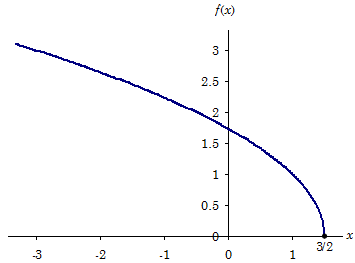
Example 4: Find the domain and range of the given function \(y = \sqrt { - 2x + 3} \)
Solution: The domain is all values that \(x\) can take so that \(y\) is defined. In this function the quantity inside the square root must be non negative, hence \(-{\rm{ }}2x + {\rm{ }}3{\rm{ }} \ge {\rm{ }}0\), hence \(x \le \frac{3}{2}\).
The graph of the function is shown below. It is visible that the graph does not go beyond the point \(x = 3/2\).
Example 5: Find the domain and range of the graph as shown in the diagram.
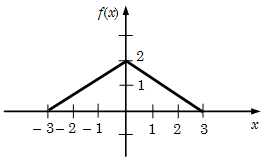
Solution: We can calculate domain and range of a function by using graph, if \(x\) and \(f(x)\) are plotted on \(x\) axis and \(y\) axis respectively, the domain is found by looking at the graph from left to right. The range is found by looking at the graph from top to bottom. Find the domain and range of the given functions. Look at the graph from left to right. For the \(x\) values, they start at \(-3\) and end at 3. So the domain is
\(-3 \le x \le 3\). Looking at the graph from top to bottom the range is \(0 \le \;f\left( x \right) \le 2\).
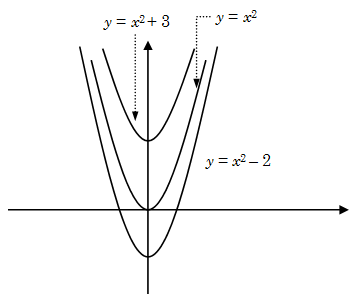
Example 6: Plot the graphs of the following functions and also find their domain and range.
\(f\left( x \right){\rm{ }} = {\rm{ }}{x^2},{\rm{ }}f\left( x \right){\rm{ }} = {\rm{ }}{x^2}-{\rm{ }}2\) and \(f\left( x \right){\rm{ }} = {\rm{ }}{x^2} + {\rm{ }}3\)
Solution: \(f\left( x \right){\rm{ }} = {x^{\bf{2}}}\): This function is defined for all values of \(x\), hence domain is all real numbers and \(f(x)\) can assume all real non negative values. Range of the function \( \ge 0\)
\(f\left( x \right){\rm{ }} = {x^{\bf{2}}}-{\rm{ }}{\bf{2}}\): This function is defined for all values of \(x\), hence domain is all real numbers and \(f(x)\) can assume all real values which are more than or equal to \(-2\). Range of the function \( \ge - 2\)
\(f\left( x \right){\rm{ }} = {x^{\bf{2}}} + {\rm{ }}{\bf{3}}\): This function is defined for all values of x, hence domain is all real numbers and f(x) can assume all real values which are more than or equal to 3. Range of the function \( \ge 3\)