
Function & Graphs
9. Reflections
A reflection is like a mirror image. The line of reflection acts as the mirror and is halfway between the point and its image. If the point lies on the line itself then it is reflection of itself. Some of the important reflections are listed below with examples.
This diagram shows graph and its reflection in \(x\) axis. Suppose \(g(x)\) is image of \(f(x)\), then at every point if \(f(x) = a\), then \(g(x) = -a\).
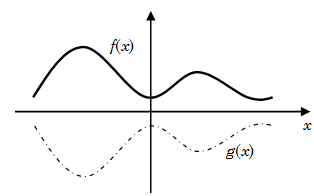
(1) \(y = -f(x)\) (This is the reflection about the \(x\)-axis of the graph \(y = f(x)\). That is for every point \((x, y)\) there is a point \((x, -y)\).
Look at the example graphs below of \(y = {x^2}\) and \(y = {\rm{ }}-{x^2}\).
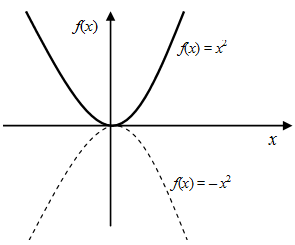
Notice the image of the graph is simply the same as the graph folded down across the \(x\)-axis. The \(x\)-axis is the line of reflection or the mirror.
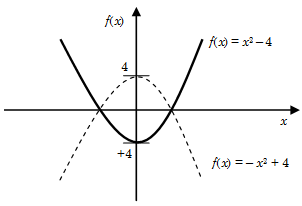
(2) \(f(x)\) \( = {x^2}-{\rm{ }}4\): to get reflection of this graph in \(x\) axis, we first plot \(f\left( x \right){\rm{ }} = {x^{\bf{2}}}-{\rm{ }}{\bf{4}}\) and this graph lies above as well as below \(x\) axis. The following diagram shows function and its image in \(x\) axis.
(3) Reflections about the line \(y = x\) is accomplished by interchanging the \(x\) and the \(y\) values. Thus for \(y = f(x)\) the reflection about the line \(y = x\) is accomplished by \(x = f(y)\). Thus the reflection about the line \(y = x\) for \(y = {x^2}\) is the equation \(x = {y^2}\). These are graphed on the following graph:
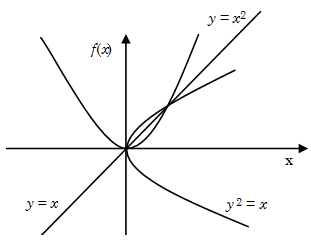
The line \(y = x\), is where you would fold the paper for these two graphs to match.