
MAH CET MCA 2025 Question Paper and Solutions
The MAH CET MCA 2025 question paper had a balanced distribution of topics. A significant portion of the paper is dedicated to Probability and probability distribution (5 questions) and Trigonometry (4 questions), followed by Permutations and Combinations (3 questions), Vectors and Differential Equations (2 questions each), and smaller contributions from Coordinate Geometry and Algebra (1 question each).
MAHCET MCA 2025 QUESTION PAPER AND SOLUTION
► Topic-Wise Question Distribution
| Topic (Click to Filter) | Number of Questions |
|---|---|
| TRIGONOMETRY | 4 |
| VECTORS | 2 |
| COORDINATE GEOMETRY | 1 |
| PROBABILITY | 5 |
| PERMUTATIONS-COMBINATIONS | 3 |
| ALGEBRA | 1 |
| DIFFERENTIAL EQUATIONS | 2 |
► Difficulty-Wise Question Distribution
A circular wire of radius 7.5 cm is cut and bent so as to lie along the circumference of a hoop of radius 120 cm. Find, in degrees, the angle subtended at the centre of the hoop.
Circumference of the circular wire = \(2\pi r = 2\pi \times 7.5 = 15\pi\) cm
This wire is bent to form an arc on the hoop of radius 120 cm.
Arc length = \(15\pi\) cm
Using the formula: Arc length = \(r\theta\) where \(\theta\) is in radians.
\(15\pi = 120\theta\)
\(\theta = \dfrac{15\pi}{120} = \dfrac{\pi}{8}\) radians
Converting to degrees: \(\theta = \dfrac{\pi}{8} \times \dfrac{180}{\pi} = \dfrac{180}{8} = 22.5^{\circ}\)
The number of parallelograms that can be formed from a set of four parallel lines intersecting three parallel lines is:
To form a parallelogram, we need to select 2 lines from one set of parallel lines and 2 lines from another set of parallel lines.
We have 4 parallel lines in one direction.
Number of ways to select 2 lines from 4 = \(^4C_2 = 6\)
We have 3 parallel lines in another direction.
Number of ways to select 2 lines from 3 = \(^3C_2 = 3\)
Total number of parallelograms = \(6 \times 3 = 18\)
What is the area other than the area common between two quadrants of the circle of radius each, which is shown as the shaded region in the figure, given that side of the square is 16?
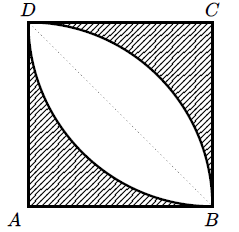
Side of square = 16, so radius of each quadrant = 16
Area of the square = \(16^2 = 256\)
Area of one quadrant = \(\dfrac{1}{4}\pi (16)^2 = 64\pi\)
Area of two quadrants = \(2 \times 64\pi = 128\pi\)
The common area between the two quadrants (lens-shaped region):
Common area = Area of 2 quadrants - Area of square = \(128\pi - 256\)
Shaded area \(=256 -(128\pi-256)\)
\(=128(4-\pi)\)
If \(X\) denotes the number on the uppermost face of a fair cubic die when it is tossed, then \(E(X)\) is
For a fair die, \(X\) can be \(1, 2, 3, 4, 5\) or \(6\), each with probability \(\dfrac{1}{6}\).
Expected value \(E(X) = \sum x_i P(x_i)\)
\(E(X) = 1 \cdot \dfrac{1}{6} + 2 \cdot \dfrac{1}{6} + 3 \cdot \dfrac{1}{6} + 4 \cdot \dfrac{1}{6} + 5 \cdot \dfrac{1}{6} + 6 \cdot \dfrac{1}{6}\)
\(E(X) = \dfrac{1 + 2 + 3 + 4 + 5 + 6}{6} = \dfrac{21}{6} = \dfrac{7}{2}\)
In the arrangements of the letters of the word INDEPENDENCE, how many arrangements begin with I and end with P, and in how many arrangements do the vowels never occur together?
Word: INDEPENDENCE (12 letters)
Letters: I(1), N(3), D(2), E(4), P(1), C(1)
Part 1: Arrangements beginning with I and ending with P
Fix I at start and P at end. Arrange remaining 10 letters: N(3), D(2), E(4), C(1)
Number of arrangements = \(\dfrac{10!}{3! \cdot 2! \cdot 4!}\)
Calculating: \(\dfrac{3628800}{6 \cdot 2 \cdot 24} = \dfrac{3628800}{288} = 12600\)
Part 2: Vowels never together
Vowels: I, E, E, E, E (5 vowels); Consonants: N, D, P, N, D, N, C (7 consonants). The required answer = total number of words – those when all the vowels are together. Total number of words \(=\dfrac{10!}{4!\times 3!\times 2!}=1663200 \)
Number of words when all the vowels are together. Assume all the vowels as one group, there will be 8 objects to be arranged in a line, number of such words is
\(\dfrac{5!}{4!}\times \dfrac{8!}{3!\times 2!}=16800\)
Hence the number of words = \(1663200-16800=1646400\)
Find the distance from the eye at which a coin of diameter 2 cm should be held so as to just conceal the full moon whose angular diameter is \(31'\).
Diameter of coin = 2 cm, Angular diameter of moon = \(31'\)
Converting \(31'\) to radians: \(31' = \dfrac{31}{60}\) degrees = \(\dfrac{31}{60} \times \dfrac{\pi}{180} = \dfrac{31\pi}{10800}\) radians
For small angles, \(\theta \approx \dfrac{d}{r}\) where \(d\) is diameter and \(r\) is distance.
\(\dfrac{31\pi}{10800} = \dfrac{2}{r}\) (diameter in cm)
or \(r = \dfrac{2 \times 10800}{31\pi} = \dfrac{21600}{31 \times 3.14159} \approx 221.7\) cm
Hence \(r = 2.217\) m
The number of real solutions of the equation \(\sqrt{1 + \cos 2x} = \sqrt{2} \cos^{-1}(\cos x)\) in the interval \(\left[-\dfrac{\pi}{2}, \pi\right]\) is
\(\sqrt{1 + \cos 2x} = \sqrt{2\cos^2 x} = \sqrt{2}|\cos x|\)
The equation becomes: \(\sqrt{2}|\cos x| = \sqrt{2}\cos^{-1}(\cos x)\)
Hence \(|\cos x| = \cos^{-1}(\cos x)\)
For \(x \in [0, \pi]\), \(\cos^{-1}(\cos x) = x\)
For \(x \in \left[-\dfrac{\pi}{2}, 0\right)\), \(\cos^{-1}(\cos x) = -x\)
Plotting both the graphs \(y=\cos x\) and \(y=\cos^{-1}(\cos x)\) we see that there are only two solutions.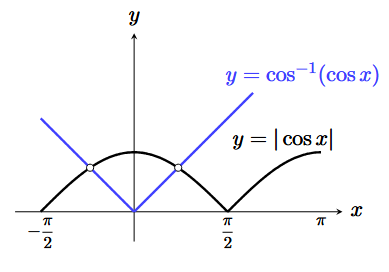
Solve the differential equation \(\dfrac{dy}{dx} + y = 1\), given that \(y(0) = 2\). Find the value of \(y\) when \(x = 1\).
This is a first-order linear differential equation in the form \(\dfrac{dy}{dx} + Py = Q\).
Here, \(P = 1\) and \(Q = 1\).
Integrating factor: I.F. = \(e^{\int P dx} = e^{\int 1 dx} = e^x\)
Multiplying the equation by I.F.:
\(e^x \dfrac{dy}{dx} + e^x y = e^x\)
\(\dfrac{d}{dx}(ye^x) = e^x\)
Integrating both sides: \(ye^x = \int e^x dx = e^x + C\)
\(y = 1 + Ce^{-x}\)
Applying initial condition \(y(0) = 2\):
\(2 = 1 + Ce^0 = 1 + C\), so \(C = 1\)
Solution: \(y = 1 + e^{-x}\)
When \(x = 1\): \(y(1) = 1 + e^{-1}\)
The projections of a line segment on the coordinate axes are \(12, 4, 3\), respectively. The length and direction cosines of the line segment are:
Projections on \(x, y, z\) axes are \(12, 4, 3\) respectively.
Length of the line segment: \(d = \sqrt{12^2 + 4^2 + 3^2} = \sqrt{169} = 13\)
Direction cosines are given by \(\ell = \dfrac{a}{d}, m = \dfrac{b}{d}, n = \dfrac{c}{d}\) where \(a, b, c\) are the projections.
\(\ell = \dfrac{12}{13}\), \(m = \dfrac{4}{13}\), \(n = \dfrac{3}{13}\)
Find the total number of ways in which 20 balls can be distributed into 5 boxes such that the first box contains exactly one ball.
First box must contain exactly 1 ball.
Number of ways to choose 1 ball from 20 = \(^{20}C_1 = 20\)
Remaining 19 balls can be distributed into remaining 4 boxes.
Each of the 19 balls can go into any of the 4 boxes, number of ways = \(4^{19}\)
Total number of ways = \(20 \times 4^{19}\)
Two customers, Ruchana and Bhakati, visit a shop during the same week (Tuesday to Saturday). Each is equally likely to visit on any day. What is the probability that they visit on consecutive days?
There are 5 days: Tuesday to Saturday. Each person can visit on any of these 5 days.
Total possible outcomes = \(5 \times 5 = 25\)
For consecutive days, the pairs are: (Tue, Wed), (Wed, Thu), (Thu, Fri), (Fri, Sat)
That's 4 pairs. But either person can visit first, so favorable outcomes are:
Ruchana visits before Bhakati : 4 ways
Bhakati visits before Ruchana: 4 ways
Total favorable outcomes = \(4 + 4 = 8\)
Probability = \(\dfrac{8}{25}\)
The coefficients of \(x^n\) in the expansions of \((1 + x)^{2n}\) and \((1 + x)^{2n - 1}\) are in the ratio:
Coefficient of \(x^n\) in \((1 + x)^{2n}\) is \(^{2n}C_{n}\)
Coefficient of \(x^n\) in \((1 + x)^{2n-1}\) is \(^{2n-1}C_{n}\)
Required ratio = \(\dfrac{^{2n}C_{n}}{^{2n-1}C_{n}}\)
\(= \dfrac{(2n!)(n!)(n-1)!}{(2n-1)!(n!)(n!)}=2\)
Therefore, the ratio is \(2:1\)
The area of an equilateral triangle is \(49\sqrt{3} \text{ cm}^2\). Taking each angular point as centre, circles are drawn with radius equal to half the length of the side of the triangle. Find the area of the triangle not included
in the circles. (use \(\pi = 3.14\))
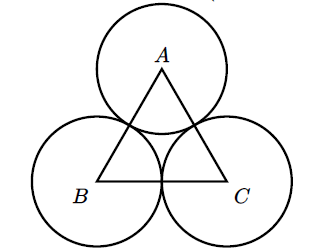
Area of equilateral triangle = \(\dfrac{\sqrt{3}}{4}a^2 = 49\sqrt{3}\)
Hence \(a^2 = 196\), or \(a = 14\) cm
Radius of each circle = \(\dfrac{a}{2} = 7\) cm
Each angle of equilateral triangle = \(60^{\circ}\)
Area of sector at each vertex = \(\dfrac{60}{360} \times \pi r^2 = \dfrac{49\pi}{6}\)
Total area of three sectors inside triangle = \(3 \times \dfrac{49\pi}{6}=\dfrac{49\pi}{2}\) cm²
Area of triangle = \(49 \sqrt{3}\) cm²
Area not covered by circles = \(\dfrac{49\pi}{2}-49\sqrt{3}=7.94\) cm².
For the parabola \(y^{2} = 4x\), which of the following points lies on it?
Check each point in the equation \(y^2 = 4x\), only \(4,4\) satisfies the equation of the parabola.
The length of the perpendicular drawn from \((1,2,3)\) to the line \(\dfrac{x-6}{3} = \dfrac{y-7}{2} = \dfrac{z-7}{-2}\) is
Point: \(P(1, 2, 3)\)
Line passes through \(A(6, 7, 7)\) with direction ratios \((3, 2, -2)\)
Vector \(\vec{AP} = (1-6, 2-7, 3-7) = (-5, -5, -4)\)
Direction vector of line: \(\vec{b} = (3, 2, -2)\)
Perpendicular distance = \(\dfrac{|\vec{AP} \times \vec{b}|}{|\vec{b}|}\)
Cross product: \(\vec{AP} \times \vec{b} = \begin{vmatrix} \hat{i} & \hat{j} & \hat{k} \\ -5 & -5 & -4 \\ 3 & 2 & -2 \end{vmatrix}\)
\(= 18\hat{i} - 22\hat{j} + 5\hat{k}\)
\(|\vec{AP} \times \vec{b}| = \sqrt{18^2 + 22^2 + 5^2} = \sqrt{324 + 484 + 25} = \sqrt{833}\)
\(|\vec{b}| = \sqrt{9 + 4 + 4} = \sqrt{17}\)
Distance = \(\dfrac{\sqrt{833}}{\sqrt{17}} = \sqrt{\dfrac{833}{17}} = \sqrt{49} = 7\)
A pendulum swings through an angle of \(30^\circ\) and describes an arc of length 17.6 cm. Find the length of the pendulum.
Arc length formula: \(s = r\theta\) where \(\theta\) is in radians.
\(\theta = 30 \times \dfrac{\pi}{180} = \dfrac{\pi}{6}\) radians
Given arc length \(s = 17.6\) cm
Hence \(17.6 = r \times \dfrac{\pi}{6}\)
\(r = \dfrac{17.6 \times 6}{\pi} = \dfrac{105.6}{3.14159} \approx 33.6\) cm
Find the domain of \(\cos^{-1}(2x - 3)\).
The domain of \(\cos^{-1}(t)\) is \([-1, 1]\).
For \(\cos^{-1}(2x - 3)\) to be defined:
\(-1 \leq 2x - 3 \leq 1\)
Hence \(1 \leq x \leq 2\)
Domain = \([1, 2]\)
Two circles touch each other externally. The sum of their areas is \(130\pi \text{ cm}^2\) and the distance between their centres is 14 cm. The radii of the circles are:
Let the radii be \(r_1\) and \(r_2\).
Sum of areas: \(\pi r_1^2 + \pi r_2^2 = 130\pi\)
So \(r_1^2 + r_2^2 = 130\) ... (1)
Circles touch externally: \(r_1 + r_2 = 14\) ... (2)
From (2): \((r_1 + r_2)^2 = 196\)
\(r_1^2 + 2r_1r_2 + r_2^2 = 196\)
Using (1): \(130 + 2r_1r_2 = 196\)
or \(r_1r_2 = 33\) ... (3)
From (2) and (3), \(r_1\) and \(r_2\) are roots of:
\(t^2 - 14t + 33 = 0\)
Factoring: \((t - 11)(t - 3) = 0\)
So \(r_1 = 11\) and \(r_2 = 3\)
The population of a town grows at a rate of \(10\%\) per year. Find the time required for the population to triple.
Let initial population = \(P_0\), Growth rate = 10% per year
Population after \(t\) years: \(P = P_0(1.1)^t\)
For population to triple: \(P = 3P_0\)
\(3P_0 = P_0(1.1)^t\) or \(3 = (1.1)^t\)
Taking logarithm: \(\log 3 = t \log 1.1\)
\(t = \dfrac{\log 3}{\log 1.1}\)
If \(\tan^{-1} \left( \dfrac{1-x}{1+x} \right) = \dfrac{1}{2} \tan^{-1} x\), then the value of \(x\) is
Using the identity: \(\tan^{-1} \left( \dfrac{1-x}{1+x} \right) = \dfrac{\pi}{4} - \tan^{-1} x\) for \(x > 0\)
The equation becomes:
\(\dfrac{\pi}{4} - \tan^{-1} x = \dfrac{1}{2} \tan^{-1} x\)
\(\dfrac{\pi}{4} = \tan^{-1} x + \dfrac{1}{2} \tan^{-1} x\)
\(\dfrac{\pi}{4} = \dfrac{3}{2} \tan^{-1} x\)
\(\tan^{-1} x = \dfrac{\pi}{6}\)
\(x = \tan \dfrac{\pi}{6} = \dfrac{1}{\sqrt{3}}\)
For the probability density function \(f(x) = \left\{ \begin{array}{ll}\dfrac{x}{18}, & 0 \leq x \leq 6\\ 0, & \text{otherwise} \end{array} \right.\), find \(P(X > 2)\).
We need to find \(P(X > 2) = \int \limits_2^6 f(x) dx\)
\(P(X > 2) = \int \limits_2^6 \dfrac{x}{18} dx = \dfrac{1}{18} \int \limits_2^6 x \, dx\)
\(= \dfrac{1}{18} \left[ \dfrac{x^2}{2} \right]_2^6 = \dfrac{1}{36} [x^2]_2^6\)
\(= \dfrac{1}{36} (36 - 4) = \dfrac{32}{36} = \dfrac{8}{9}\)
The incomes of A, B, and C are in the ratio \(7:9:12\) and their expenditures are in the ratio \(8:9:15\). If A saves one-fourth of his income, then the ratio of their savings is:
Let incomes of A, B, C be \(7x, 9x, 12x\)
Let expenditures be \(8y, 9y, 15y\)
A saves \(\dfrac{1}{4}\) of his income:
Hence \(7x-8y=\dfrac{7x}{4}\)
Or \(y= \dfrac{21x}{32}\)
Putting the value of \(y\) in terms of \(x\), we get the ratio of their savings as \( 56:99:69\)
Solve the differential equation \((y^2 + 3xy)dx + (x^2 + xy)dy = 0\), given that \(y = 1\) when \(x = 1\).
The equation is \((y^2 + 3xy)dx + (x^2 + xy)dy = 0\)
This is a homogeneous equation. Let \(y = vx\), so \(dy = vdx + xdv\)
Substituting:
\((v^2x^2 + 3vx^2)dx + (x^2 + vx^2)(vdx + xdv) = 0\)
\(x^2(v^2 + 3v)dx + x^2(1 + v)(vdx + xdv) = 0\)
Dividing by \(x^2\):
\((v^2 + 3v)dx + (1 + v)(vdx + xdv) = 0\)
\((v^2 + 3v + v + v^2)dx + (1 + v)xdv = 0\)
\((2v^2 + 4v)dx + (1 + v)xdv = 0\)
\(\dfrac{dx}{x} = -\dfrac{(1 + v)dv}{2v(v + 2)}\)
Integrating and applying initial condition \(x = 1, y = 1\) (so \(v = 1\)):
After integration and simplification: \(y = \dfrac{x + 1}{x^2}\)
The probability of answering exactly 6 out of 10 questions correctly in a true/false examination is:
This is a binomial distribution problem with \(n = 10\) and \(p = 0.5\).
Probability of exactly 6 correct = \(\binom{10}{6} (0.5)^6 (0.5)^4\)
\(P(X = 6) = \binom{10}{6} (0.5)^{10}\)
\(\binom{10}{6} = \dfrac{10!}{6! \cdot 4!} = 210\)
\(P(X = 6) = 210 \times \dfrac{1}{1024} = \dfrac{210}{1024} \approx 0.205\)
Two cubes each of volume \(64\) cm³ are joined face to face. Find the surface area of the resulting cuboid.
Side of cube: \(a^3 = 64\), so \(a = 4\) cm
When joined face to face, the cuboid has dimensions:
Length = \(8\) cm, Width = \(4\) cm, Height = \(4\) cm
Surface area = \(2(lb + bh + hl)\)
\(= 2(8 \times 4 + 4 \times 4 + 4 \times 8)\)
\(= 2(32 + 16 + 32) = 160\text{ cm}^2\)
Two trains A and B are moving towards each other with speeds \(60\) km/h and \(90\) km/h respectively. A bird flies at \(120\) km/h between them. Find the total distance travelled by the bird, if the initial distance between the trains is \(300\) km.
Relative speed of trains = \(60 + 90 = 150\) km/h, initital distnace between the trains is \(300\) km, hence
Time until trains meet = \(\dfrac{300}{150}=2\) hours
Distance traveled by bird in this time = \(120 \times 2=240\)
Find the differential equation corresponding to the family \(y = ax^2\).
Given family: \(y = ax^2\) so \(\dfrac{dy}{dx} = 2ax\)
From the original equation: \(a = \dfrac{y}{x^2}\)
Substituting:
\(\dfrac{dy}{dx} = 2 \cdot \dfrac{y}{x^2} \cdot x = \dfrac{2y}{x}\)
Therefore: \(y' = \dfrac{2y}{x}\)
The variance of a binomial distribution is 2 and the number of trials is 9. If the probability of success is greater then the probability of failure, then the probability of success.
For binomial distribution: Variance = \(np(1-p)\)
As the number of trianls is \(n = 9\) and variance = 2
\(9p(1-p) = 2\)
\(9p - 9p^2 = 2\)
\(9p^2 - 9p + 2 = 0\) or \(p = \dfrac{1}{3} \text{ or } \dfrac{2}{3}\), as probability of success is greater, so the answer is \(\dfrac{2}{3}\).
If \(a = 9\), \(b = 7\), and \(c = 12\), find angle \(C\) using the cosine rule.
Cosine rule: \(c^2 = a^2 + b^2 - 2ab\cos C\)
\(\Rightarrow \cos C = \dfrac{a^2 + b^2 - c^2}{2ab}\)
\(\cos C = \dfrac{9^2 + 7^2 - 12^2}{2 \times 9 \times 7}\)
\(= \dfrac{81 + 49 - 144}{126} = \dfrac{-14}{126} = -\dfrac{1}{9}\)
\(C = \cos^{-1}\left(-\dfrac{1}{9}\right) \approx 96.37^\circ\)
Find the area of a sector of a circle with radius 6 cm and central angle \(60^\circ\).
Area of sector = \(\dfrac{\theta}{360} \times \pi r^2\) where \(\theta\) is in degrees
Given: \(r = 6\) cm, \(\theta = 60^\circ\)
\(\text{Area} = \dfrac{60}{360} \times \pi \times 6^2\)
\(= \dfrac{1}{6} \times \pi \times 36 = 6\pi \text{ cm}^2\)