
08 Time, Speed and Distance
5. Average Speed
Average speed is always defined as total distance covered in unit time. It is not always equal to average of the speeds.
Average speed = \(\left[ {\frac{{{\rm{total distance}}}}{{{\rm{total time}}}}} \right]\)
For example if a man goes to office @ 20 km/hr and comes back @ 30 km/hr then the average speed will not be equal to \(\frac{{{\rm{20}} + {\rm{30}}}}{{\rm{2}}}\)= 25
Average speed = \(\frac{{x + x}}{{\frac{{\rm{x}}}{{{\rm{20}}}} + \frac{x}{{30}}}}\) = \(\frac{{{\rm{2}} \times {\rm{20 }} \times {\rm{30}}}}{{{\rm{20}} + {\rm{30}}}}\)= 24 km/hr.
In general if an object first covers a distance at a speed of u and then covers the same distance at the speed of v, then its average speed = \(\frac{{2uv}}{{v + u}}\)
Example 14: If a person goes around an equilateral triangle shaped field at speed of 10, 20 and 40 km/h on the first, second and third side respectively and reaches back to the starting point, then find his average speed during the journey.
Solution: Let the measure of each side of triangle is \(D\) km. The person traveled the distance from \(A\) to \(B\) with 10 kmph, \(B\) to \(C\) with 20 kmph and \(C\) to \(A\) with 40 kmph.
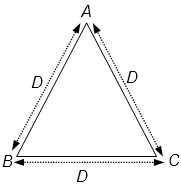
If \({T_{AB}} = \) Time taken by the person to travel from \(A\) to \(B\), \({T_{BC}} = \) Time taken by the persons to travel from \(B\) to \(C\) and \({T_{CA}} = \) Time taken by the persons to travel from \(C\) to \(A\).
Then total time = \({T_{AB}} + {\rm{ }}{T_{BC}} + {\rm{ }}{T_{CA}}\)
\( = \frac{D}{{10}} + \frac{D}{{20}} + \frac{D}{{40}} = D\left( {\frac{{8 + 4 + 2}}{{80}}} \right) = \frac{{7D}}{{40}}\)
Total distance traveled = \(D + D + D = 3D\)
Hence, Average speed
= \(\frac{{3D}}{{7D/40}} = \frac{{120}}{7} = 17\frac{1}{7}kmph.\)
Note that it can be easily proven that if a person moves on the sides of an equilateral triangle with the speeds \({u_1},\,{u_2}\,\& \,{u_3}\) and returns to the initial place, then his average speed will be
\(\frac{{3{u_1}{u_2}{u_3}}}{{{u_1}{u_2} + {u_2}{u_3} + {u_3}{u_1}}}\)