
08 Time, Speed and Distance
7. Races and Circular Tracks
When two persons \(P\) and \(Q\) are running a race, they can start the race at the same time or one of them, may start a little later than the other. In the second case, suppose \(P\) starts the race and after 5 seconds, \(Q\) starts. Then we say \(P\) has a “start” of 5 seconds. Alternatively, in a race between \(P\) and \(Q\), \(P\) starts first and then when \(P\) has covered a distance of 10 meters, \(Q\) starts. Then we say that \(P\) has a “start” of 10 meters.
In a race between \(P\) and \(Q\) where \(Q\) is the winner, by the time \(Q\) reaches the winning post, if \(P\) still has another 15 meters to reach the winning post, then we say that \(Q\) has won the race by 15 meters. Similarly, if \(P\) reaches the winning post 10 seconds after \(Q\) reaches it, then we say that \(Q\) has won the race by 10 seconds.
In problems on RACES, we normally consider a 100 m race or a 1 km race. The length of the track NEED NOT necessarily be one of the two figures mentioned above but can be as given in the problem.
When two or more persons running around a circular track (starting at the same point and at the same time), then we will be interested in two main issues:
when they will meet for the first time and
when they will meet for the first time at the starting point
To solve the problems on circular tracks, you should keep the following points in mind.
When two persons are running around a circular track in OPPOSITE directions, the relative speed is equal to the sum of the speeds of the two individuals and from one meeting point to the next meeting point, the two of them TOGETHER cover a distance equal to the length of the track.
When two persons are running around a circular tack in the SAME direction the relative speed is equal to the difference of the speeds of the two individuals and from one meeting point to the next meeting point, the faster person covers one COMPLETE ROUND more than the slower person. We can now tabulate the time taken by the persons to meet for the first time ever or for the first time at the starting point in various cases.
When TWO people are running around a circular track
Let the two people A and B with respective speeds of A and \(B (A > B)\) be running around a circular track (of length L) starting at the same point and at the same time.
Then,
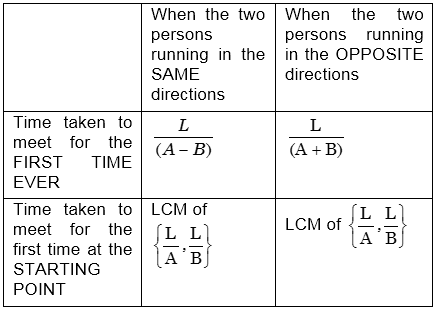
Please note that when we have to find out the time taken by the two persons to meet for the first time at the staring point, what we have to do is to find out the time taken by each of them to complete one full round and then take the LCM of these two timings (L/A and L/B are the timings taken by the two of them respectively to complete on full round.
Example 17: there are three persons \(A, B\) and \(C\). They are running in the same direction, around a circular track of length 120 m. Their speeds are 20, 15 and 10 m/sec. If they start at the same time from the same point, find the time after which they will meet for the first time.
Solution: \({T_{AB}}\) is the time taken when A will over take B for the first time,
then \({T_{AB}}\) = \(\frac{{{\rm{length}}\,\,{\rm{of}}\,\,{\rm{the}}\,\,{\rm{path}}}}{{{\rm{Speed}}\,\,{\rm{of}}\,\,{\rm{A}} - {\rm{speed}}\,\,{\rm{of}}\,\,{\rm{B}}}}\)
\({T_{AB}}\) = \(\frac{{120}}{{20 - 15}} = 24\) sec
Similarly \({T_{AC}}\) is the time when \(A\) will also overtake \(C\), then
\({T_{AC}}\) = \(\frac{{{\rm{length}}\,\,{\rm{of}}\,\,{\rm{the}}\,\,{\rm{path}}}}{{{\rm{Speed}}\,\,{\rm{of}}\,\,{\rm{A}} - {\rm{speed}}\,\,{\rm{of}}\,{\rm{C}}}}\)=\(\frac{{120}}{{20 - 10}} = 12\,\sec \)
Required time is LCM of 24 and 12 sec = 24 sec.
Example 18: There are three persons \(A, B\) and \(C\). They are running around a circular track in the same direction. They can complete one round of this circle in 1 min, 3min and 5 min respectively. If they start at the same time from the same point, find the time after which they will meet for the first time.
Solution: Suppose circumference of the circular path is 15 meter (LCM of 1, 3, 5). So speeds of \(A, B\) and \(C\) will be 15, 5 and 3 m/min.
Suppose \({T_{AB}}\) is the time taken when \(A\) will over take \(B\) for the first time, then
\({T_{AB}}\) = \(\frac{{{\rm{length}}\,\,{\rm{of}}\,\,{\rm{the}}\,\,{\rm{path}}}}{{{\rm{Speed}}\,\,{\rm{of}}\,\,{\rm{A}} - {\rm{speed}}\,\,{\rm{of}}\,\,{\rm{B}}}}\)
\({T_{AB}}\) = \(\frac{{15}}{{15 - 5}} = \frac{3}{2}\)
Similarly \({T_{AC}}\) is the time when \(A\) will also overtake \(C\), then
\({T_{AC}}\) = \(\frac{{{\rm{length}}\,\,{\rm{of}}\,\,{\rm{the}}\,\,{\rm{path}}}}{{{\rm{Speed}}\,\,{\rm{of}}\,\,{\rm{A}} - {\rm{speed}}\,\,{\rm{of}}\,\,{\rm{B}}}}\)=\(\frac{{15}}{{15 - 3}} = \frac{5}{4}\)
Now the required time when \(A, B\) and \(C\) will be at the same place for the first time will be LCM of \({T_{AB}}\) and \({T_{AC}}\)
Hence the required time = LCM of \(\frac{3}{2}\,\,{\rm{and}}\,\,\frac{5}{4}\) = \(\frac{{15}}{2}\)
= 7.5 minutes