
CAT 22 QUANT slot 01
CAT 2021 Quantitative Ability Slot 01
(Total questions: 22)
Question 01: Let ABCD be a parallelogram such that the coordinates of its three vertices A, B, C are (1, 1), (3, 4) and (– 2, 8), respectively. Then, the coordinates of the vertex D are:
(a) (– 4, 5)
(b) (4,
5)
(c) (– 3, 4)
(d) (0, 11)
We know that diagonals of a parallelogram intersect at the midpoint, therefore midpoint of A and C will be the same as that of B and D. Let point D is \((x,y)\)
\(\left( {\frac{{1 - 2}}{2},\,\frac{{1 + 8}}{2}} \right) = \left( {\frac{{x +
3}}{2},\,\frac{{y + 4}}{2}} \right)\)
\( \Rightarrow x = - 4,\,\,y = 5\)
Question 02: The number of ways of distributing 20 identical balloons among 4 children such that each child gets some balloons, but no child gets an odd number of balloons, is
Given that each child gets some balloons and an even number of balloons. Let the number of balloons are \((2a + 2),\,(2b + 2),\,(2c + 2)\) and \((2d + 2)\) , where
\(2a + 2 + 2b + 2 + 2c + 2 + 2d + 2 = 20\)
\( \Rightarrow a + b + c +
d = 6\)
Here \(a,\,b,\,c,\,d\) are non-negative integers, the number of solutions is
\(^{6 + 4 - 1}{{\rm{C}}_{4 - 1}} = {\,^{\rm{9}}}{{\rm{C}}_{\rm{3}}} = 84\)
Question 03: A mixture contains lemon juice and sugar syrup in equal proportion. If a new mixture is created by adding this mixture and sugar syrup in the ratio 1 : 3, then the ratio of lemon juice and sugar syrup
in the new mixture is
(a) 1 : 6
(b) 1 : 4
(c) 1 : 5
(d) 1 : 7
Ratio of lemon juice and sugar syrup in the mixture = 1: 1. Let us assume 1 kg of this mixture is added in 3 kg of sugar syrup, then ratio of the lemon juice in the new mixture = \(\frac{{1 \times \frac{1}{2}}}{{1 + 3}} = \frac{1}{8}\)
Ratio
of lemon juice and sugar syrup = 1 : 7
Question 04: For natural numbers \(x,\,y\) and \(z\) , if \(xy + yz = 19\) and \(yz + xz = 51\) , then the minimum possible value of \(xyz\) is:
From the given equations, \(y(x + z) = 19\) and \(z(x + y) = 51\)
From the first relation, \(y = 1\) as \(x + z\) cannot be 1 since both are natural numbers. Hence \(x + z = 19\) .
Also \(z\) must be a factor of 51 and less than 19,
so it can only be 3 or 17.
Possible values of \((x,\,y,\,z)\) are (2, 1, 17) or (16, 1, 3)
Minimum value of \(xyz = 34\)
Question 05: Let \(a,b,c\) be non-zero real numbers such that \({b^2} < 4ac\) , and \(f\left( x \right) = a{x^2} + bx + c\) . If the set S consists of all integers \(m\) such that \(f\left( m \right) < 0\)
, then the set S must necessarily be:
(a) the set of all integers
(b) either the empty set or the set of all integers
(c) the empty set
(d) the set of all positive integers
Given that \({b^2} < 4ac\) , hence the roots of the quadratic equation \(a{x^2} + bx + c = 0\) are not real. That means the graph of the function \(f\left( x \right) = a{x^2} + bx + c\) will not intersect with \(x\) axis, it is either lies
above x axis or below x axis, depending upon the sign of \(a\) .
When \(a > 0\) , \(f(x)\) is always positive.
When \(a < 0\) , \(f(x)\) is always negative.
Thus \(f\left( m \right) < 0\) can be always true or can be
always false. The S can be either empty or set of all integers.
Question 06: Trains A and B start traveling at the same time towards each other at constant speeds from stations X and Y, respectively. Train A reaches station Y in 10 minutes while train B takes 9 minutes to reach
station X after meeting train A. Then the total time taken, in minutes, by train B to travel from station Y to station X is:
(a) 15
(b) 12
(c) 6
(d) 10
Let the two trains meet after a time \(t\) , and take \({t_1}\) and \({t_2}\) time to reach to Y and X respectively, then
\(t = \sqrt {{t_1}\,{t_2}} \)
\( \Rightarrow t = \sqrt {9 \times (10 - t)} \)
\( \Rightarrow t = 6\)
Time
taken by train B = 6 + 9 = 15 minutes.
Question 07: The average of three integers is 13. When a natural number \(n\) is included, the average of these four integers remains an odd integer. The minimum possible value of \(n\) is
(a) 3
(b) 4
(c)
5
(d) 1
Sum of the three numbers = 39.
Given that \(\frac{{39 + n}}{4}\) is an odd number. As \(\frac{{39 + n}}{4}\) is more than 9, so the next odd number is 11.
\( \Rightarrow \frac{{39 + n}}{4} = 11\) or \(n = 5\)
Question 08: Pinky is standing in a queue at a ticket counter. Suppose the ratio of the number of persons standing ahead of Pinky to the number of persons standing behind her in the queue is 3 : 5. If the total number of persons in the queue is less than 300, then the maximum possible number of persons standing ahead of Pinky is:
Let the number of persons standing ahead and standing behind are 3k and 5k, then the total number of persons in the queue = 8k + 1
Since the total number of persons in the queue is less than 300,
8k + 1 < 300
Hence the biggest value
of 8k can be 296, or k = 37.
Maximum possible number of persons standing ahead of Pinky is 3k = 111
Question 09: Ankita buys 4 kg cashews, 14 kg peanuts and 6 kg almonds when the cost of 7 kg cashews is the same as that of 30 kg peanuts or 9 kg almonds. She mixes all the three nuts and marks a price for the mixture
in order to make a profit of ₹1752. She sells 4 kg of the mixture at this marked price and the remaining at a 20% discount on the marked price, thus making a total profit of ₹744. Then the amount, in rupees, that she had spent in buying almonds is
(a)
1440
(b) 1176
(c) 1680
(d) 2520
Let the cost of one kg of cashews, peanuts and almonds are x, y and z, then
7x = 30y = 9z = 630k (say)
Or x, y, z = 90k, 21k, 70k respectively.
Suppose the marked price is p, then the expected revenue = 24p and actual revenue = 4p
+ 20(0.8p) = 20p.
The difference between the revenue = 4p = 1752 – 744 = 1008
Hence p = 252
Also, it is given that,
24p – 4(90k) – 14(21k) – 6(70k) = 1752
Putting the value of p as 252, we get k = 4
Amount spent in
purchasing almonds = 6(70k) = 420k = ₹1680
Question 10: The largest real value of a for which the equation \(\left| {x + a} \right| + \left| {x-1} \right| = 2\) has an infinite number of solutions for \(x\) is
(a) – 1
(b) 0
(c) 1
(d) 2
Consider the function \(y = \,|x - {x_1}| + |x - {x_2}|\) , this function has the same value at \(x = {x_1}\) and \(x = {x_2}\) , the value is, \(y = \,|\,{x_1} - {x_2}|\) . Also, it has the same value between \({x_1}\) and \({x_2}\) . Therefore
for infinite values of \(x\) , between \({x_1}\) and \({x_2}\) , the value of \(y\) remains constant. 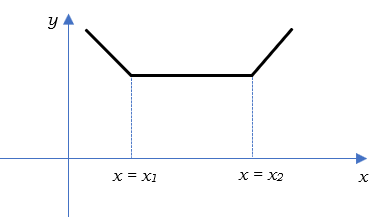
Let us
assume \(y = \,|x + a| + |x - 1|\)
At \(x = 1,\) the value of \(y\) is \(|1 + a|\)
At \(x = - a\) , the value of \(y\) is \(| - a - 1|\, = \,|a + 1|\)
This value remains same for all values of \(x\) between \( - a\) and 1. As
per the question this value is 2.
Hence \(|1 + a|\, = 2 \Rightarrow a = - 3,\,\,1\)
The biggest value of \(a = 1\)
Question 11: A trapezium ABCD has side AD parallel to BC, angle BAD = 90°, BC = 3cm and AD = 8cm. If the perimeter of this trapezium is 36 cm, then its area, in sq. cm, is
Let the sides \(AB = x,\,\,CD = y\) , then
\(8 + x + 3 + y = 36\) 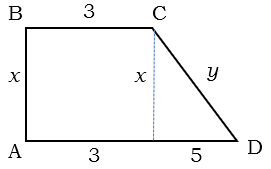
\( \Rightarrow x + y = 25\)
Also
\(y = \sqrt {{5^2} + {x^2}} \)
Solving these two equations, we get \(x = 12\) .
Area of the trapezium = \(\frac{{8 \times 12}}{2} = 48\)
Question 12: For any real number \(x\), let \(\left[ x \right]\) be the largest integer less than or equal to \(x\). If \(\sum\limits_{n = 1}^N {\left[ {\frac{1}{5} + \frac{n}{{25}}} \right]} = 25\) , then \(N\) is
The value of \(\left[ {\frac{1}{5} + \frac{n}{{25}}} \right]\) remains 0, for \(1 \le n \le 19\)
\(\left[ {\frac{1}{5} + \frac{n}{{25}}} \right]\) attains a value 1 for \(20 \le n \le 44\) . As these are 25 values and each one is equal to
1, the sum of the values of \(\left[ {\frac{1}{5} + \frac{n}{{25}}} \right]\) will be 25 when \(n = 44\) .
Question 13: In a village, the ratio of number of males to females is 5 : 4. The ratio of number of literate males to literate females is 2 : 3. The ratio of the number of illiterate males to illiterate females is 4 : 3. If 3600 males in the village are literate, then the total number of females in the village is:
Given that 3600 males in the village are literate, hence number of literate females = \(\frac{3}{2} \times 3600 = 5400\)
Number of illiterate males and females = \(4x,\;3x\)
Now \(\frac{{3600 + 4x}}{{5400 + 3x}} = \frac{5}{4}\) \( \Rightarrow
x = 12600\)
Number of females = \(5400 + 3x = 43200\)
Question 14: Amal buys 110 kg of syrup and 120 kg of juice, syrup being 20% less costly than juice, per kg. He sells 10 kg of syrup at 10% profit and 20 kg of juice at 20% profit. Mixing the remaining juice and syrup, Amal sells the mixture at ₹ 308.32 per kg and makes an overall profit of 64%. Then, Amal's cost price for syrup, in rupees per kg, is
Quantity of syrup and juice = 110 kg and 120 kg.
Let the cost price of juice per kg be 10p and cost price of syrup per kg is 8p.
Revenue by selling, 10 kg of syrup at 10% profit and 20 kg of juice at 20% profit is
10×1.1×8p + 20×1.2×10p
= 88p + 240p = 328p
Revenue from the remaining sales = 200×308.32 = 61644
Given that he makes an overall 64% profit,
328p + 61644 = 1.64(110×8p + 120×10p)
Or 328p + 61644 = 1.64(2080p)
Solving this we get, p = 20.
Cost price for syrup per kg = 8p = 8×20 = ₹160.
Question 15: Let \(a\) and \(b\) be natural numbers. If \({a^2} + ab + a = 14\) and \({b^2} + ab + b = 28\) , then \(\left( {2a + b} \right)\) equals
(a) 7
(b) 10
(c) 9
(d) 8
Adding both the equations, we have
\({a^2} + {b^2} + 2ab + a + b = 42\)
\( \Rightarrow {(a + b)^2} + (a + b) = 42\)
\( \Rightarrow (a + b)(a + b + 1) = 42\)
As 42 can be written as 6×7 and \(a,\,b\) are natural numbers, so there
is only one possibility, \(a + b = 6\) .
Using the first equation, \({a^2} + ab + a = 14\)
\( \Rightarrow a(a + b) + a = 14\)
Putting the value of \(a + b\) , we get \(a = 2\) and thus \(b = 3\)
Therefore \(\left( {2a +
b} \right)\) = 7.
Question 16: Alex invested his savings in two parts. The simple interest earned on the first part at 15% per annum for 4 years is the same as the simple interest earned on the second part at 12% per annum for 3 years.
Then, the percentage of his savings invested in the first part is
(a) 62.5%
(b) 37.5%
(c) 60%
(d) 40%
Suppose the investments in the two parts are \(x\) and \(y\) , then
\(\frac{{p \times 15 \times 4}}{{100}} = \frac{{q \times 12 \times 3}}{{100}}\)
\( \Rightarrow \frac{p}{q} = \frac{{12 \times 3}}{{15 \times 4}} = \frac{3}{5}\)
The percentage of his savings invested in the first part = \(\frac{3}{8} \times 100 = 37.5\% \)
Question 17: In a class of 100 students, 73 like coffee, 80 like tea and 52 like lemonade. It may be possible that some students do not like any of these three drinks. Then the difference between the maximum and
minimum possible number of students who like all the three drinks is
(a) 48
(b) 53
(c) 47
(d) 52
Number of students who
do not coffee = 27
do not tea = 20
do not lemonade = 48
Maximum number of students not liking at least one drink = 27 + 20 + 48 = 95
Hence minimum number of students linking all = 100 – 95 = 5
Maximum
number of students linking all = min(73, 80, 52) = 52
Required difference = 52 – 5 = 47.
Question 18: For any natural number \(n\), suppose the sum of the first \(n\) terms of an arithmetic progression is \(n + 2{n^2}\). If the \({n^{{\rm{th}}}}\) term of the progression is divisible by 9, then the smallest
possible value of \(n\) is
(a) 4
(b) 8
(c) 7
(d) 9
First term of the series is same as the sum of the first term, hence the first term = \(1 + 2 \times {1^2} = 3\) .
Sum of the first to term = \(2 + 2 \times {2^2} = 10\) , so the second term = 7.
Common difference = 4.
\({n^{{\rm{th}}}}\)
term = \(3 + (n - 1) \times 4 = 4n - 1\)
Given that \({n^{{\rm{th}}}}\) term is divisible by 9, hence \(n = 7\) .
Question 19: All the vertices of a rectangle lie on a circle of radius \(R\). If the perimeter of the rectangle is \(P\), then the area of the rectangle is:
(a) \(\frac{{{P^2}}}{2} - 2PR\)
(b) \(\frac{{{P^2}}}{8}
- 2{R^2}\)
(c) \(\frac{{{P^2}}}{{16}} - {R^2}\)
(d) \(\frac{{{P^2}}}{8} - 2{R^2}\)
Let the sides of the rectangle are \(x,\;y\) , then
\(2(x + y) = P\) and
\({x^2} + {y^2} = 4{R^2}\)
Squaring the first equation,
\(4({x^2} + {y^2} + 2xy) = {P^2}\)
Putting the value of \({x^2} + {y^2}\) from the second equation,
we have,
\(4(4{R^2} + 2A) = {P^2}\)
\( \Rightarrow A = \frac{{{P^2}}}{8} - 2{R^2}\)
Question 20: The average weight of students in a class increases by 600 gm when some new students join the class. If the average weight of the new students is 3 kg more than the average weight of the original students,
then the ratio of the number of original students to the number of new students is:
(a) 1 : 2
(b) 3 : 1
(c) 1 : 4
(d) 4 : 1
We know that any excess over the average is uniformly distributed over the number of observations. Here excess weight is 3kg per student. And the increment is 600 gm. Suppose the number of original and new students are \(x\) and \(y\) , then
\(\frac{{3y}}{{x + y}} = 0.60 \Rightarrow x = 4y\)
Question 21: Let A be the largest positive integer that divides all the numbers of the form \({3^k} + {4^k} + {5^k}\), and B be the largest positive integer that divides all the numbers of the form \({4^k} + 3{(4)^k} + {4^{k + 2}}\), where \(k\) is any positive integer. Then (A + B) equals
For any natural value of \(k\) , the number \({3^k} + {4^k} + {5^k}\) is always even, hence the value of A = 2.
The number \({4^k} + 3{(4)^k} + {4^{k + 2}}\) can be written as \({4^k}(1 + 3 + 16) = {4^k} \times 20\)
As \(k\) is a natural
number, so the greatest number that can always divide this number is \(80\) , so B = 80.
Hence A + B = 82
Question 22: Let \(0 \le a \le x \le 100\) and \(f\left( x \right) = \left| {x-a} \right| + \left| {x-100} \right| + \left| {x-a-50} \right|\) . Then the maximum value of \(f(x)\) becomes 100 when \(a\) is equal
to
(a) 100
(b) 25
(c) 0
(d) 50
Given that \(a \le x \le 100\) , the function can be written as
\(f(x) = x - a + (100 - x)\, + |x - a - 50|\)
\(f(x) = 100 - a + |x - (a + 50)|\)
Let \(y = \,|x - (a + 50)|\) , where \(a \le x \le a + 100\) 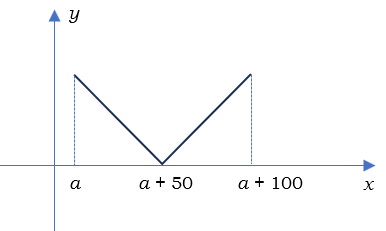
Plotting the graph for \(y,\) we see that it is V shaped graph, it has a minimum value at \(x = a + 50\) and maximum value at \(x = a\) or \(x = a + 100\) .
The value of \(y\) at \(x =
a\) or \(x = a + 100\) = 50.
The maximum value of \(f(x)\) is
\(100 - a + y = 100 - a + 50 = 150 - a\)
Since maximum value of \(f(x)\) is 100, so \(a = 50\)