
NIMCET 2024 Question Paper and Solutions
NIMCET Previous Year Papers!
Solving previous year papers always helps student to know the actual format of the paper and the difficulty level of the questions. Practicing these papers is the best way to familiarize yourself with the latest exam trends, important concepts, and question patterns. We strongly advise you to go through NIMCET 2024 Question Paper and Solutions.
NIMCET 2024 QUESTION PAPER AND SOLUTION
► Topic-Wise Question Distribution
| Topic (Click to Filter) | Number of Questions |
|---|---|
| MATRICES | 2 |
| TRIGONOMETRY | 4 |
| VECTORS | 6 |
| COORDINATE GEOMETRY | 7 |
| STATISTICS | 2 |
| PROBABILITY | 7 |
| PERMUTATIONS-COMBINATIONS | 3 |
| ALGEBRA | 4 |
| INTEGRATION | 2 |
| DIFFERENTIATION | 7 |
► Difficulty-Wise Question Distribution
If (4,3) and (12,5) are the two foci of an ellipse passing through the origin, then the eccentricity of the ellipse is:
We know that the distance between the foci is \(2ae\) and the sum of the distances from any point on the ellipse from the two foci is \(2a\).
Hence \(\sqrt{(12 - 4)^2 + (5 - 3)^2} = 2ae\)
Therefore \(ae = \sqrt{17}\)
Also \(PS + PS' = 2a\), here P is origin as the ellipse passes through origin.
So \(\sqrt{12^2 + 5^2} + \sqrt{4^2 + 3^2} = 2a\)
Or \(a = 9\). Putting the value of \(a\), we get \(e = \dfrac{\sqrt{17}}{9}\).
The number of one-to-one functions \(f:\{1,2,3\} \to \{a,b,c,d,e\}\) is:
The number of one-to-one functions from set A to B = \(^nP_r\), where \(r\) and \(n\) are the number of elements in A and B.
Hence the answer is \(^5P_3 = 5 \times 4 \times 3 = 60\)
The value of the limit \(\lim_{x \to 0} \left(\dfrac{1^x + 2^x + 3^x + 4^x}{4}\right)^{1/x}\) is:
Given that \(x \to 0\), hence \(1^x \approx 2^x \approx 3^x \approx 4^x \approx 1\)
Since all numbers are tending to the same value, we can take their Geometric Mean in place of Arithmetic Mean.
And the value of the limit = \(24^{1/4} = (4!)^{1/4}\)
The value of \(m\) for which the volume of the parallelepiped is 4 cubic units, whose three edges are represented by: \(a = m\hat{i} + \hat{j} + \hat{k}\), \(b = \hat{i} - \hat{j} + \hat{k}, c = \hat{i} + 2\hat{j} - \hat{k}\) is:
Volume of the parallelepiped is given by the determinant = 4
\(\Rightarrow m(-1) - 1(-2) + (3) = 4\)
\(\Rightarrow m = 5 - 4 = 1\)
The number of distinct real values of \(\lambda\) for which the vectors \(\lambda^2\hat{i} + \hat{j} + \hat{k}, \hat{i} + \lambda^2\hat{j} + \hat{k}\) and \(\hat{i} + \hat{j} + \lambda^2\hat{k}\) are coplanar is:
For coplanar vectors, the scalar triple product is zero.
Solving the determinant: \((\lambda^2 + 2)(1 - \lambda^2)(1 - \lambda^2) = 0\)
Hence \(\lambda = \pm 1\). There are two possible values.
There are 9 bottles labeled 1,2,3,...,9 and 9 boxes labeled 1,2,3,...,9. The number of ways one can put these bottles in the boxes so that each box gets one bottle and exactly 5 bottles go in their corresponding numbered boxes is:
Given that exactly 5 bottles go to corresponding boxes, and remaining 4 are placed in wrong boxes.
This can be done in \(^9C_5 \times D_4\), where \(D_4\) is the derangements of 4 objects.
Required answer = \(^9C_5 \times 9\)
If the perpendicular bisector of the line segment joining \(P(1,4)\) and \(Q(k,3)\) has \(y\)-intercept \(-4\), then the possible values of \(k\) are:
As the perpendicular bisector is equidistant from points \(P\) and \(Q\), the point \((0, -4)\) has same distance from \(P\) and \(Q\).
\(\Rightarrow \sqrt{k^2 + 49} = \sqrt{1 + 64}\)
\(\Rightarrow k = \pm 4\)
Let C denote the set of all tuples \((x,y)\) which satisfy \(x^2 - 2^y = 0\), where \(x\) and \(y\) are natural numbers. What is the cardinality of C?
Given that \(x\) and \(y\) are natural numbers, there are many solutions to the equation \(x^2 - 2^y = 0\).
Some of them are (2, 2), (4, 4), (8, 6), (16, 8) etc. This question was wrong.
If \(x = 1 + \sqrt[6]{2} + \sqrt[6]{4} + \sqrt[6]{8} + \sqrt[6]{16} + \sqrt[6]{32}\), then the value of \(\left(1 + \dfrac{1}{x}\right)^{24}\) is:
Let \(\sqrt[6]{2} = a\), then \(x = 1 + a + a^2 + a^3 + a^4 + a^5 = \dfrac{a^6 - 1}{a - 1}\)
\(\Rightarrow x = \dfrac{2 - 1}{\sqrt[6]{2} - 1} = \dfrac{1}{\sqrt[6]{2} - 1}\)
Hence \(1 + \dfrac{1}{x} = \sqrt[6]{2}\)
\(\Rightarrow \left(1 + \dfrac{1}{x}\right)^{24} = (\sqrt[6]{2})^{24} = 16\)
The number of solutions of \(5^{1 + |\sin x| + |\sin x|^2 + \ldots \infty} = 25\), where \(x \in (-\pi,\pi)\), is:
Let \(|\sin x| = a\), then \(5^{\dfrac{1}{1-a}} = 25\)
\(\Rightarrow \dfrac{1}{1-a} = 2\) or \(a = \dfrac{1}{2}\)
So \(\sin x = \pm \dfrac{1}{2}\), giving 4 solutions in the interval \((-\pi, \pi)\)
The system of equations \(x + 2y + 2z = 5\), \(x + 2y + 3z = 6\), \(x + 2y + \lambda z = \mu\) has infinitely many solutions if:
Subtract equation (1) from (2), we get \(z = 1\)
Subtract equation (2) from (3), we get \((\lambda - 3)z = \mu - 6\)
Putting value of \(z\), we get \(\lambda - 3 = \mu - 6\)
There are many values of \(\lambda, \mu\) for which the equations will have many solutions. Choice (3) is the correct answer.
Which of the following is TRUE?
Only choice (B) is correct.
If \(F = 40\) N, \(|D| = 3\) m and \(\theta = 60°\), then the work done by \(F\) acting from P to Q is:
Work done = \(|F||D|\cos\theta = 40 \times 3 \times \dfrac{1}{2} = 60\)
A committee of 5 is to be chosen from a group of 9 people. The probability that a certain married couple will either serve together or not at all is:
Required probability = P(couple is there) + P(couple is not there)
= \(\dfrac{1 \times ^7C_3}{^9C_5} + \dfrac{^7C_5}{^9C_5} = \dfrac{56}{126} = \dfrac{4}{9}\)
Find the cardinality of the set C, which is defined as \(C = \{x | \sin 4x = \dfrac{1}{2}, x \in (-9\pi, 3\pi)\}\):
Assume \(4x = \theta\), then \(\sin\theta = \dfrac{1}{2}\) and \(-36\pi < \theta < 12\pi\)
We can shift the interval to \(0 < \theta < 48\pi\)
In the interval \((0, 2\pi)\), \(\sin\theta = \dfrac{1}{2}\) has two solutions, hence in \(0 < \theta < 48\pi\), there will be 48 solutions.
At how many points do the following curves intersect: \(\dfrac{y^2}{9} - \dfrac{x^2}{16} = 1\) and \(\dfrac{x^2}{4} + \dfrac{(y-4)^2}{16} = 1\)
The axis of hyperbola lies along y-axis and major axis of ellipse also lies on y-axis.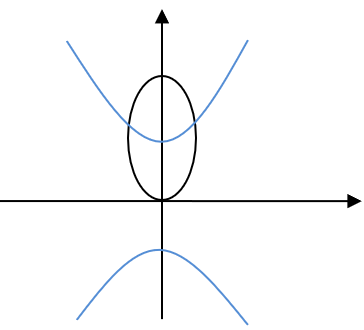
Centre of ellipse is (0, 4) and length of its major axis is 8. Thus, it passes through origin.
Hence there will be only two intersection points.
If for non-zero x, \(cf(x) + df(\dfrac{1}{x}) = |\log|x|| + 3\), where \(c \ne d\), then \(\int \limits_1^e f(x)dx =\):
Put \(x = \dfrac{1}{x}\) in the given equation and eliminate \(f(\dfrac{1}{x})\).
We get \(f(x) = \dfrac{(c-d)}{c^2-d^2}(\log|x| + 3)\)
Integrating from 1 to e: \(\dfrac{c-d}{c^2-d^2}[x\log x - x + 3x]_1^e = \dfrac{c-d}{c^2-d^2}[3e-2]\)
A critical orthopaedic surgery is performed on 3 patients. The probability of recovering a patient is 0.6. Then the probability that after surgery, exactly two of them will recover is:
The required probability = \(^3C_2(0.6)^2(0.4)^1 = 0.432\)
The value of \(\tan(\dfrac{\pi}{4} + \theta)\tan(\dfrac{3\pi}{4} + \theta)\) is:
Using the formula \(\tan(x+y) = \dfrac{\tan x + \tan y}{1 - \tan x \tan y}\)
\(= \dfrac{1 + \tan\theta}{1 - \tan\theta} \times \dfrac{-1 + \tan\theta}{1 + \tan\theta} = -1\)
If \(\sin x = \sin y\) and \(\cos x = \cos y\), then the value of \(x - y\) is:
The period of \(\sin x\) and \(\cos x\) is \(2\pi\)
Hence \(x - y = 2\pi\)
For an invertible matrix A, which of the following is not always true:
We know that \(|A(adj(A))| = |A|^{n-1}\)
This value should be non-zero, but it can be 1.
For what values of \(\lambda\) does the equation \(6x^2 - xy + \lambda y^2 = 0\) represent two perpendicular lines and two lines inclined at an angle of \(\dfrac{\pi}{4}\):
Angle between the lines is given by \(\tan\theta = \dfrac{2\sqrt{h^2 - ab}}{a + b}\)
\(\Rightarrow 1 = \dfrac{2\sqrt{\dfrac{1}{4} - 6\lambda}}{6 + \lambda}\)
Solving this equation, we get \(\lambda = -35\)
A speaks truth in 40% and B in 50% of the cases. The probability that they contradict each other while narrating some incident is:
Required probability = \(0.40(1 - 0.50) + (1 - 0.40)0.50 = 0.5\)
The two parabolas \(y^2 = 4a(x + c)\) and \(y^2 = 4bx, a > b > 0\) cannot have a common normal unless:
Equation of the normal for the parabola \( y^2=4a(x+c) \) is: \( y=m(x+c)-2am-am^3 \)
Equation of the normal for the parabola \( y^2=4bx \) is: \( y=mx-2bm-bm^3 \)
As both have a common normal, so \( m(x+c)-2am-am^3=mx-2bm-bm^3 \)
Hence \( (a-b)m^3=(2b-2a+c)m \), leaving the case when \( m=0 \)
\(\Rightarrow m^2=\dfrac{2b-2a+c}{a-b} =-2+\dfrac{c}{a-b}\)
As we know that \( m^2>0 \), so \( \dfrac{c}{a-b}>2 \)
A man starts at the origin O and walks a distance of 3 units in the north-east direction and then walks a distance of 4 units in the north-west direction to reach the point P. Then \(\overrightarrow{OP}\) is equal to:
His movement can be represented as:
\(3\left(\dfrac{\hat{i} + \hat{j}}{\sqrt{2}}\right) + 4\left(\dfrac{-\hat{i} + \hat{j}}{\sqrt{2}}\right) = \dfrac{1}{\sqrt{2}}(-\hat{i} + 7\hat{j})\)
Among the given numbers below, the smallest number which will be divided by 9, 10, 15, and 20, leaving the remainders 4, 5, 10, and 15 respectively, is:
The difference between all remainders from divisors is 5, hence answer should be:
LCM(9, 10, 15, 20)k - 5 = 180k - 5
There is only one such number 355.
The value of \(\sum_{r=1}^n \dfrac{^nP_r}{2^n \times r!}\) is:
We know that \(\dfrac{^nP_r}{r!} = ^nC_r\)
Hence the given sum = \(\dfrac{1}{2^n}(^nC_1 + ^nC_2 + ... + ^nC_n)\)
= \(\dfrac{1}{2^n}(2^n - 1) = 1 - \dfrac{1}{2^n}\)
Let A and B be two events defined on a sample space. Suppose \(A^C\) denotes the complement of A relative to the sample space. Then the probability \(P((A \cap B^C) \cup (A^C \cap B))\) equals:
The event means either only A occurs, or only B occurs.
This probability = \(P(A \cup B) - P(A \cap B) = P(A) + P(B) - 2P(A \cap B)\)
Let Z be the set of all integers and consider the sets \(X = \{(x,y): x^2 + 2y^2 = 3, x,y \in Z\}\) and \(Y = \{(x,y): x > y, x,y \in Z\}\). Then the number of elements in \(X \cap Y\) is:
The integer solutions of \(x^2 + 2y^2 = 3\) are: (1, 1), (1, -1), (-1, 1), and (-1, -1).
Only in one case \(x > y\), hence number of elements in \(X \cap Y\) will be only one.
The value of f(1) for \(f\left(\dfrac{1-x}{1+x}\right) = x + 2\) is:
Put \(x = 0\) in the function to get the value of f(1).
\(f(1) = 0 + 2 = 2\)
Given a set A with median \(m_1 = 2\) and set B with median \(m_2 = 4\), what can we say about the median of the combined set?
The median of the combined data will be at least 2.
Let \(f(x) = \begin{cases} x^2\sin\dfrac{1}{x}, & x \ne 0 \\ 0, & x = 0 \end{cases}\) Then which of the following is true:
We know that for any value of x, \(\sin x\) is finite and its values remain between -1 and 1.
f'(0) can be calculated and equals 0, hence function is differentiable at x = 0.
However, \(f'(x) = 2x\sin(\dfrac{1}{x}) - \cos(\dfrac{1}{x})\)
When \(x \to 0\), \(\cos(\dfrac{1}{x})\) does not give a definite value, hence f'(x) is not continuous at x = 0.
A coin is thrown 8 number of times. What is the probability of getting a head in an odd number of throws?
We know that the probability of getting head in an even number of times is same as that of getting an odd number of times.
Hence the probability = \(\dfrac{1}{2}\)
Consider the function \(f(x) = x^{2/3}(6-x)^{1/3}\). Which of the following statements is false?
\(f'(x) = (6-x)^{-2/3}x^{-1/3}(4-x)\)
We see that f'(x) > 0 in interval (0, 4), so it increases. Also f'(x) < 0 when x > 6, it decreases.
Also f''(x) = 0 at x = 6, hence f(x) has a point of inflection at x = 6. Third statement is false.
The value of \(\lim_{x \to 0} \dfrac{e^x - e^{-x} - 2x}{1 - \cos x}\) is equal to:
Applying L'Hospital's rule:
\(\lim_{x \to 0} \dfrac{e^x + e^{-x} - 2}{\sin x}\)
Applying L'Hospital's rule again:
\(= \lim_{x \to 0} \dfrac{e^x - e^{-x}}{\cos x} = 0\)
Consider the function \(f(x) = \begin{cases} -x^3 + 3x^2 + 1, & x \le 2 \\ \cos x, & 2 < x \le 4 \\ e^{-x}, & x > 4 \end{cases}\) Which of the following statements about \(f(x)\) is true?
To find maxima or minima, differentiate: f'(x) = -3x² + 6x = 0
Therefore x = 0, 2
At x = 2, the function is maximum with value 5. Hence it is bigger than values of cos x and e^(-x).
But the cubic function can achieve even bigger values at negative values of x, for example f(-2) = 21.
Hence at x = 2, the function achieves only local maxima.
If one AM (Arithmetic mean) a and two GM's (Geometric means) p and q be inserted between any two positive numbers, the value of \(p^3 + q^3\) is:
Let the two numbers are x, y, then x, a, y are in AP and x, p, q, y are in GP.
Hence 2a = x + y and \(\dfrac{p}{x} = \dfrac{q}{p} = \dfrac{y}{q}\)
Therefore \(x = \dfrac{p^2}{q}, y = \dfrac{q^2}{p}\)
Putting these values: \(2a = \dfrac{p^2}{q} + \dfrac{q^2}{p}\)
Or \(p^3 + q^3 = 2apq\)
The equation \(3x^2 + 10xy + 11y^2 + 14x + 12y + 5 = 0\) represents:
We see that \(h = 5, a = 3, b = 11, g = 7, f = 6, c = 5\)
\(abc + 2fgh - af^2 - bg^2 - ch^2 \ne 0\)
And \(h^2 < ab\), hence it is an ellipse.
Which of the following is false about the points \((1, \dfrac{1}{2})\) and \((3, -\dfrac{1}{2})\):
Put the points in the given lines and check the signs. If signs are same, points are on same side, otherwise on different sides.
At point (1, 1/2), the first line is negative, but the second line is positive.
At point (3, -1/2), the first line is negative, but the second line is positive.
Only choice (4) is wrong. The first three choices are correct.
How much work does it take to slide a crate for a distance of 25 m along a loading dock by pulling on it with a 180N force where the dock is at an angle of 45° from the horizontal?
The work done is \(\overline{F} \cdot \overline{d} = |F||d|\cos\theta\)
= \(180 \times 25 \times \cos 45° = 3181.98 J\)
The vector \(\vec{A} = (2x + 1)\hat{i} + (x^2 - 6y)\hat{j} + (xy^2 + 3z)\hat{k}\) is a:
The divergence of the vector \(\bar{A}\) is given by:
\(div(\bar{A}) = \dfrac{\partial A_x}{\partial x} + \dfrac{\partial A_y}{\partial y} + \dfrac{\partial A_z}{\partial z}\)
Here \(A_x = 2x + 1, A_y = x^2 - 6y, A_z = xy^2 + 3z\)
Hence \(div(\bar{A}) = 2 - 6 + 3 = -1\)
Since \(div(\bar{A}) < 0\), the vector field is a sink field.
Region R is defined as a region in the first quadrant satisfying the condition \(x^2 + y^2 < 4\). Given that a point P = (r,s) lies in R, what is the probability that r > s?
We know that \(x^2 + y^2 = 4\) is a circle and its one fourth part lies in the first quadrant.
In point P = (r,s), r and s are x and y coordinates, and we need to find the probability that x > y.
The favorable area is half of the quarter circle.

Hence required probability = \(\dfrac{1}{2}\)
Lines \(L_1, L_2, \ldots, L_{10}\) are distinct among which the lines \(L_2, L_4, L_6, L_8, L_{10}\) are parallel to each other and the lines \(L_1, L_3, L_5, L_7, L_9\) pass through a given point C. The number of points of intersection of pairs of lines from the complete set \(L_1, L_2, L_3, \ldots, L_{10}\) is:
Total number of intersection points (in normal case) = \(^{10}C_2\)
But five lines \(L_2, L_4, L_6, L_8, L_{10}\) are parallel, hence these lines do not intersect.
Also five lines \(L_1, L_3, L_5, L_7, L_9\) intersect at same point, hence create only one intersecting point.
Number of intersecting points = \(^{10}C_2 - ^5C_2 - ^5C_2 + 1 = 26\)
If the line \(a^2x + ay + 1 = 0\), for some real number a, is normal to the curve xy = 1, then:
Let any point on curve xy = 1 be \((t, \dfrac{1}{t})\).
To calculate slope of tangent, differentiate: \(xy' + y = 0\) so \(y' = -\dfrac{y}{x}\)
Slope of tangent = \(-\dfrac{1/t}{t} = -\dfrac{1}{t^2}\)
Slope of normal = \(t^2\)
As \(t^2 > 0\), slope of normal should be positive.
Therefore \(-\dfrac{a^2}{a} > 0\) or \(a < 0\)
Out of a group of 50 students taking examinations in Mathematics, Physics, and Chemistry, 37 students passed Mathematics, 24 passed Physics, and 43 passed Chemistry. Additionally, no more than 19 students passed both Mathematics and Physics, no more than 29 passed both Mathematics and Chemistry, and no more than 20 passed both Physics and Chemistry. What is the maximum number of students who could have passed all three examinations?
Let the number of students passed in Mathematics, Physics and Chemistry be denoted by M, P and C.
Using inclusion-exclusion principle:
\(50 = M + P + C - (M \cap P + P \cap C + M \cap C)\)
\(+ M \cap P \cap C\)
\(\Rightarrow M \cap P \cap C = 50 + 19 + 29 + 20 - 37 - 24 - 43 = 14\)
Let \(f:\mathbb{R} \to \mathbb{R}\) be a function such that \(f(0) = \dfrac{1}{\pi}\) and \(f(x) = \dfrac{x}{e^{\pi x} - 1}\) for \(x \ne 0\), then:
Check limit at x = 0: \(\lim_{x \to 0} \dfrac{x}{e^{\pi x} - 1} = \dfrac{1}{\pi}\)
Hence function is continuous at x = 0.
Check derivative: \(f'(0^+) = \lim_{h \to 0} \dfrac{f(h) - f(0)}{h}\)
After calculation: \(f'(0^+) = -\dfrac{1}{2}\) and \(f'(0^-) = \dfrac{1}{2}\)
Function is continuous but not differentiable at x = 0. Correct answer is (4).
If \(f(x) = \cos[\pi^2]x + \cos[-\pi^2]x\), where [.] stands for the greatest integer function, then \(f(\dfrac{\pi}{2})\) is:
Since \(\pi^2 \approx 9.8\), hence \([\pi^2] = 9\) and \([-\pi^2] = -10\)
The given question becomes: \(\cos 9x + \cos(-10x) = \cos 9x + \cos 10x\)
\(f(\dfrac{\pi}{2}) = \cos\dfrac{9\pi}{2} + \cos\dfrac{10\pi}{2} = 0 + (-1) = -1\)
If three distinct numbers are chosen randomly from the first 100 natural numbers, then the probability that all three of them are divisible by both 2 and 3 is:
All three numbers should be multiples of 6. There are 16 multiples of 6 in first 100 natural numbers.
Required probability = \(\dfrac{^{16}C_3}{^{100}C_3} = \dfrac{16 \times 15 \times 14}{100 \times 99 \times 98} = \dfrac{4}{1155}\)
It is given that the mean, median, and mode of a data set is \(1, 3^x\) and \(9^x\) respectively. The possible values of the mode is:
We know that 3(median) - Mode = 2(Mean)
\(\Rightarrow 3 \times 3^x - 9^x = 2 \times 1\)
\(\Rightarrow y^2 - 3y + 2 = 0\), where \(y = 3^x\)
\(\Rightarrow y = 1, 2\)
Hence possible value of mode = 1, 4
The value of the series \(\dfrac{2}{3!} + \dfrac{4}{5!} + \dfrac{6}{7!} + \cdots\) is:
nth term is given by: \(\dfrac{2n}{(2n+1)!} = \dfrac{2n+1-1}{(2n+1)!} = \dfrac{1}{2n!} - \dfrac{1}{(2n+1)!}\)
Sum = \(\left(\dfrac{e + e^{-1}}{2} - 1\right) - \left(\dfrac{e - e^{-1}}{2} - 1\right) = e^{-1}\)