
NIMCET 2018 Question Paper and Solutions
NIMCET Previous Year Papers!
The NIMCET 2018 Question Paper with detailed solutions is provided here for complete exam analysis and effective practice. The overall difficulty level of NIMCET 2018 was moderate to difficult, with Mathematics being relatively challenging. Questions covered all major syllabus areas, with noticeable weightage from Trigonometry, Vectors, Algebra (9 questions), Permutations–Combinations and Probability (7 questions combined). Solving the NIMCET 2018 paper will help you to understand the exam pattern, topic-wise distribution, and section-wise difficulty level.
NIMCET 2018 QUESTION PAPER AND SOLUTION
► Topic-Wise Question Distribution
| Topic (Click to Filter) | Number of Questions |
|---|---|
| MATRICES | 2 |
| TRIGONOMETRY | 8 |
| VECTORS | 4 |
| COORDINATE GEOMETRY | 7 |
| STATISTICS | 1 |
| PROBABILITY | 4 |
| PERMUTATIONS-COMBINATIONS | 3 |
| ALGEBRA | 8 |
| INTEGRATION | 4 |
| DIFFERENTIATION | 6 |
► Difficulty-Wise Question Distribution
The point of intersection of circle \(x^2 + y^2 + 10x - 12y + 51 = 0\) and the line \(3y + x = 3\) is:
Given line: \(x = 3 - 3y\). Substitute the value of \(x\) into the equation of the circle:
\((3 - 3y)^2 + y^2 + 10(3 - 3y) - 12y + 51 = 0\)
\(9 - 18y + 9y^2 + y^2 + 30 - 30y - 12y + 51 = 0\)
\(\Rightarrow y^2 - 6y + 9 = 0\)
\((y - 3)^2 = 0 \Rightarrow y = 3\) and \(x=-6\)
Therefore, point of intersection is \((-6, 3)\)
The number of solutions of the equation \(\sin x + \sin 5x = \sin 3x\) lying in the interval \([0,\pi]\) is:
Using \(\sin C+\sin D\) identity: \(\sin x + \sin 5x = 2\sin 3x \cos 2x\)
So equation becomes: \(2\sin 3x \cos 2x = \sin 3x\)
\(\sin 3x (2\cos 2x - 1) = 0\)
Case 1: \(\sin 3x = 0 \Rightarrow 3x = n\pi \Rightarrow x = \dfrac{n\pi}{3}\)
In \([0,\pi]\): \(x = 0, \dfrac{\pi}{3}, \dfrac{2\pi}{3}, \pi\): 4 solutions
Case 2: \(\cos 2x = \dfrac{1}{2} \Rightarrow 2x = 2n\pi \pm \dfrac{\pi}{3}\)
\(x = n\pi \pm \dfrac{\pi}{6}\)
In \([0,\pi]\): \(x = \dfrac{\pi}{6}\) (for \(n=0\)), \(x = \dfrac{5\pi}{6}\) (for \(n=1\)): 2 solutions
As none of the solutions is common, so there are 6 solutions.
In an acute angle \(\triangle ABC\) the least value of \(\sec A + \sec B + \sec C\) is:
For an acute triangle, the minimum value of \(\sec A + \sec B + \sec C\) occurs when the triangle is equilateral.
When \(A = B = C = 60°\):
Therefore, \(\sec A + \sec B + \sec C = 2 + 2 + 2 = 6\)
Thus, the least value is 6.
Let \(P = \{\theta : \sin \theta - \cos \theta = \sqrt{2}\cos \theta\}\) and \(Q = \{\theta : \sin \theta + \cos \theta = \sqrt{2}\sin \theta\}\) be two sets. Then:
For set P: \(\sin \theta - \cos \theta = \sqrt{2}\cos \theta\)
\(\sin \theta = \cos \theta + \sqrt{2}\cos \theta = \cos \theta(1 + \sqrt{2})\)
\(\tan \theta = 1 + \sqrt{2}\)
For set Q: \(\sin \theta + \cos \theta = \sqrt{2}\sin \theta\)
\(\cos \theta = \sqrt{2}\sin \theta - \sin \theta = \sin \theta(\sqrt{2} - 1)\)
\(\cot \theta = \sqrt{2} - 1\)
\(\tan \theta = \dfrac{1}{\sqrt{2} - 1} = \dfrac{1(\sqrt{2} + 1)}{(\sqrt{2} - 1)(\sqrt{2} + 1)} = \sqrt{2} + 1\)
Both sets satisfy \(\tan \theta = \sqrt{2} + 1\)
Therefore \(P = Q\)
If \(\tan x = \dfrac{\tan y}{2} = \dfrac{\tan z}{5}\) and \(x + y + z = \pi\), then the value of \(\tan^2 x + \tan^2 y + \tan^2 z\) is:
Let \(\tan x = 2k\). Then \(\tan y = 3k\), \(\tan z = 5k\)
Since \(x + y + z = \pi\), we have \(\tan x +\tan y+ \tan z = \tan x \tan y \tan z\)
\(\Rightarrow 2k +3k +5k=(2k)(3k)(5k) \) or \(k^2=\dfrac{1}{3}\)
Then \(\tan^2 x + \tan^2 y + \tan^2 z = 4k^2 + 9k^2 + 25k^2 = 38k^2\)
\(= 38 \times \dfrac{1}{3} = \dfrac{38}{3}\)
The circles whose equations are \(x^2 + y^2 + c^2 = 2ax\) and \(x^2 + y^2 + c^2 - 2by = 0\) will touch one another externally if:
The centre and the radius of the first circle are: \(C_1(a,0)\),\(r_1 = \sqrt{a^2 - c^2}\)
For the second circle, centre and the radius are: \(C_2(0,b)\), radius \(r_2 = \sqrt{b^2 - c^2}\)
Distance between centres: \(d = \sqrt{a^2 + b^2}\)
To touch externally, \(d = r_1 + r_2\)
\(\sqrt{a^2 + b^2} = \sqrt{a^2 - c^2} + \sqrt{b^2 - c^2}\)
Squaring both sides:
\(a^2 + b^2 = a^2 - c^2 + b^2 - c^2 + 2\sqrt{(a^2 - c^2)(b^2 - c^2)}\)
\(c^2 = \sqrt{(a^2 - c^2)(b^2 - c^2)}\)
Squaring again: \(c^4 = (a^2 - c^2)(b^2 - c^2)\)
\(c^4 = a^2 b^2 - a^2 c^2 - b^2 c^2 + c^4\)
\(0 = a^2 b^2 - a^2 c^2 - b^2 c^2\)
Dividing by \(a^2 b^2 c^2\): \(\dfrac{1}{c^2} = \dfrac{1}{b^2} + \dfrac{1}{a^2}\)
The locus of the orthocenter of the triangle formed by the lines \((1 + p)x - py + p(1 + p) = 0\), \((1 + q)x - qy + q(1 + q) = 0\) and \(y = 0\) where \(p \ne q\) is:
The given lines are:
\(\ell_1: (1+p)x - py + p(1+p) = 0\), let this line cuts \(x\) axis at \(A\), then \(A = (-p,0)\)
Slope of this line is \(\dfrac{1+p}{p}\)
\(\ell_2: (1+q)x - qy + q(1+q) = 0\), let this line cuts \(x\) axis at \(B\), then \(B = (-q,0)\)
Slope of this line is \(\dfrac{1+q}{q}\)
\(\ell_3: y = 0\) (x-axis)
Equation of the line that is perpendicular to the line \(\ell_2\) and passing through \(A\) is:
\(y-0=\dfrac{-q}{1+q}(x+p)\) or \(y(1+q)+qx+qp=0\)
Equation of the line that is perpendicular to the line \(\ell_1\) and passing through \(B\) is:
\(y-0=\dfrac{-p}{1+p}(x+q)\) or \(y(1+p)+px+qp=0\)
Subtracting the second equation from the first, we get,
\(y(q-p)+x(q-p)=0\) or \(y=-x\), this is an equation of a straight line.
Equation of a common tangent with positive slope to the circle \(x^2 + y^2 - 8x = 0\) as well as to the hyperbola \(\dfrac{x^2}{9} - \dfrac{y^2}{4} = 1\) is:
Circle: \(x^2 + y^2 - 8x = 0 \Rightarrow (x-4)^2 + y^2 = 16\)
Centre \((4,0)\), radius 4
Hyperbola: \(\dfrac{x^2}{9} - \dfrac{y^2}{4} = 1\)
Let tangent be \(y = mx + c\) with \(m > 0\)
For circle: \(\dfrac{|4m + c|}{\sqrt{m^2 + 1}} = 4 \Rightarrow (4m + c)^2 = 16(m^2 + 1)\) ... (1)
For hyperbola: \(c^2 = 9m^2 - 4\) ... (2)
From (2): \(c = \sqrt{9m^2 - 4}\) (positive case)
Substituting in (1) and solving: \(495m^4 + 104m^2 - 400 = 0\)
Solving: \(m^2 = \dfrac{4}{5} \Rightarrow m = \dfrac{2}{\sqrt{5}}\)
Then \(c = \sqrt{9 \times \dfrac{4}{5} - 4} = \sqrt{\dfrac{16}{5}} = \dfrac{4}{\sqrt{5}}\)
Tangent: \(y = \dfrac{2}{\sqrt{5}}x + \dfrac{4}{\sqrt{5}}\)
Multiply by \(\sqrt{5}\): \(\sqrt{5}y = 2x + 4\)
Therefore: \(2x - \sqrt{5}y + 4 = 0\)
The area enclosed between the curves \(y^2 = x\) and \(y = |x|\) is:
Curve \(y^2 = x\) is a rightward opening parabola
For \(x \ge 0\): \(y = |x| = x\)
Intersection: \(x^2 = x \Rightarrow x(x-1) = 0 \Rightarrow x = 0, 1\), so the intersection points are \((0,0)\) and \((1,1)\)
Area in first quadrant = \(\int \limits_0^1 (\sqrt{x} - x)\, dx\)
\(= \left[\dfrac{2x^{3/2}}{3} - \dfrac{x^2}{2}\right]_0^1 = \dfrac{2}{3} - \dfrac{1}{2} = \dfrac{1}{6}\)
Therefore, area = \(\dfrac{1}{6}\) sq. unit
Equation of the line perpendicular to \(x - 2y = 1\) and passing through \((1, 1)\) is:
Given line: \(x - 2y = 1 \Rightarrow y = \dfrac{x}{2} - \dfrac{1}{2}\)
Slope \(m = \dfrac{1}{2}\)
Perpendicular slope = \(-2\) (since product of slopes = -1)
Line through \((1,1)\) with slope -2:
\(y - 1 = -2(x - 1)\)
\(y - 1 = -2x + 2\)
\(y = -2x + 3\)
If \(A = \begin{bmatrix} 0 & 5 \\ 0 & 0 \end{bmatrix}\) and \(f(x) = 1 + x + x^{2} + \ldots + x^{16}\), then \(f(A) =\)
Given \(A = \begin{bmatrix} 0 & 5 \\ 0 & 0 \end{bmatrix}\).
First, calculate \(A^2 = \begin{bmatrix} 0 & 5 \\ 0 & 0 \end{bmatrix} \begin{bmatrix} 0 & 5 \\ 0 & 0 \end{bmatrix} = \begin{bmatrix} 0 & 0 \\ 0 & 0 \end{bmatrix}\).
So \(A^n = 0\) for all \(n \geq 2\).
Then \(f(A) = I + A + A^2 + \ldots + A^{16} = I + A\).
\(I + A = \begin{bmatrix} 1 & 0 \\ 0 & 1 \end{bmatrix} + \begin{bmatrix} 0 & 5 \\ 0 & 0 \end{bmatrix} = \begin{bmatrix} 1 & 5 \\ 0 & 1 \end{bmatrix}\).
9 balls are to be placed in 9 boxes and 5 of the balls cannot fit into 3 small boxes. The number of ways of arranging one ball in each of the boxes is
There are 9 boxes. 3 boxes are small. 5 specific balls cannot fit into these 3 small boxes. So these 5 balls must go into the remaining 6 boxes.
First, arrange the 5 restricted balls into the 6 boxes: number of ways = \(P(6,5) = 6 \times 5 \times 4 \times 3 \times 2 = 720\).
After placing these 5 balls, we have 4 balls left (the unrestricted ones) and 4 boxes left (since 5 boxes are already filled). These can be arranged in \(4! = 24\) ways.
Total ways = \(720 \times 24 = 17280\).
Which of the following functions is inverse of itself?
A function is inverse of itself if \(f(f(x)) = x\) for all \(x\) in domain. We can check the options and find the correct one
For option (a):\(f(f(x)) = f\left(\dfrac{1-x}{1+x}\right) = \dfrac{1 - \dfrac{1-x}{1+x}}{1 + \dfrac{1-x}{1+x}}\)
\(= \dfrac{\dfrac{1+x - (1-x)}{1+x}}{\dfrac{1+x + 1-x}{1+x}} = \dfrac{\dfrac{2x}{1+x}}{\dfrac{2}{1+x}} = x\).
So it is self-inverse. Rest of the functions are not self-inverse. So (a) is the correct choice.
A student council has 10 members. From this one President, one Vice-President, one Secretary, one Joint-Secretary and two Executive Committee members have to be elected. In how many ways this can be done?
We need to select and assign positions.
Choose the President: 10 ways.
Then Vice-President from remaining 9: 9 ways.
Secretary from remaining 8: 8 ways.
Joint-Secretary from remaining 7: 7 ways.
Now we have 6 members left, from which we need to choose 2 Executive Committee members. Since these two positions are identical, number of ways = \(^6\text{C}_2 = 15\).
Total ways = \(10 \times 9 \times 8 \times 7 \times 15 = 75600\).
In a survey where 100 students reported which subjects they like, 32 students in total liked Mathematics, 38 students liked Business and 30 students liked Literature. Moreover 7 students liked both Mathematics and Literature, 10 students liked both Mathematics and Business, 8 students liked both Business and Literature, 5 students liked all three subjects. Then the number of people who liked exactly one subject is
Here are the three sets representing the Venn diagrams for Mathematics, Business and Literature. Number of students who like all three subjects is 5.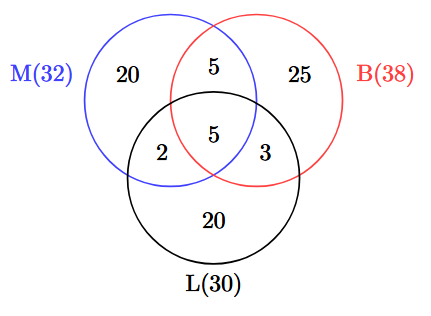
It is clear from the diagram that the number of students who like exactly one subjects is \(20+25+20=65\)
The number of natural numbers which are smaller than \(2 \times 10^{8}\) and which contain only the digits 1 and 2 is
Numbers containing only digits \(1\) and \(2\).
Numbers less than \(2 \times 10^8 = 200,000,000\) include:
One-digit numbers which contain only the digits 1 and 2 \(2^1\)
Two-digit numbers which contain only the digits 1 and 2 \(2^2\) and so on up to 8 digit numbers. It also include 9-digit numbers which start with 1 only.
Nine-digit numbers \(=1\times 2^8\)
The total numbers are \(2^1+2^2+2^3+...+2^8+2^8=766\)
If \(\displaystyle \lim_{x\to \infty}\left(1 + \dfrac{a}{x} + \dfrac{b}{x^{2}}\right)^{2x} = e^{2}\), then the value of a and b are
We know that \(\displaystyle \lim_{x\to a} \left(f(x)\right)^{g(x)}\), where \(f(a)\to 1\) and \(g(a) \to \infty\) is:
\(\displaystyle \lim_{x\to a} e^{g(x)[f(x)-1]}\)
Hence the value of \(\displaystyle \lim_{x\to \infty} \left(1 + \dfrac{a}{x} + \dfrac{b}{x^{2}}\right)^{2x}\) is \(\displaystyle \lim_{x\to \infty}e^{2x[\frac{a}{x}+\frac{b}{x^2}]}\)
\(\displaystyle \lim_{x\to \infty} e^{2a+\frac{2b}{x}}=e^{2a}\)
Given that the value of the limit is \(e^2\), hence \(a=1\) and \(b\) can take any value.
If \(f(x) = \sin^{5}x + \sin^{3}x\) and \(g(x) = \cos^{6}x + \sin^{3}x\), then the value of \(\int \limits_{0}^{\frac{\pi}{2}}[f(x) + f(-x)][g(x) + g(-x)]dx\)
Note that \(f(-x) = \sin^{5}(-x) + \sin^{3}(-x) = -\sin^{5}x - \sin^{3}x = -f(x)\).
So \(f(x) + f(-x) = 0\).
Hence the integrand \([f(x) + f(-x)][g(x) + g(-x)]\) is identically zero.
Therefore the integral is zero.
\(\dfrac{d^{2}x}{dy^{2}}\) equals
We know \(\dfrac{dx}{dy} = \dfrac{1}{\dfrac{dy}{dx}}\).
Then \(\dfrac{d^{2}x}{dy^{2}} = \dfrac{d}{dy}\left(\dfrac{dx}{dy}\right) = \dfrac{d}{dx}\left(\dfrac{dx}{dy}\right) \cdot \dfrac{dx}{dy}\)
\(= \dfrac{d}{dx}\left(\dfrac{1}{y'}\right) \cdot \dfrac{1}{y'}\) where \(y' = \dfrac{dy}{dx}\).
\(\dfrac{d}{dx}\left(\dfrac{1}{y'}\right) = -\dfrac{y''}{(y')^{2}}\). So
\(\dfrac{d^{2}x}{dy^{2}} = -\dfrac{y''}{(y')^{2}} \cdot \dfrac{1}{y'} = -\dfrac{y''}{(y')^{3}}\).
Thus \(\dfrac{d^{2}x}{dy^{2}} = -\left(\dfrac{d^{2}y}{dx^{2}}\right) \left(\dfrac{dy}{dx}\right)^{-3}\).
Differential co-efficient of \(\log_{10}x\) with respect to \(\log_{x}10\) is
Let \(u = \log_{10}x = \dfrac{\ln x}{\ln 10}\) and \(v = \log_{x}10 = \dfrac{\ln 10}{\ln x}\).
Then \(\dfrac{du}{dx} = \dfrac{1}{x \ln 10}\) and \(\dfrac{dv}{dx} = -\dfrac{\ln 10}{x (\ln x)^{2}}\).
We need \(\dfrac{du}{dv} = \dfrac{du/dx}{dv/dx} = \dfrac{\frac{1}{x \ln 10}}{-\frac{\ln 10}{x (\ln x)^{2}}}\)
\(= -\dfrac{1}{x \ln 10} \cdot \dfrac{x (\ln x)^{2}}{\ln 10} = -\dfrac{(\ln x)^{2}}{(\ln 10)^{2}}\).
Since \(\ln x = \log_{e} x\), hence choice (a) is correct.
\(f(x) = x + |x|\) is continuous for:
For \(x \ge 0\): \(f(x) = x + x = 2x\)
For \(x < 0\): \(f(x) = x + (-x) = 0\)
At \(x = 0\):
Left-hand limit: \(\displaystyle \lim_{x\to 0^-} f(x) = 0\)
Right-hand limit: \(\displaystyle \lim_{x\to 0^+} f(x) = 0\)
\(f(0) = 0 + |0| = 0\)
Since left-hand limit = right-hand limit = \(f(0)\), the function is continuous at \(x = 0\), therefore, \(f\) is continuous for all \(x \in (-\infty, \infty)\)
If \(a, b\) and \(c\) are unit vectors, then \(|a - b|^2 + |b - c|^2 + |c - a|^2\) does not exceed:
\(|a - b|^2 = |a|^2 + |b|^2 - 2a\cdot b = 2 - 2a\cdot b\) (since \(|a| = |b| = 1\))
Similarly: \(|b - c|^2 = 2 - 2b\cdot c\) and \(|c - a|^2 = 2 - 2c\cdot a\)
Sum = \(6 - 2(a\cdot b + b\cdot c + c\cdot a)\)...(1)
Let \(S = a\cdot b + b\cdot c + c\cdot a\)
We know \((a + b + c)^2 = |a|^2 + |b|^2 + |c|^2 + 2(a\cdot b + b\cdot c + c\cdot a) = 3 + 2S\)
Since \((a + b + c)^2 \ge 0\): \(3 + 2S \ge 0 \Rightarrow S \ge -\dfrac{3}{2}\)
Putting the value of \(S\) in equation (1), maximum value of the sum = \(6 - 2S = 6 - 2(-\dfrac{3}{2}) = 6 + 3 = 9\)
The vector \(\vec{a}=\alpha\hat{i} + 2\hat{j} + \beta\hat{k}\) lies in the plane of the vectors \(\vec{b}=\hat{i} + \hat{j}\) and \(\vec{c}=\hat{j} + \hat{k}\) and bisects the angle between \(\vec{b}\) and \(\vec{c}\). Then, which one of the following gives possible values of \(\alpha\) and \(\beta\)?
For angle bisector: \(\vec{a}\) is proportional to \(\dfrac{\vec{b}}{|\vec{b}|} + \dfrac{\vec{c}}{|\vec{c}|}\)
\(|\vec{b}| = \sqrt{2}\), \(|\vec{c}| = \sqrt{2}\)
\(\dfrac{\vec{b}}{\sqrt{2}} + \dfrac{\vec{c}}{\sqrt{2}} = \dfrac{1}{\sqrt{2}}[(\hat{i} + \hat{j}) + (\hat{j} + \hat{k})] = \dfrac{1}{\sqrt{2}}(\hat{i} + 2\hat{j} + \hat{k})\)
So \(\vec{a}\) should be proportional to \(\hat{i} + 2\hat{j} + \hat{k}\)
Therefore \(\alpha = 1, \beta = 1\)
Forces \(4\hat{i} - 3\hat{j} + 7\hat{k}\) and \(-2\hat{i} + 2\hat{j} - 8\hat{k}\) are acting on a particle and displace it from the point \((5, 7, 1)\) to \((2, 5, -6)\), then the work done by the force is:
Net force: \(\vec{F} = (4\hat{i} - 3\hat{j} + 7\hat{k}) + (-2\hat{i} + 2\hat{j} - 8\hat{k}) = 2\hat{i} - \hat{j} - \hat{k}\)
Displacement vector: \(\vec{d} = (2-5)\hat{i} + (5-7)\hat{j} + (-6-1)\hat{k} = -3\hat{i} - 2\hat{j} - 7\hat{k}\)
Work done = \(\vec{F} \cdot \vec{d} = (2)(-3) + (-1)(-2) + (-1)(-7)\)
\(= -6 + 2 + 7 = 3\)
A bird is flying in a straight line with velocity vector \(10\vec{i} + 6\vec{j} + \vec{k}\), measured in km/hr. If starting point is \((1, 2, 3)\), how much time does it take to reach a point in space that is 13 metre high from ground?
Initial position: \((1, 2, 3)\) and the final height of the bird is 13 m, so the displacement of the bird along \(z\) axis is 10 m.
Velocity of the bird \(=10\vec{i} + 6\vec{j} + \vec{k}\) km/hr, that means the velocity in \(z\) direction is \(v_z = 1\) km/hr \(=\dfrac{5}{18}\) m/s
Time taken to cover a distance of 10 m in the \(z\) direction \(=\dfrac{10}{\frac{5}{18}}=36\) seconds.
If A and B are two events and \(P(A\cup B)=\dfrac{5}{6}\), \(P(A\cap B)=\dfrac{1}{3}\), \(P(B)=\dfrac{1}{2}\), then A and B are two events which are:
We have \(P(A\cup B) = P(A) + P(B) - P(A\cap B)\)
\(\dfrac{5}{6} = P(A) + \dfrac{1}{2} - \dfrac{1}{3}\)
\(\dfrac{5}{6} = P(A) + \dfrac{3}{6} - \dfrac{2}{6} = P(A) + \dfrac{1}{6}\)
\(P(A) = \dfrac{5}{6} - \dfrac{1}{6} = \dfrac{4}{6} = \dfrac{2}{3}\)
Check independence: \(P(A)P(B) = \dfrac{2}{3} \times \dfrac{1}{2} = \dfrac{1}{3}\)
Since \(P(A \cap B) = \dfrac{1}{3} = P(A)P(B)\), events \(A\) and \(B\) are independent.
If \(\alpha_1,\alpha_2,\alpha_3,\dots,\alpha_n\) are positive real numbers whose product is a fixed number \(C\), then the minimum value of \(\alpha_1 + \alpha_2 + \ldots +2\alpha_n\) is:
By AM-GM inequality:
\(\dfrac{\alpha_1 + \alpha_2 + \ldots + 2\alpha_n}{n} \ge (\alpha_1\alpha_2\ldots 2\alpha_n)^{1/n} = (2C)^{1/n}\)
Therefore: \(\alpha_1 + \alpha_2 + \ldots + 2\alpha_n \ge n(2C)^{1/n}\)
If \(a, b, c\) are the roots of the equation \(x^3 - 3x^2 + 3x + 7=0\), then the value of \((a+1)(b+1)(c+1)\) is:
For the cubic \(x^3 - 3x^2 + 3x + 7 = 0\):
Sum of roots: \(a + b + c = 3\)
Sum of pairwise products: \(ab + bc + ca = 3\)
Product of roots: \(abc = -7\)
Now expand \((a+1)(b+1)(c+1)\):
\(= abc + ab + bc + ca + a + b + c + 1\)
\(= (-7) + 3 + 3 + 1=0\)
The coefficient of \(x^n\) in the expansion of \((1 - 2x + 3x^2 - 4x^3 + \ldots \text{ to } \infty)^{-n}\) is:
We know that \(1+2x+3x^2+4x^3+......+\infty=\dfrac{1}{(1-x)^2} \), therefore \(1 - 2x + 3x^2 - 4x^3 + \ldots = (1 + x)^{-2}\) for \(|x| < 1\)
So the expression becomes:
\([(1+x)^{-2}]^{-n} = (1+x)^{2n}\)
Coefficient of \(x^n\) in \((1+x)^{2n}\) is:
\(^{2n}\text{C}_n = \dfrac{(2n)!}{n! \cdot n!} = \dfrac{(2n)!}{(n!)^2}\)
Let \(\alpha,\beta\) be the roots of the equation \(x^2 - px + r=0\) and \(\dfrac{\alpha}{2},\; 2\beta\) be the roots of the equation \(x^2 - qx + r=0\). Then, the value of \(r\) is:
From first equation: \(\alpha + \beta = p\), \(\alpha\beta = r\)
From second equation: \(\dfrac{\alpha}{2} + 2\beta = q\) and \(\dfrac{\alpha}{2} \times 2\beta = \alpha\beta = r\)
From \(\dfrac{\alpha}{2} + 2\beta = q\), multiply by 2: \(\alpha + 4\beta = 2q\)
We have \(\alpha + \beta = p\)
Subtracting: \((\alpha + 4\beta) - (\alpha + \beta) = 2q - p\)
\(3\beta = 2q - p \Rightarrow \beta = \dfrac{2q - p}{3}\)
Then \(\alpha = p - \beta = p - \dfrac{2q - p}{3} = \dfrac{3p - 2q + p}{3} = \dfrac{4p - 2q}{3} = \dfrac{2(2p - q)}{3}\)
Now \(r = \alpha\beta = \dfrac{2(2p - q)}{3} \times \dfrac{2q - p}{3} = \dfrac{2(2p - q)(2q - p)}{9}\)
The value of \(\cot \left(\text{cosec}^{-1}\dfrac{5}{3} + \tan^{-1}\dfrac{2}{3}\right)\) is:
Let \(\theta = \text{cosec}^{-1}\dfrac{5}{3}\), then \(\text{cosec}\theta = \dfrac{5}{3} \Rightarrow \sin\theta = \dfrac{3}{5}\)
Since \(\theta\) is in principal range: \(\cos\theta = \dfrac{4}{5}\)
So \(\cot\theta = \dfrac{\cos\theta}{\sin\theta} = \dfrac{4/5}{3/5} = \dfrac{4}{3}\) or \(\tan\theta = \dfrac{3}{4}\)
Let \(\phi = \tan^{-1}\dfrac{2}{3}\). Then \(\tan\phi = \dfrac{2}{3}\)
We need \(\cot(\theta + \phi) = \dfrac{1}{\tan(\theta + \phi)}\)
\(\tan(\theta + \phi) = \dfrac{\tan\theta + \tan\phi}{1 - \tan\theta \tan\phi} = \dfrac{\frac{3}{4} + \frac{2}{3}}{1 - \frac{3}{4} \cdot \frac{2}{3}}\)
\(= \dfrac{\frac{9 + 8}{12}}{1 - \frac{1}{2}} = \dfrac{17}{6}\)
Therefore \(\cot(\theta + \phi) = \dfrac{6}{17}\)
If \(\sin \theta = 3\sin (\theta + 2\alpha)\), then the value of \(\tan (\theta + \alpha) + 2\tan \alpha\) is:
Rewrite the equation as
\(\sin(\theta + \alpha - \alpha) = 3\sin(\theta + \alpha + \alpha)\)
\(\sin(\theta + \alpha)\cos\alpha - \cos(\theta + \alpha)\sin\alpha = 3[\sin(\theta + \alpha)\cos\alpha + \cos(\theta + \alpha)\sin\alpha]\)
\(\Rightarrow \sin(\theta + \alpha)\cos\alpha - \cos(\theta + \alpha)\sin\alpha\)
\(= 3\sin(\theta + \alpha)\cos\alpha + 3\cos(\theta + \alpha)\sin\alpha\)
\(\Rightarrow \sin(\theta + \alpha)\cos\alpha + 2\cos(\theta + \alpha)\sin\alpha = 0\)
Divide both sides by \(\cos(\theta + \alpha)\cos\alpha\)
\(\dfrac{\sin(\theta + \alpha)\cos\alpha}{\cos(\theta + \alpha)\cos\alpha} + \dfrac{2\cos(\theta + \alpha)\sin\alpha}{\cos(\theta + \alpha)\cos\alpha} = 0\)
\(\Rightarrow \tan(\theta + \alpha) + 2\tan\alpha = 0\)
In a triangle \(ABC, \angle A = 90°\) and \(D\) is mid-point of \(AC\). The value of \(BC^2 - BD^2\) is equal to:
Let \(AB = c\), \(AC = b\), \(BC = a\)
Since \(\angle A = 90°\): \(a^2 = b^2 + c^2\) (Pythagorean theorem)
D is midpoint of AC, so \(AD = \dfrac{b}{2}\) and \(DC = \dfrac{b}{2}\)
In right triangle ABD:
\(BD^2 = AB^2 + AD^2 = c^2 + \left(\dfrac{b}{2}\right)^2 = c^2 + \dfrac{b^2}{4}\)
Then \(BC^2 - BD^2 = a^2 - \left(c^2 + \dfrac{b^2}{4}\right)\)
\(= (b^2 + c^2) - c^2 - \dfrac{b^2}{4} = b^2 - \dfrac{b^2}{4} = \dfrac{3b^2}{4}\)
Since \(AD^2 = \left(\dfrac{b}{2}\right)^2 = \dfrac{b^2}{4}\):
\(BC^2 - BD^2 = 3 \times \dfrac{b^2}{4} = 3AD^2\)
Through any point \((x,y)\) of a curve which passes through the origin, lines are drawn parallel to the coordinate axes. The curve given that divides the rectangle formed by the two lines and the axes into two areas, one of which is twice the other, represents a family of:
Let the curve be \(y = f(x)\). At point \((x,y)\), the rectangle formed has area \(xy\).
Area under curve: \(\int \limits_0^x y\, dx\)
Remaining area: \(xy - \int \limits_0^x y\, dx\)
Case 1: \(\int \limits_0^x y\, dx = \dfrac{2}{3}xy\)
Differentiating with respect to x: \(y = \dfrac{2}{3}(y + xy')\)
\(3y = 2y + 2xy' \Rightarrow y = 2xy'\)
\(\dfrac{dy}{y} = \dfrac{dx}{2x} \Rightarrow \ln y = \dfrac{1}{2}\ln x + c\)
\(y^2 = kx\) (a parabola)
Case 2: \(\int \limits_0^x y\, dx = \dfrac{1}{3}xy\)
This also leads to \(y = kx^2\) (a parabola), therefore, the family represents parabolas.
A line through \((4, 2)\) meets the coordinates axes at \(P\) and \(Q\). Then the locus of the circumcenter of \(\triangle OPQ\) is:
Let the line through \((4,2)\) have intercept form: \(\dfrac{x}{a} + \dfrac{y}{b} = 1\)
It meets axes at \(P(a,0)\) and \(Q(0,b)\)
Since (4,2) lies on the line: \(\dfrac{4}{a} + \dfrac{2}{b} = 1\)
Triangle OPQ is right-angled at O (origin)
For a right triangle, circumcenter is the midpoint of hypotenuse PQ
Circumcenter = \(\left(\dfrac{a}{2}, \dfrac{b}{2}\right)\)
Let \((h,k) = \left(\dfrac{a}{2}, \dfrac{b}{2}\right) \Rightarrow a = 2h, b = 2k\)
Substituting in line condition: \(\dfrac{4}{2h} + \dfrac{2}{2k} = 1\)
\(\dfrac{2}{h} + \dfrac{1}{k} = 1\), therefore, locus is \(\dfrac{2}{x} + \dfrac{1}{y} = 1\)
\(6 + \log_{\frac{1}{4}} \dfrac{1}{\sqrt{2}} \left[ \sqrt{1-\dfrac{1}{\sqrt{2}}\sqrt{1-\dfrac{1}{\sqrt{2}}\sqrt{1-....\infty}} }\right]=\)
Let \(x=\dfrac{1}{\sqrt{2}} \left[ \sqrt{1-\dfrac{1}{\sqrt{2}}\sqrt{1-\dfrac{1}{\sqrt{2}}\sqrt{1-....\infty}} }\right]\), then
\(x=\dfrac{1}{\sqrt{2}}\sqrt{(1-x)} \)
\(\Rightarrow x^2=\dfrac{1-x}{2}\) or \(2x^2+x-1=0 \)
\(\Rightarrow x=\dfrac{1}{2}\) as \(x\) is positive.
So the number is \(6+\log_{\frac{1}{4}}\dfrac{1}{2}=6+\log_{\frac{1}{4}}\left[\dfrac{1}{4}\right]^\frac{1}{2}\)
\(=6+\dfrac{1}{2}=\dfrac{13}{2}\)
The function \(f(x) = \log \left(x + \sqrt{x^2 + 1}\right)\) is:
\(f(-x) = \log \left(-x + \sqrt{x^2 + 1}\right)\)
Multiply numerator and denominator by conjugate \((x + \sqrt{x^2+1})\):
\(f(-x) = \log \left(\dfrac{(-x + \sqrt{x^2+1})(x + \sqrt{x^2+1})}{x + \sqrt{x^2+1}}\right)\)
\(= \log \left(\dfrac{x^2+1 - x^2}{x + \sqrt{x^2+1}}\right)\)
\(= \log \left(\dfrac{1}{x + \sqrt{x^2+1}}\right)\)
\(= -\log(x + \sqrt{x^2+1}) = -f(x)\)
Therefore, \(f\) is an odd function
Two persons A and B agree to meet on 20th April 2018 between 6 P.M. and 7 P.M. with the understanding that they will wait no longer than 20 minutes for the other. What is the probability that they meet?
Let \(x\) and \(y\) be arrival times of A and B in minutes after 6 P.M.
So \(0 \le x, y \le 60\)
They meet if \(|x - y| \le 20\)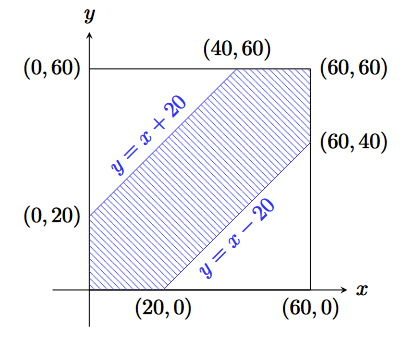
Sample space: square \([0,60] \times [0,60]\) with area \(= 3600\)
Meeting region: strip between lines \(y = x - 20\) and \(y = x + 20\)
Non-meeting region: two corner triangles, each with area \(\dfrac{1}{2} \times 40 \times 40 = 800\)
Total non-meeting area \(= 1600\)
Meeting area \(= 3600 - 1600 = 2000\)
Probability \(=\dfrac{2000}{3600} = \dfrac{5}{9}\)
Note: There is a direct shortcut for this type of question, probability that they will meet \(=1-\dfrac{(60-m)^2}{m^2}\), where \(m\) is the minutes for which each of them waits.
Three numbers \(a, b\) and \(c\) are chosen at random (without replacement) from among the numbers 1, 2, 3, ..., 99. The probability that \(a^3 + b^3 + c^3 - 3abc\) is divisible by 3 is:
We use the identity: \(a^3 + b^3 + c^3 - 3abc = \dfrac{1}{2}(a+b+c)[(a-b)^2 + (b-c)^2 + (c-a)^2]\)
Numbers 1 to 99 have 33 numbers in each category \(3k, 3k+1, 3k+2\)
The expression is divisible by 3 when:
Case 1: All three numbers are from the same category
Number of ways: \(3 \times ^{33}C_3\)
Case 2: One number from each category
Number of ways: \(^{33}C_1 \times ^{33}C_1 \times ^{33}C_1 = (^{33}C_1)^3\)
Total favorable outcomes = \(3 \cdot ^{33}C_3 + (^{33}C_1)^3\)
Total ways = \(^{99}C_3\)
Probability = \(\dfrac{3 \cdot ^{33}C_3 + (^{33}C_1)^3}{^{99}C_3}\)
A and B play a game where each is asked to select a number from 1 to 25. If the two numbers match, both of them win a prize. The probability that they will not win a prize in a single trial is:
Total number of ways to choose numbers: \(25 \times 25 = 625\)
Number of ways they match (both choose same number): 25
Probability they win = \(\dfrac{25}{625} = \dfrac{1}{25}\)
Probability they do not win = \(1 - \dfrac{1}{25} = \dfrac{24}{25}\)
The quadratic equation whose roots are \(\sin^2 18°\) and \(\cos^2 36°\) is:
We know \(\sin 18° = \dfrac{\sqrt{5} - 1}{4}\)
So \(\sin^2 18° = \left(\dfrac{\sqrt{5} - 1}{4}\right)^2 = \dfrac{6 - 2\sqrt{5}}{16} = \dfrac{3 - \sqrt{5}}{8}\)
Also \(\cos 36° = \dfrac{\sqrt{5} + 1}{4}\)
So \(\cos^2 36° = \left(\dfrac{\sqrt{5} + 1}{4}\right)^2 = \dfrac{6 + 2\sqrt{5}}{16} = \dfrac{3 + \sqrt{5}}{8}\)
Sum of roots = \(\dfrac{3 - \sqrt{5}}{8} + \dfrac{3 + \sqrt{5}}{8} = \dfrac{6}{8} = \dfrac{3}{4}\)
Product of roots = \(\dfrac{3 - \sqrt{5}}{8} \times \dfrac{3 + \sqrt{5}}{8} = \dfrac{9 - 5}{64} = \dfrac{4}{64} = \dfrac{1}{16}\)
Quadratic equation: \(x^2 - (\text{sum})x + \text{product} = 0\)
\(x^2 - \dfrac{3}{4}x + \dfrac{1}{16} = 0\) or \(16x^2 - 12x + 1 = 0\)
Sum to infinity of a geometric progression is twice the sum of the first two terms. Then what are the possible values of the common ratio?
Let first term \(= a\), common ratio \(= r\) (with \(|r| < 1\) for convergence)
Sum to infinity = \(\dfrac{a}{1-r}\)
Sum of first two terms = \(a + ar = a(1+r)\)
Given: \(\dfrac{a}{1-r} = 2a(1+r)\)
\(\Rightarrow 1 - r^2 = \dfrac{1}{2}\) or \(r = \pm \dfrac{1}{\sqrt{2}}\)
Suppose that \(m\) and \(n\) are fixed numbers such that the \(m^{\text{th}}\) \(a_m\) is equal to \(n\) and the \(n^{\text{th}}\) term \(a_n\) is equal to \(m\; (m \ne n)\), then \((m + n)^{\text{th}}\) term is:
Assuming the sequence is in Harmonic Progression (HP), the reciprocals are in AP.
Let \(b_k = \dfrac{1}{a_k}\). Then \(b_m = \dfrac{1}{n}\) and \(b_n = \dfrac{1}{m}\)
Since b's are in AP: \(b_m - b_n = (m-n)d\)
\(\dfrac{1}{n} - \dfrac{1}{m} = (m-n)d\)
\(\dfrac{m-n}{mn} = (m-n)d\) or \(d = \dfrac{1}{mn}\)
Then \(b_{m+n} = b_m + (m+n-m)d = \dfrac{1}{n} + n \cdot \dfrac{1}{mn}\)
\(= \dfrac{1}{n} + \dfrac{1}{m} = \dfrac{m+n}{mn}\)
Therefore \(a_{m+n} = \dfrac{1}{b_{m+n}} = \dfrac{mn}{m+n}\)
If \(A\) is an invertible skew symmetric matrix, then \(A^{-1}\) is a:
For a skew symmetric matrix: \(A^T = -A\)
Taking transpose of inverse:
\((A^{-1})^T = (A^T)^{-1} = (-A)^{-1} = -A^{-1}\)
This shows \((A^{-1})^T = -A^{-1}\)
Therefore, \(A^{-1}\) is also skew symmetric
If the mean of the squares of first \(n\) natural numbers be 11, then \(n\) is equal to:
Mean of squares of first \(n\) natural numbers:
\(\dfrac{1^2 + 2^2 + \ldots + n^2}{n} = \dfrac{n(n+1)(2n+1)}{6n} = \dfrac{(n+1)(2n+1)}{6}\)
Given that, \(\dfrac{(n+1)(2n+1)}{6} = 11\)
\((n+1)(2n+1) = 66\)
\(2n^2 + 3n - 65 = 0\)
Factoring: \((2n+13)(n-5) = 0\) or \(n = 5\)
The set of points, where \(f(x) = \dfrac{x}{1 + |x|}\), is differentiable, is:
For \(x \ge 0\): \(f(x) = \dfrac{x}{1+x}\), which is differentiable for all \(x \ge 0\)
For \(x < 0\): \(f(x) = \dfrac{x}{1-x}\), which is differentiable for all \(x < 0\)
At \(x = 0\), check differentiability:
Left derivative: \(\displaystyle \lim_{h\to 0^-} \dfrac{f(0+h)-f(0)}{h} = \displaystyle \lim_{h\to 0^-} \dfrac{\frac{h}{1-h}}{h} = \displaystyle \lim_{h\to 0^-} \dfrac{1}{1-h} = 1\)
Right derivative: \(\displaystyle \lim_{h\to 0^+} \dfrac{f(0+h)-f(0)}{h} = \displaystyle \lim_{h\to 0^+} \dfrac{\frac{h}{1+h}}{h} = \displaystyle \lim_{h\to 0^+} \dfrac{1}{1+h} = 1\)
Since left derivative = right derivative, \(f\) is differentiable at 0
Therefore, \(f\) is differentiable everywhere on \((-\infty,\infty)\)
\(\int \limits_{0}^{\pi} x f(\sin x)\, dx\) is equal to:
Let \(I = \int \limits_{0}^{\pi} x f(\sin x)\, dx\)
Using property \(\int \limits_{0}^{a} f(x)\, dx = \int \limits_{0}^{a} f(a-x)\, dx\):
\(I = \int \limits_{0}^{\pi} (\pi - x) f(\sin(\pi - x))\, dx\)
Since \(\sin(\pi - x) = \sin x\):
\(I = \int \limits_{0}^{\pi} (\pi - x) f(\sin x)\, dx\)
Adding both expressions for \(I\):
\(2I = \int \limits_{0}^{\pi} [x + (\pi - x)] f(\sin x)\, dx = \pi \int \limits_{0}^{\pi} f(\sin x)\, dx\)
Therefore: \(I = \dfrac{\pi}{2} \int \limits_{0}^{\pi} f(\sin x)\, dx\)
Let \(f:R\to R\) be defined by \(f(x) = \begin{cases} x + 2 & \text{if } x < 0\\ |x - 2| & \text{if } x \ge 0 \end{cases}\). Find \(\int \limits_{-2}^{3} f(x)\, dx\).
For \(x < 0\): \(f(x) = x + 2\)
For \(x \ge 0\): \(f(x) = |x-2| = \begin{cases} 2-x & \text{if } 0 \le x < 2\\ x-2 & \text{if } x \ge 2 \end{cases}\)
\(\int \limits_{-2}^{3} f(x)\, dx = \int \limits_{-2}^{0} (x+2)\, dx + \int \limits_{0}^{2} (2-x)\, dx + \int \limits_{2}^{3} (x-2)\, dx\)
First integral: \(\left[\dfrac{x^2}{2} + 2x\right]_{-2}^{0} = 0 - (2 - 4) = 2\)
Second integral: \(\left[2x - \dfrac{x^2}{2}\right]_{0}^{2} = (4 - 2) - 0 = 2\)
Third integral: \(\left[\dfrac{x^2}{2} - 2x\right]_{2}^{3} = \left(\dfrac{9}{2} - 6\right) - (2 - 4) = -\dfrac{3}{2} + 2 = \dfrac{1}{2}\)
Total = \(2 + 2 + 0.5 = 4.5\)
Slope of two lines \(6x^2 - xy - 2y^2 = 0\) differ by:
The equation \(6x^2 - xy - 2y^2 = 0\) represents a pair of lines through origin
Dividing by \(x^2\) (assuming \(x \ne 0\)): \(6 - m - 2m^2 = 0\) where \(m = \dfrac{y}{x}\)
\(2m^2 + m - 6 = 0\)
For roots \(m_1, m_2\): \(m_1 + m_2 = -\dfrac{1}{2}\) and \(m_1 m_2 = -3\)
Difference of slopes: \(|m_1 - m_2| = \sqrt{(m_1 - m_2)^2} = \sqrt{(m_1+m_2)^2 - 4m_1 m_2}\)
\(= \sqrt{\dfrac{1}{4}+12} = \dfrac{7}{2}\)
If the radius of a circle changes at the rate of \(\dfrac{-2}{\pi}\) m/sec, at what rate does the circle's area change when the radius is 10m?
Area of circle: \(A = \pi r^2\)
Differentiating with respect to time:
\(\dfrac{dA}{dt} = 2\pi r \dfrac{dr}{dt}\)
Given: \(\dfrac{dr}{dt} = -\dfrac{2}{\pi}\) m/sec and \(r = 10\) m
Substituting:
\(\dfrac{dA}{dt} = 2\pi \times 10 \times \left(-\dfrac{2}{\pi}\right)\)
\(= 20\pi \times \left(-\dfrac{2}{\pi}\right) = 20 \times (-2) = -40\) m²/sec