
NIMCET 2025 Question Paper and Solutions
NIMCET Previous Year Papers!
The NIMCET 2025 Mathematics section was moderate to difficult, with slightly higher emphasis on Trigonometry and Vectors. Questions were distributed across all major areas of the syllabus, testing both conceptual knowledge and speed. In this paper, the key focus areas include: Trigonometry, Vectors, Algebra, Permutations & Combinations, Probability, and Coordinate Geometry. To strengthen your conceptual knowledge you can refer to the following detailed theory chapters. Each chapter includes explanations, solved examples, and practice exercises:
NIMCET 2025 QUESTION PAPER AND SOLUTION
► Topic-Wise Question Distribution
| Topic (Click to Filter) | Number of Questions |
|---|---|
| MATRICES | 3 |
| TRIGONOMETRY | 8 |
| VECTORS | 6 |
| COORDINATE GEOMETRY | 6 |
| STATISTICS | 3 |
| PROBABILITY | 4 |
| PERMUTATIONS-COMBINATIONS | 5 |
| ALGEBRA | 7 |
| INTEGRATION | 3 |
| DIFFERENTIATION | 5 |
► Difficulty-Wise Question Distribution
Consider the matrix \(\begin{pmatrix} -1 & -1 & 2 \\ 0 & -1 & -1 \\ 0 & 0 & -1 \end{pmatrix}\). The sum of all the entries of the matrix \(A^{19}\) is:
The given matrix \(A\) is upper triangular with eigenvalues \(-1, -1, -1\). Write \(A = -I + N\), where
\(N = \begin{pmatrix} 0 & -1 & 2 \\ 0 & 0 & -1 \\ 0 & 0 & 0 \end{pmatrix}\)
Then \(N^2 = \begin{pmatrix} 0 & 0 & 1 \\ 0 & 0 & 0 \\ 0 & 0 & 0 \end{pmatrix}\) and \(N^3 = 0\). By the binomial theorem,
\(A^{19} = (-I + N)^{19} = \sum_{k=0}^{2} \binom{19}{k} (-I)^{19-k} N^k\)
\(= (-1)^{19}I + \binom{19}{1}(-1)^{18} N + \binom{19}{2}(-1)^{17} N^2\)
\(= -I + 19N - \binom{19}{2} N^2\), where \(\binom{19}{2} = 171\)
\(A^{19} = -\begin{pmatrix}1&0&0\\0&1&0\\0&0&1\end{pmatrix} + 19\begin{pmatrix}0&-1&2\\0&0&-1\\0&0&0\end{pmatrix} - 171\begin{pmatrix}0&0&1\\0&0&0\\0&0&0\end{pmatrix}\)
\(= \begin{pmatrix} -1 & -19 & -133 \\ 0 & -1 & -19 \\ 0 & 0 & -1 \end{pmatrix}\)
Sum of all entries = \((-1) + (-19) + (-133) + 0 + (-1) + (-19) + 0 + 0 + (-1) = -174\)
The absolute value is \(174\).
What is the general solution of the equation \(\cot \theta + \tan \theta = 2\)?
\(\cot \theta + \tan \theta = 2\)
This is possible only when \(\tan \theta = 1\)
\(\theta = n\pi + \dfrac{\pi}{4}\)
The length of the projection of \(\vec{a} = 2\hat{i} + 3\hat{j} + \hat{k}\) on \(\vec{b} = -2\hat{i} + \hat{j} + 2\hat{k}\) is equal to:
Length of projection of \(\vec{a}\) on \(\vec{b}\) = \(\left| \dfrac{\vec{a} \cdot \vec{b}}{|\vec{b}|} \right|\)
\(\vec{a} \cdot \vec{b} = (2)(-2) + (3)(1) + (1)(2) = -4 + 3 + 2 = 1\)
\(|\vec{b}| = \sqrt{(-2)^2 + 1^2 + 2^2} = \sqrt{4 + 1 + 4} = \sqrt{9} = 3\)
Length of projection = \(\left| \dfrac{1}{3} \right| = \dfrac{1}{3}\)
If \(x\), \(y\), and \(z\) are the three cube roots of 27, then the determinant of the matrix \(\begin{bmatrix} x & y & z \\ y & z & x \\ z & x & y \end{bmatrix}\) is:
The three cube roots of 27 are \(3\), \(3\omega\), and \(3\omega^2\), where \(\omega\) is the complex cube root of unity with \(\omega^3 = 1\) and \(1 + \omega + \omega^2 = 0\).
Let the matrix be \(A = \begin{bmatrix} x & y & z \\ y & z & x \\ z & x & y \end{bmatrix}\).
Observe that the sum of all rows is \(x + y + z\).
Since \(x + y + z = 3 + 3\omega + 3\omega^2 = 3(1 + \omega + \omega^2) = 0\), the rows are linearly dependent.
Therefore, the determinant is \(0\).
A circle with its center in the first quadrant touches both the coordinate axes and the line \(x - y - 2 = 0\). Then the area of the circle is:
Let the center be \((r, r)\) since the circle touches both axes in the first quadrant, and the radius is \(r\).
The perpendicular distance from center \((r, r)\) to the line \(x - y - 2 = 0\) equals the radius \(r\).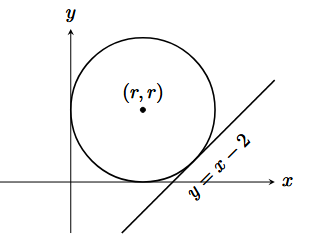
Distance = \(\dfrac{|r - r - 2|}{\sqrt{1^2 + (-1)^2}} = \dfrac{|-2|}{\sqrt{2}} = \dfrac{2}{\sqrt{2}} = \sqrt{2}\)
So \(r = \sqrt{2}\).
Area of circle = \(\pi r^2 = \pi (\sqrt{2})^2 = 2\pi\)
The scores of students in a national level examination are normally distributed with a mean of 500 and a standard deviation of 100. If the value of the cumulative distribution of the standard normal random variable at 0.5 is 0.691, then the probability that a randomly selected student scored between 450 and 500 is:
Let \(X\) be the score. Given \(X \sim N(500, 100^2)\).
We need \(P(450 < X < 500)\).
Convert to standard normal: \(P(450 < X < 500) = P\left(\dfrac{450 - 500}{100} < Z < \dfrac{500 - 500}{100}\right)\)
\(= P(-0.5 < Z < 0)\)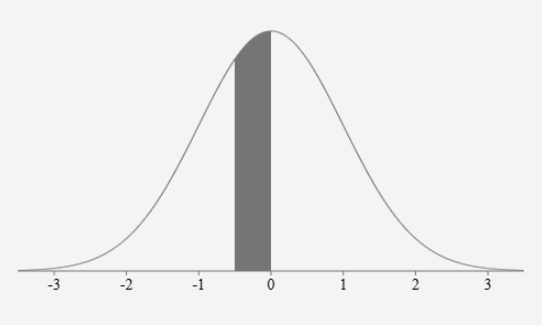
\(= \Phi(0) - \Phi(-0.5)\) \(= \Phi(0.5) - \Phi(0)\) \(= 0.691 -0.5\)
Therefore, \(P(-0.5 < Z < 0) = 0.191\)
Let \(E\) and \(F\) be two events such that \(P(E) > 0\) and \(P(F) > 0\). Which one of the following is NOT equivalent to the condition that \(P(E) = P(E|F)\)?
Given \(P(E) = P(E|F) = \dfrac{P(E \cap F)}{P(F)}\)
This implies \(P(E)P(F) = P(E \cap F)\), which means \(E\) and \(F\) are independent.
We know that, if two events \(A\) and \(B\) are independent, then \(A^c\) and \(B\) are also independent. Also \(A^c\) and \(B^c\) are also independent. Now check each option:
(a) If \(E\) and \(F\) are independent, then \(E^c\) and \(F\) are also independent. So (a) is true.
(b) Directly states \(E\) and \(F\) are independent, so it is also true.
(d) \(P(F) = P(F|E) = \dfrac{P(F \cap E)}{P(E)}\) gives \(P(F)P(E) = P(F \cap E)\), same condition, so it is true.
(c) \(P(E^c) P(F^c) \neq P(E^c \cap F^c)\) means \(E^c\) and \(F^c\) are NOT independent.
If \(E\) and \(F\) are independent, then \(E^c\) and \(F^c\) are also independent, so \(P(E^c) P(F^c) = P(E^c \cap F^c)\).
Thus (c) contradicts the independence condition, so it is NOT true.
The circle \(x^2 + y^2 + \alpha x + \beta y + \gamma = 0\) is the image of the circle \(x^2 + y^2 - 6x - 10y + 30 = 0\) across the line \(3x + y = 2\). The value of \(\lfloor \alpha + \beta + \gamma \rfloor\) is: (where \(\lfloor \cdot \rfloor\) represents the floor function)
The given circle is \(x^2 + y^2 - 6x - 10y + 30 = 0\).
Center: \(C = (3, 5)\) and radius \(r = \sqrt{9 + 25 - 30} = 2\)
The image of this circle across the line \(3x + y = 2\) will have the same radius \(2\).
Let the image center be \(C' = (h, k)\), then using the reflection formula:
\(\dfrac{h-3}{3} = \dfrac{k-5}{1} = \dfrac{-2(3 \cdot 3 + 5 - 2)}{3^2 + 1^2} = \dfrac{-2(12)}{10} = \dfrac{-24}{10} = -2.4\)
\(h = 3 + 3(-2.4) = 3 - 7.2 = -4.2\)
\(k = 5 + 1(-2.4) = 5 - 2.4 = 2.6\)
So image center \(C' = (-4.2, 2.6)\).
Equation of image circle: \((x + 4.2)^2 + (y - 2.6)^2 = 4\)
\(x^2 + 8.4x + 17.64 + y^2 - 5.2y + 6.76 = 4\)
\(x^2 + y^2 + 8.4x - 5.2y + 20.4 = 0\)
So \(\alpha = 8.4\), \(\beta = -5.2\), \(\gamma = 20.4\)
\(\alpha + \beta + \gamma = 8.4 - 5.2 + 20.4 = 23.6\)
Floor value = \(\lfloor 23.6 \rfloor = 23\)
A tower subtends an angle of \(30^\circ\) at a point on the same level as the foot of the tower. At a second point \(h\) meters above the first, the depression of the foot of the tower is \(60^\circ\). What is the horizontal distance of the tower from the point?
Let \(AB\) be the tower with foot \(B\) and top \(A\).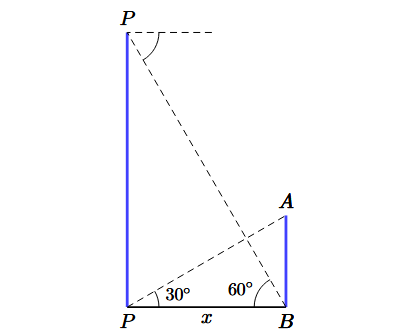
Let the first point be \(P\) at ground level, and the second point \(Q\) is \(h\) meters above \(P\).
At \(Q\), the angle of depression of the foot \(B\) is \(60^\circ\). Hence \(\angle QBP = 60^\circ\).
Let the horizontal distance be \(x\).
\(\tan 60^\circ = \dfrac{PQ}{PB} = \dfrac{h}{x}\)
\(\Rightarrow x = \dfrac{h}{\tan 60^\circ} = h \cot 60^\circ\)
The captains of five cricket teams, including India and Australia, are lined up randomly next to one another for a group photo. What is the probability that the captains of India and Australia will stand next to each other?
Total number of ways to arrange 5 captains = \(5! = 120\).
Treat India and Australia as a single block. Then we have 4 items to arrange (the block plus the other 3 captains).
Number of arrangements = \(4! = 24\).
Within the block, India and Australia can be arranged in \(2! = 2\) ways.
So favorable arrangements = \(24 \times 2 = 48\).
Probability = \(\dfrac{48}{120} = \dfrac{2}{5}\)
Let \(A = \{5^n - 4n - 1 : n \in \mathbb{N}\}\) and \(B = \{16(n - 1) : n \in \mathbb{N}\}\) be sets, then:
Write \(5^n = (1 + 4)^n\) and expand using the binomial theorem:
\((1 + 4)^n = 1 + 4n + \binom{n}{2} \times 4^2 + \binom{n}{3} \times 4^3 + \ldots\)
Then \(5^n - 4n - 1 = \binom{n}{2} \times 4^2 + \binom{n}{3} \times 4^3 + \ldots\)
For \(k \geq 2\), each term \(\binom{n}{k} 4^k\) is divisible by \(4^2 = 16\).
Thus \(5^n - 4n - 1\) is divisible by 16 for all \(n \in \mathbb{N}\).
So every element of \(A\) is a multiple of 16.
The set \(B = \{16(n - 1) : n \in \mathbb{N}\}\) contains all non-negative multiples of 16: \(0, 16, 32, 48, \ldots\)
Since \(A\) consists of some specific multiples of 16 (not necessarily all), we have \(A \subseteq B\).
Therefore, \(A \subset B\).
If \(\vec{a}\) and \(\vec{b}\) are two vectors such that \(|\vec{a}| = 3\), \(|\vec{b}| = 4\), and \(|\vec{a} + \vec{b}| = 1\), then the value of \(|\vec{a} - \vec{b}|\) is:
We know that \(|\vec{a} + \vec{b}|^2 = |\vec{a}|^2 + |\vec{b}|^2 + 2\vec{a} \cdot \vec{b}\)
Given \(|\vec{a} + \vec{b}| = 1\), so:
\(1^2 = 3^2 + 4^2 + 2\vec{a} \cdot \vec{b}\)
\(1 = 9 + 16 + 2\vec{a} \cdot \vec{b}\)
\(\vec{a} \cdot \vec{b} = -12\)
Now, \(|\vec{a} - \vec{b}|^2 = |\vec{a}|^2 + |\vec{b}|^2 - 2\vec{a} \cdot \vec{b}\)
\(= 9 + 16 - 2(-12)=49\)
Therefore, \(|\vec{a} - \vec{b}| = \sqrt{49} = 7\)
The value of the integral \(\int \limits_{0}^{\frac{\pi}{2}} \dfrac{1 + 2\cos x}{(2 + \cos x)^2} \, dx\) lies in the interval:
Let \(I = \int \limits_{0}^{\dfrac{\pi}{2}} \dfrac{1 + 2\cos x}{(2 + \cos x)^2} \, dx\)
Rewrite the integrand by dividing numerator and denominator appropriately.
Let \(t = 2\csc x + \cot x\)
Then \(dt = (-2\csc x \cot x - \csc^2 x) dx = -(2\cot x \csc x + \csc^2 x) dx\)
So \((2\cot x \csc x + \csc^2 x) dx = -dt\)
The numerator \(\csc^2 x + 2\cot x \csc x = (2\cot x \csc x + \csc^2 x)\)
Thus the integrand becomes \(\dfrac{-dt}{t^2}\)
When \(x = 0\), \(t \to \infty\); when \(x = \dfrac{\pi}{2}\), \(t = 2\)
Therefore, \(I = \int_{\infty}^{2} \dfrac{-dt}{t^2} = \int_{2}^{\infty} \dfrac{dt}{t^2} = \left[-\dfrac{1}{t}\right]_{2}^{\infty} = 0 - \left(-\dfrac{1}{2}\right) = \dfrac{1}{2}\)
Since \(\dfrac{1}{2} \in (0, 1)\), the integral lies in the interval \((0, 1)\).
If \(\vec{a}\), \(\vec{b}\), and \(\vec{c}\) are three vectors such that \(\vec{a} \times \vec{b} = \vec{c}\), \(\vec{a} \cdot \vec{c} = 2\), and \(\vec{b} \cdot \vec{c} = 1\), and if \(|\vec{b}| = 1\), then the value of \(|\vec{a}|\) is:
Given \(\vec{a} \times \vec{b} = \vec{c}\)
Take the cross product with \(\vec{c}\) on both sides:
\(\vec{c} \times (\vec{a} \times \vec{b}) = \vec{c} \times \vec{c} = 0\)
Using the vector triple product formula:
\(\vec{c} \times (\vec{a} \times \vec{b}) = (\vec{c} \cdot \vec{b})\vec{a} - (\vec{c} \cdot \vec{a})\vec{b} = 0\)
Given \(\vec{c} \cdot \vec{a} = 2\) and \(\vec{c} \cdot \vec{b} = 1\), we get:
\(1 \cdot \vec{a} - 2\vec{b} = 0\) or \(\vec{a} = 2\vec{b}\)
Therefore, \(|\vec{a}| = 2|\vec{b}| = 2 \times 1 = 2\)
The obtuse angle between lines \(2y = x + 1\) and \(y = 3x + 2\) is:
First line: \(2y = x + 1 \Rightarrow y = \dfrac{1}{2}x + \dfrac{1}{2}\), slope \(m_1 = \dfrac{1}{2}\)
Second line: \(y = 3x + 2\), slope \(m_2 = 3\)
Angle between lines: \(\tan \theta = \left| \dfrac{m_2 - m_1}{1 + m_1 m_2} \right| = \left| \dfrac{3 - \dfrac{1}{2}}{1 + \dfrac{1}{2} \cdot 3} \right|\)
\(= \left| \dfrac{\dfrac{5}{2}}{1 + \dfrac{3}{2}} \right| = \left| \dfrac{\dfrac{5}{2}}{\dfrac{5}{2}} \right| = 1\)
So \(\theta = \dfrac{\pi}{4}\) (acute angle)
The obtuse angle = \(\pi - \dfrac{\pi}{4} = \dfrac{3\pi}{4}\)
Consider the sample space \(\Omega = \{(x, y) : x, y \in \{1, 2, 3, 4\}\}\) where each outcome is equally likely. Let \(A = \{x \geq 2\}\) and \(B = \{y > x\}\) be two events. Then which of the following is NOT true?
Total outcomes = \(4 \times 4 = 16\)
Event \(A = \{x \geq 2\}\): \(x\) can be 2, 3, or 4 (3 values), \(y\) can be any of 4 values
\(P(A) = \dfrac{12}{16} = \dfrac{3}{4}\) ✓
Event \(B = \{y > x\}\): Favorable outcomes are (1,2), (1,3), (1,4), (2,3), (2,4), (3,4) = 6 outcomes
\(P(B) = \dfrac{6}{16} = \dfrac{3}{8}\) ✓
Event \(A \cap B = \{x \geq 2 \text{ and } y > x\}\): (2,3), (2,4), (3,4) = 3 outcomes
\(P(A \cap B) = \dfrac{3}{16} \neq \dfrac{1}{4}\) ✗ (This is NOT true)
Check independence: \(P(A)P(B) = \dfrac{3}{4} \times \dfrac{3}{8} = \dfrac{9}{32} \neq \dfrac{3}{16}\)
So \(A\) and \(B\) are not independent ✓
If \(8^{x-1} = \left(\dfrac{1}{4}\right)^x\), then the value of \(\dfrac{1}{\log_{x+1} 4 - \log_{x+1} 5} + \dfrac{1}{\log_{1-x} 4 - \log_{1-x} 5}\) is:
\(8^{x-1} = 4^{-x}\)
\(2^{3(x-1)} = 2^{-2x}\)
Equating exponents: \(3x - 3 = -2x\)
\(x = \dfrac{3}{5}\)
Then \(x + 1 = \dfrac{3}{5} + 1 = \dfrac{8}{5}\) and \(1 - x = 1 - \dfrac{3}{5} = \dfrac{2}{5}\)
Now evaluate the expression:
\(\dfrac{1}{\log_{x+1} 4 - \log_{x+1} 5} + \dfrac{1}{\log_{1-x} 4 - \log_{1-x} 5}\)
\(= \dfrac{1}{\log_{8/5} 4 - \log_{8/5} 5} + \dfrac{1}{\log_{2/5} 4 - \log_{2/5} 5}\)
\(= \dfrac{1}{\log_{8/5} \dfrac{4}{5}} + \dfrac{1}{\log_{2/5} \dfrac{4}{5}}\)
\(= \log_{4/5} \dfrac{8}{5} + \log_{4/5} \dfrac{2}{5}\)
\(= \log_{4/5} \left(\dfrac{8}{5} \times \dfrac{2}{5}\right)\)
\(= \log_{4/5} \dfrac{16}{25}\)
\(= 2 \log_{4/5} \dfrac{4}{5}=2\)
Let \(x\) be a positive real number such that \(x^{(8 \log_5 x - 24)} = 5^{-4}\). Then the product of all possible values of \(x\) is:
Given \(x^{(8 \log_5 x - 24)} = 5^{-4}\)
Let \(t = \log_5 x\), then \(x = 5^t\)
LHS = \((5^t)^{(8t - 24)} = 5^{t(8t - 24)}\)
So \(5^{t(8t - 24)} = 5^{-4}\)
Equating exponents: \(t(8t - 24) = -4\)
\(8t^2 - 24t + 4 = 0\)
Divide by 4: \(2t^2 - 6t + 1 = 0\)
Sum of roots: \(t_1 + t_2 = \dfrac{6}{2} = 3\)
Since \(x = 5^t\), the product of all possible values of \(x\) is:
\(x_1 \times x_2 = 5^{t_1} \times 5^{t_2} = 5^{t_1 + t_2} = 5^3 = 125\)
A tower subtends angles \(\alpha\), \(2\alpha\), and \(3\alpha\) respectively at points A, B, and C which are lying on a horizontal line through the foot of the tower. Then \(\dfrac{AB}{BC}\) equals:
Let tower height = \(h\). If \(x_1, x_2, x_3\) are distances of A, B, C from the foot, then:
\(x_1 = h\cot \alpha,\; x_2 = h\cot 2\alpha,\; x_3 = h\cot 3\alpha\)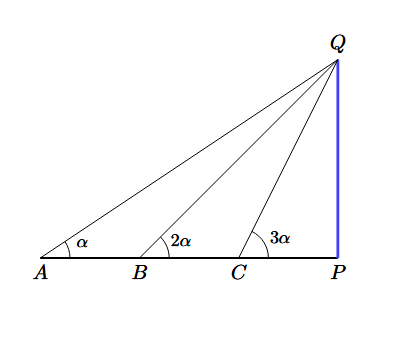
\(AB = x_1 - x_2 = h(\cot \alpha - \cot 2\alpha)\)
\(BC = x_2 - x_3 = h(\cot 2\alpha - \cot 3\alpha)\)
\(\dfrac{AB}{BC} = \dfrac{\cot \alpha - \cot 2\alpha}{\cot 2\alpha - \cot 3\alpha}\)
Using \(\cot A - \cot B = \dfrac{\sin(B-A)}{\sin A \sin B}\):
Numerator = \(\dfrac{\sin \alpha}{\sin \alpha \sin 2\alpha}\), Denominator = \(\dfrac{\sin \alpha}{\sin 2\alpha \sin 3\alpha}\)
Thus \(\dfrac{AB}{BC} = \dfrac{\sin 3\alpha}{\sin \alpha}\)
Now \(\dfrac{\sin 3\alpha}{\sin \alpha} = 3 - 4\sin^2 \alpha = 4\cos^2 \alpha - 1 = 1 + 2(2\cos^2 \alpha - 1) = 1 + 2\cos 2\alpha\)
There are 40 female and 20 male students in a class. If the average heights of female and male students are 5.15 feet and 5.66 feet, respectively, then the average height (in feet) of all the students in the class equals:
Number of female students = 40, average height = 5.15 feet
Total height of female students = \(40 \times 5.15 = 206\) feet
Number of male students = 20, average height = 5.66 feet
Total height of male students = \(20 \times 5.66 = 113.2\) feet
Total students = \(40 + 20 = 60\)
Total height of all students = \(206 + 113.2 = 319.2\) feet
Average height of all students = \(\dfrac{319.2}{60} = 5.32\) feet
Let \(A\) and \(B\) be two square matrices of the same order satisfying \(A^2 + 5A + 5I = 0\) and \(B^2 + 3B + I = 0\) respectively, where \(I\) is the identity matrix. Then the inverse of the matrix \(C = BA + 2B + 2A + 4I\) is:
Factor \(C\):
\(C = BA + 2B + 2A + 4I = B(A + 2I) + 2(A + 2I) = (B + 2I)(A + 2I)\)
From \(A^2 + 5A + 5I = 0\):
\(A^2 + 5A + 6I = I\)
\((A + 2I)(A + 3I) = I\)
So \((A + 2I)^{-1} = A + 3I\)
From \(B^2 + 3B + I = 0\):
\(B^2 + 3B + 2I = I\)
\((B + 2I)(B + I) = I\)
So \((B + 2I)^{-1} = B + I\)
Thus:
\(C^{-1} = [(B + 2I)(A + 2I)]^{-1} = (A + 2I)^{-1}(B + 2I)^{-1}\)
\(= (A + 3I)(B + I)\)
\(= AB + A + 3B + 3I\)
Suppose \(t_1, t_2, \ldots, t_5\) are in AP such that \(\displaystyle \sum_{\ell=0}^{18} t_{3\ell+1} = 1197\) and \(t_7 + 3t_{22} = 174\). If \(\displaystyle \sum_{\ell=1}^9 t_\ell^2 = 947b\), then the value of \(b\) is:
Let the first term be \(a\) and common difference be \(d\).
Given \(\sum_{\ell=0}^{18} t_{3\ell+1} = 1197\):
\(t_1 + t_4 + t_7 + \ldots + t_{55} = 1197\) (19 terms with common difference 3d)
Sum = \(\dfrac{19}{2}[2a + 18(3d)] = \dfrac{19}{2}[2a + 54d] = 1197\)
\(2a + 54d = 126\)
\(a + 27d = 63\) ...(1)
Given \(t_7 + 3t_{22} = 174\):
\((a + 6d) + 3(a + 21d) = 174\)
\(a + 6d + 3a + 63d = 174\)
\(4a + 69d = 174\) ...(2)
From equations (1) and (2): \(d = 2\) and \(a = 9\)
Now \(\sum_{\ell=1}^9 t_\ell^2 = \sum_{\ell=1}^9 [9 + (\ell-1)2]^2 = \sum_{\ell=1}^9 (2\ell + 7)^2\)
\(= \sum_{\ell=1}^9 (4\ell^2 + 28\ell + 49)\)
\(= 4\sum_{\ell=1}^9 \ell^2 + 28\sum_{\ell=1}^9 \ell + 49 \times 9\)
\(\sum_{\ell=1}^9 \ell^2 = \dfrac{9 \times 10 \times 19}{6} = 285\)
\(\sum_{\ell=1}^9 \ell = \dfrac{9 \times 10}{2} = 45\)
Sum = \(4(285) + 28(45) + 441 = 1140 + 1260 + 441 = 2841\)
So \(947b = 2841 \Rightarrow b = \dfrac{2841}{947} = 3\)
The slope of the normal line to the curve \(x = t^2 + 3t - 8\) and \(y = 2t^2 - 2t - 5\) at the point \((2, -1)\) is:
Given \(x = t^2 + 3t - 8\) and \(y = 2t^2 - 2t - 5\)
For point \((2, -1)\), find \(t\):
\(t^2 + 3t - 8 = 2\)
\(t^2 + 3t - 10 = 0\)
\((t + 5)(t - 2) = 0\)
\(t = -5\) or \(t = 2\)
Check \(y\) value:
For \(t = 2\): \(y = 2(4) - 2(2) - 5 = 8 - 4 - 5 = -1\) ✓
For \(t = -5\): \(y = 2(25) - 2(-5) - 5 = 50 + 10 - 5 = 55\) ✗
So \(t = 2\)
\(\dfrac{dx}{dt} = 2t + 3 = 2(2) + 3 = 7\)
\(\dfrac{dy}{dt} = 4t - 2 = 4(2) - 2 = 6\)
Slope of tangent = \(\dfrac{dy}{dx} = \dfrac{dy/dt}{dx/dt} = \dfrac{6}{7}\)
Slope of normal = \(-\dfrac{1}{\text{slope of tangent}} = -\dfrac{7}{6}\)
If \(\vec{a} = \hat{i} + \hat{j} + \hat{k}\), \(\vec{b} = 2\hat{i} - \hat{j} + 3\hat{k}\), and \(\vec{c} = \hat{i} - 2\hat{j} + \hat{k}\), then a vector of magnitude \(\sqrt{22}\) which is parallel to \(2\vec{a} - \vec{b} + 3\vec{c}\) is:
Given \(\vec{a} = \hat{i} + \hat{j} + \hat{k}\), \(\vec{b} = 2\hat{i} - \hat{j} + 3\hat{k}\), \(\vec{c} = \hat{i} - 2\hat{j} + \hat{k}\)
\(2\vec{a} = 2\hat{i} + 2\hat{j} + 2\hat{k}\)
\(3\vec{c} = 3\hat{i} - 6\hat{j} + 3\hat{k}\)
\(2\vec{a} - \vec{b} + 3\vec{c} = (2\hat{i} + 2\hat{j} + 2\hat{k}) - (2\hat{i} - \hat{j} + 3\hat{k}) + (3\hat{i} - 6\hat{j} + 3\hat{k})\)
\(= (2 - 2 + 3)\hat{i} + (2 + 1 - 6)\hat{j} + (2 - 3 + 3)\hat{k}\)
\(= 3\hat{i} - 3\hat{j} + 2\hat{k}\)
Magnitude = \(\sqrt{3^2 + (-3)^2 + 2^2} = \sqrt{9 + 9 + 4} = \sqrt{22}\)
Since the magnitude is already \(\sqrt{22}\), the required vector is \(3\hat{i} - 3\hat{j} + 2\hat{k}\).
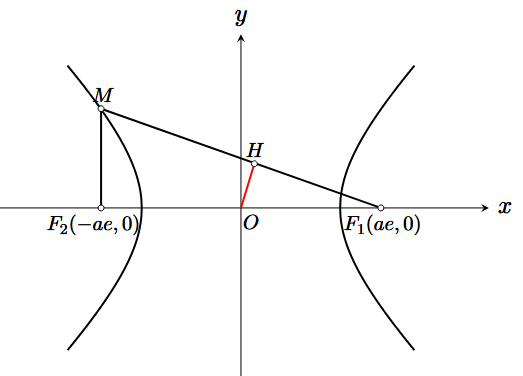
Let \(F_1, F_2\) be the foci of the hyperbola \(\dfrac{x^2}{a^2} - \dfrac{y^2}{b^2} = 1\), \(a > 0, b > 0\), and let \(O\) be the origin. Let \(M\) be an arbitrary point on the curve above the \(X\)-axis and \(H\) be a point on \(MF_1\) such that \(MF_2 \perp F_1F_2\), \(MF_1 \perp OH\), and \(|OH| = \lambda |OF_2|\) with \(\lambda \in \left(\dfrac{2}{5}, \dfrac{3}{5}\right)\). Then the range of the eccentricity \(e\) is:
Given \(MF_2 \perp F_1F_2\), so \(M\) is vertically above \(F_2\).
Foci: \(F_1(ae, 0)\), \(F_2(-ae, 0)\). Let \(M = (-ae, k)\).
From the hyperbola equation: \(\dfrac{(-ae)^2}{a^2} - \dfrac{k^2}{b^2} = 1\)
Since \(b^2 = a^2(e^2 - 1)\):
\(k^2 = b^2(e^2 - 1) = a^2(e^2 - 1)^2\) or \(k = a(e^2 - 1)\)
Triangles \(F_1OH\) and \(F_1F_2M\) are similar, so
\(\dfrac{OH}{F_1H}=\dfrac{F_2M}{F_1F_2}\)
\(\dfrac{\lambda ae}{\sqrt{a^2e^2-\lambda^2a^2e^2}}=\dfrac{a(e^2-1)}{2ae}\)
Solving the quadratic in \(e\), we get
\(e = \dfrac{\lambda + 1}{\sqrt{1 - \lambda^2}}\)
For \(\lambda = \dfrac{2}{5}\): \(e = \dfrac{7/5}{\sqrt{21}/5} = \sqrt{\dfrac{7}{3}}\)
For \(\lambda = \dfrac{3}{5}\): \(e = \dfrac{8/5}{4/5} = 2\)
Thus \(e \in \left(\sqrt{\dfrac{7}{3}}, 2\right)\)
Which one of the following is NOT a correct statement?
Variance is the square of the standard deviation.
If observations are measured in units \(u\), then:
- Standard deviation is in units \(u\)
- Variance is in units \(u^2\) (squared units)
Therefore, statement (A) is NOT correct because variance is expressed in squared units, not the same units as the observations.
All other statements are correct properties of statistical measures.
The number of accidents per week in a town follows a Poisson distribution with mean 3. If the probability that there are three accidents in two weeks is \(k e^{-6}\), then the value of \(k\) is:
For Poisson distribution, mean per week = 3
Mean for two weeks = \(3 \times 2 = 6\)
Let \(X\) be the number of accidents in two weeks. Then \(X \sim \text{Poisson}(6)\)
The probability mass function: \(P(X = k) = \dfrac{e^{-\lambda} \lambda^k}{k!}\)
\(P(X = 3) = \dfrac{e^{-6} \cdot 6^3}{3!} = \dfrac{e^{-6} \cdot 216}{6} = 36e^{-6}\)
Given \(P(X = 3) = ke^{-6}\)
Thus \(36e^{-6} = ke^{-6}\)
\(k = 36\)
The curve \(y = \dfrac{x}{1 + x \tan x}\) attains maxima:
Given \(y = \dfrac{x}{1 + x \tan x}\)
Differentiating using the quotient rule:
\(\dfrac{dy}{dx} = \dfrac{(1 + x \tan x)(1) - x(\tan x + x \sec^2 x)}{(1 + x \tan x)^2}\)
\(= \dfrac{1 + x \tan x - x \tan x - x^2 \sec^2 x}{(1 + x \tan x)^2}\)
\(= \dfrac{1 - x^2 \sec^2 x}{(1 + x \tan x)^2}\)
For critical points, set \(\dfrac{dy}{dx} = 0\):
\(1 - x^2 \sec^2 x = 0\)
\(x^2 \sec^2 x = 1\)
\(x^2 = \cos^2 x\)
\(x = \pm \cos x\)
Using the second derivative test (or analyzing the sign change), we find:
At \(x = \cos x\), the curve attains a maximum.
At \(x = -\cos x\), the curve attains a minimum.
The number of permutations of the letters of the word BANGLORE such that the string ANGLE appears together in all permutations is:
The word BANGLORE has 8 letters: B, A, N, G, L, O, R, E.
The string ANGLE consists of 5 letters: A, N, G, L, E.
Treat ANGLE as a single block.
Remaining letters: B, O, R
Total objects to arrange: [ANGLE block], B, O, R = 4 objects
Number of arrangements = \(4! = 24\)
Note: Within the block ANGLE, the letters must appear in that exact order (not rearranged), so no additional permutations within the block.
An airplane, when \(4000\) m high from the ground, passes vertically above another airplane at an instant when the angles of elevation of the two airplanes from the same point on the ground are \(60^\circ\) and \(30^\circ\) respectively. Find the vertical distance between the two airplanes.
Let the point on the ground be \(P\). Let the lower airplane be at height \(h\) and the upper airplane at height \(4000\) m. Let the horizontal distance from \(P\) to the airplanes be \(x\).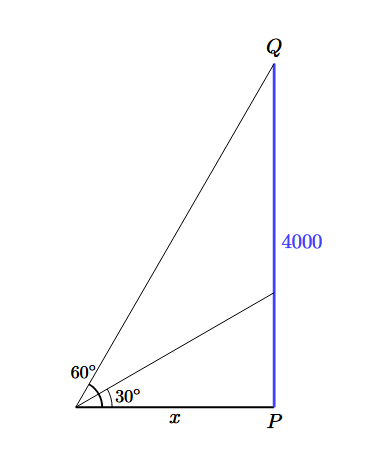
For the lower airplane (angle of elevation \(30^\circ\)):
\(\tan 30^\circ = \dfrac{h}{x}\)
\(x = h\sqrt{3}\)
For the upper airplane (angle of elevation \(60^\circ\)):
\(\tan 60^\circ = \dfrac{4000}{x}\)
\(x = \dfrac{4000}{\sqrt{3}}\)
Equating the two expressions for \(x\):
\(h\sqrt{3} = \dfrac{4000}{\sqrt{3}}\)
\(h = \dfrac{4000}{3}\)
Vertical distance between airplanes = \(4000 - h = 4000 - \dfrac{4000}{3} = \dfrac{12000 - 4000}{3} = \dfrac{8000}{3}\) m
The number of 3-digit integers that are multiples of 6 which can be formed by using the digits 1, 2, 3, 4, 5, 6 without repetition is:
For a number to be a multiple of 6, it must be divisible by both 2 and 3.
The last digit must be even: 2, 4, or 6
The sum of all three digits must be divisible by 3.
Case 1: Last digit = 2
Sum of remaining two digits must make total divisible by 3.
Possible pairs: (1,3), (3,4), (6,1), (6,4) → 4 pairs × 2 orders = 8 numbers
Case 2: Last digit = 4
Possible pairs: (2,3), (3,5), (2,6), (5,6) → 4 pairs × 2 orders = 8 numbers
Case 3: Last digit = 6
Possible pairs: (1,2), (1,5), (2,4), (4,5) → 4 pairs × 2 orders = 8 numbers
Total = 8 + 8 + 8 = 24
What is the value of \(\lim_{x \to \infty} -(x+1) \left( e^{\dfrac{1}{x+1}} - 1 \right)\)?
Let \(t = x + 1\). As \(x \to \infty\), \(t \to \infty\).
The given limit becomes: \(\lim_{t \to \infty} -t \left( e^{\dfrac{1}{t}} - 1 \right)\)
Using the Taylor expansion: \(e^{\dfrac{1}{t}} = 1 + \dfrac{1}{t} + \dfrac{1}{2t^2} + \dfrac{1}{6t^3} + \cdots\)
Then \(e^{\dfrac{1}{t}} - 1 = \dfrac{1}{t} + \dfrac{1}{2t^2} + \dfrac{1}{6t^3} + \cdots\)
Multiplying by \(-t\):
\(-t \left( e^{\dfrac{1}{t}} - 1 \right) = -t \left( \dfrac{1}{t} + \dfrac{1}{2t^2} + \dfrac{1}{6t^3} + \cdots \right)\)
\(= -1 - \dfrac{1}{2t} - \dfrac{1}{6t^2} - \cdots\)
As \(t \to \infty\), all terms except \(-1\) tend to \(0\).
Therefore, the limit is \(-1\).
The number of all even integers between 99 and 999 which are not multiples of 3 and 5 is:
Even integers between 99 and 999 are from 100 to 998 inclusive.
Total even numbers = \(\dfrac{998 - 100}{2} + 1 = 450\)
Let \(A\) = even numbers divisible by 3 (i.e., divisible by 6):
First = 102, Last = 996
Count = \(\dfrac{996 - 102}{6} + 1 = 150\)
Let \(B\) = even numbers divisible by 5 (i.e., divisible by 10):
First = 100, Last = 990
Count = \(\dfrac{990 - 100}{10} + 1 = 90\)
Numbers divisible by both 3 and 5 (i.e., divisible by 30):
First = 120, Last = 990
Count = \(\dfrac{990 - 120}{30} + 1 = 30\)
By inclusion-exclusion principle:
Numbers divisible by 3 or 5 = \(150 + 90 - 30 = 210\)
Therefore, numbers NOT divisible by 3 or 5 = \(450 - 210 = 240\)
Let \(\vec{a}\) and \(\vec{c}\) be unit vectors such that the angle between them is \(\cos^{-1}\left(\dfrac{1}{4}\right)\). If \(\vec{b} = 2\vec{c} + \lambda \vec{a}\), where \(\lambda > 0\) and \(|\vec{b}| = 4\), then \(\lambda\) is equal to:
Given \(\vec{a}\) and \(\vec{c}\) are unit vectors, so \(|\vec{a}| = 1\) and \(|\vec{c}| = 1\).
The angle between \(\vec{a}\) and \(\vec{c}\) is \(\cos^{-1}\left(\dfrac{1}{4}\right)\), therefore:
\(\vec{a} \cdot \vec{c} = \cos\left(\cos^{-1}\left(\dfrac{1}{4}\right)\right) = \dfrac{1}{4}\)
We have \(\vec{b} = 2\vec{c} + \lambda \vec{a}\) and \(|\vec{b}| = 4\)
Taking the dot product of \(\vec{b}\) with itself:
\(|\vec{b}|^2 = (2\vec{c} + \lambda \vec{a}) \cdot (2\vec{c} + \lambda \vec{a})\)
\(16 = 4|\vec{c}|^2 + \lambda^2 |\vec{a}|^2 + 4\lambda (\vec{a} \cdot \vec{c})\)
\(16 = 4(1) + \lambda^2(1) + 4\lambda\left(\dfrac{1}{4}\right)\)
\(16 = 4 + \lambda^2 + \lambda\)
\(\lambda^2 + \lambda - 12 = 0\)
\((\lambda + 4)(\lambda - 3) = 0\)
\(\lambda = 3\) or \(\lambda = -4\)
Since \(\lambda > 0\), we get \(\lambda = 3\)
Let \(g : \mathbb{R} \to \mathbb{R}\) and \(h : \mathbb{R} \to \mathbb{R}\) be two functions such that \(h(x) = \text{sgn}(g(x))\). Then select which of the following is NOT true? (\(\mathbb{R}\) denotes the set of all real numbers, sgn stands for signum function)
Since \(h(x) = \text{sgn}(g(x))\) is defined for all real \(x\) where \(g(x)\) is defined, the domain of \(h\) is exactly the same as the domain of \(g\).
Thus statement (C) is FALSE.
Statement (A) is TRUE: Domain of \(h(x)\) = Domain of \(g(x)\)
Statement (B) is TRUE: The continuity of \(h\) fails precisely at points where \(g(x) = 0\) (where the signum function has a jump discontinuity), while \(g\) may be continuous at those points.
Statement (D) is TRUE: The signum function has a discontinuity at zero, so \(h\) is discontinuous at points where \(g(x) = 0\).
If the maximum value of \(\sin x + \sin(x+1)\) is \(k \cos \dfrac{1}{2}\), then the value of \(k\) is:
Using the sum-to-product identity: \(\sin C + \sin D = 2\sin\left(\dfrac{C+D}{2}\right)\cos\left(\dfrac{C-D}{2}\right)\)
\(\sin x + \sin(x+1) = 2\sin\left(x + \dfrac{1}{2}\right)\cos\left(\dfrac{1}{2}\right)\)
The maximum value of \(\sin\left(x + \dfrac{1}{2}\right)\) is \(1\).
Therefore, the maximum value = \(2 \times 1 \times \cos\dfrac{1}{2} = 2\cos\dfrac{1}{2}\)
Hence \(k = 2\)
The value of \(\dfrac{d}{dx} \displaystyle \int \limits_{\sin^2 x}^{2 \sin x} e^{t^2} \, dt\) at \(x = \pi\) is:
Let \(F(x) = \int \limits_{\sin^2 x}^{2\sin x} e^{t^2} \, dt\)
Using Leibniz rule for differentiation under the integral sign:
\(\dfrac{dF}{dx} = e^{(2\sin x)^2} \cdot \dfrac{d}{dx}(2\sin x) - e^{(\sin^2 x)^2} \cdot \dfrac{d}{dx}(\sin^2 x)\)
At \(x = \pi\): \(\sin \pi = 0\)
First term:
\(\dfrac{d}{dx}(2\sin x) = 2\cos x\)
At \(x = \pi\): \(2\cos \pi = 2(-1) = -2\)
So first term = \(e^{0} \times (-2) = -2\)
Second term:
\(\dfrac{d}{dx}(\sin^2 x) = 2\sin x \cos x\)
At \(x = \pi\): \(2\sin \pi \cos \pi = 2(0)(-1) = 0\)
So second term = \(e^{0} \times 0 = 0\)
Therefore, \(\dfrac{dF}{dx}\bigg|_{x=\pi} = -2 - 0 = -2\)
Given the equations \(x + y = 1\), \(x^2 + y^2 = 2\), \(x^5 + y^5 = A\). Let \(N\) be the number of solution pairs \((x, y)\) to this system of equations. Then \(AN\) is equal to:
From \(x + y = 1\) and \(x^2 + y^2 = 2\):
\(x^2 + y^2 = (x + y)^2 - 2xy\)
\(2 = 1 - 2xy\)
\(xy = -\dfrac{1}{2}\)
\(x\) and \(y\) are roots of \(t^2 - t - \dfrac{1}{2} = 0\), giving two ordered pairs, so \(N = 2\)
Now calculate \(x^5 + y^5\):
\(x^2 + y^2 = 2\)
\(x^3 + y^3 = (x + y)^3 - 3xy(x + y) = 1 - 3\left(-\dfrac{1}{2}\right)(1) = 1 + \dfrac{3}{2} = \dfrac{5}{2}\)
\(x^4 + y^4 = (x^2 + y^2)^2 - 2x^2y^2 = 4 - 2\left(\dfrac{1}{4}\right) = \dfrac{7}{2}\)
\(x^5 + y^5 = (x^2 + y^2)(x^3 + y^3) - x^2y^2(x + y)\)
\(= 2 \cdot \dfrac{5}{2} - \dfrac{1}{4}(1) = 5 - \dfrac{1}{4} = \dfrac{19}{4}\)
Thus \(A = \dfrac{19}{4}\) and \(AN = \dfrac{19}{4} \times 2 = \dfrac{19}{2}\)
An equilateral triangle is inscribed in the parabola \(y^2 = x\), with one vertex of the triangle at the vertex of the parabola. The centroid of the triangle is:
Let \(O(0, 0)\) be the vertex of the parabola and one vertex of the equilateral triangle.
Let the side length be \(a\). The other two vertices \(A\) and \(B\) are symmetric about the \(x\)-axis. For an equilateral triangle with one vertex at the origin and side length \(a\), if the opposite side is perpendicular to the
axis of symmetry, the other vertices are at distance \(a\) from the origin and at distance \(\dfrac{a\sqrt{3}}{2}\) along the axis.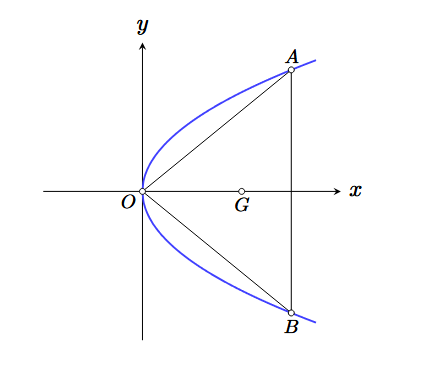
Let \(A = \left(\dfrac{a\sqrt{3}}{2}, \dfrac{a}{2}\right)\) (in the first quadrant)
Since \(A\) lies on \(y^2 = x\):
\(\left(\dfrac{a}{2}\right)^2 = \dfrac{a\sqrt{3}}{2}\)
\(a = 2\sqrt{3}\)
The \(x\)-coordinate of the midpoint of \(AB\) is \(\dfrac{a\sqrt{3}}{2} = \dfrac{2\sqrt{3} \cdot \sqrt{3}}{2} = 3\)
In an equilateral triangle, the centroid divides the median in ratio \(2:1\) from the vertex.
Distance from \(O\) to midpoint of \(AB\) = 3
Centroid \(G\) is at \(\dfrac{2}{3} \times 3 = 2\) from \(O\) along the \(x\)-axis.
Thus \(G = (2, 0)\)
The number of three-digit numbers that can be formed using 0, 1, 2, 3, and 5 where these digits are allowed to repeat any number of times is equal to:
For a three-digit number, the hundreds place cannot be 0.
Available digits: 0, 1, 2, 3, 5
Hundreds place: Can be filled by 1, 2, 3, or 5 → 4 choices
Tens place: Can be filled by any of 0, 1, 2, 3, 5 → 5 choices
Units place: Can be filled by any of 0, 1, 2, 3, 5 → 5 choices
Since repetition is allowed:
Total number of three-digit numbers = \(4 \times 5 \times 5 = 100\)
If \( B = \sin^2 \alpha + \cos^4 \alpha \), then for all real \( \alpha \)
Let \( t = \sin^2 \alpha \), where \( 0 \leq t \leq 1 \).
Then \( \cos^2 \alpha = 1 - t \), so \( \cos^4 \alpha = (1 - t)^2 \).
Thus \( B = t + (1 - t)^2 \).
Simplifying, \( B = t + 1 - 2t + t^2 = t^2 - t + 1 \).
Completing the square, \( B = \left(t - \dfrac{1}{2}\right)^2 + \dfrac{3}{4} \).
At \( t = \dfrac{1}{2} \), the minimum value is \( B = \dfrac{3}{4} \).
At \( t = 0 \), \( B = 1 \).
Therefore, \( \dfrac{3}{4} \leq B \leq 1 \).
Let \( f : \mathbb{R} \to \mathbb{R} \) be any function defined as \( f(x) = \begin{cases} x^\alpha \sin \dfrac{1}{x^\beta}, & x \neq 0 \\ 0, & x = 0 \end{cases} \), where \( \alpha, \beta \in \mathbb{R} \). Which of the following is true?
For continuity at \( x = 0 \), we require \( \lim_{x \to 0} f(x) = f(0) = 0 \).
Consider \( \lim_{x \to 0} x^\alpha \sin \left( \dfrac{1}{x^\beta} \right) \).
The sine term oscillates between \( -1 \) and \( 1 \).
Hence \( |x^\alpha \sin(\cdot)| \leq |x^\alpha| \).
The limit \( x^\alpha \to 0 \) as \( x \to 0 \) if and only if \( \alpha > 0 \), irrespective of the value of \( \beta \).
Therefore \( \lim_{x \to 0} f(x) = 0 \) for all \( \alpha > 0 \) and any \( \beta \in \mathbb{R} \).
Thus \( f \) is continuous at \( x = 0 \) for all \( \alpha > 0 \) and \( \beta \in \mathbb{R} \).
Options (A) and (D) are false since \( \beta \) does not affect continuity and \( \alpha > 0 \) is necessary.
Option (B) is false because differentiability requires stronger conditions on \( \alpha \) and \( \beta \).
If \( \cos^2 10^\circ \cos 20^\circ \cos 40^\circ \cos 50^\circ \cos 70^\circ = a + \dfrac{\sqrt{3}}{16} \cos 10^\circ \), then \( 3a^{-1} \) is equal to
Rewrite the expression as
\((\cos 10^\circ \cos 50^\circ \cos 70^\circ)(\cos 10^\circ \cos 20^\circ \cos 40^\circ)\)
\(= \dfrac{\cos (3\times10^\circ)}{4} \left( \dfrac{\sin 80^\circ}{8 \sin 10^\circ}\right)\)
\(= \dfrac{\sqrt{3}\sin 80^\circ}{64 \sin 10^\circ}\)
Given that \(\dfrac{\sqrt{3}\sin 80^\circ}{64 \sin 10^\circ}=\dfrac{\sqrt{3}}{16} \cos 10^\circ + a\)
\(\Rightarrow a = \dfrac{\sqrt{3}}{64} \left[\dfrac{\sin 80^\circ}{\sin 10^\circ}-4\cos 10^\circ \right]\)
\(\Rightarrow a = \dfrac{\sqrt{3}}{64} \left[\dfrac{\sin 80^\circ-4\cos 10^\circ \sin 10^\circ }{\sin 10^\circ}\right]\)
\(\Rightarrow a = \dfrac{\sqrt{3}}{64} \left[\dfrac{\sin 80^\circ- \sin 20^\circ- \sin 20^\circ }{\sin 10^\circ}\right]\)
\(\Rightarrow a = \dfrac{\sqrt{3}}{64} \left[\dfrac{2\cos 50^\circ \sin 30^\circ- \sin 20^\circ }{\sin 10^\circ}\right]\)
\(\Rightarrow a = \dfrac{\sqrt{3}}{64} \left[\dfrac{\cos 50^\circ - \sin 20^\circ }{\sin 10^\circ}\right]\)
\(\Rightarrow a = \dfrac{\sqrt{3}}{64} \left[\dfrac{\sin 40^\circ - \sin 20^\circ }{\sin 10^\circ}\right]\)
\(\Rightarrow a = \dfrac{\sqrt{3}}{64} \left[\dfrac{2\cos 30^\circ \sin 10^\circ }{\sin 10^\circ}\right]\)
\(\Rightarrow a=\dfrac{3}{64}\)
Thus \( 3a^{-1} = 3 \times \dfrac{64}{3} = 64 \).
Let \( A = \{1, 2, 3, \dots, 20\} \). Let \( R \subseteq A \times A \) such that \( R = \{(x, y) : y = 2x - 7\} \). Then the number of elements in \( R \) is equal to
We require \(x \in A\) and \(y \in A\) such that \(y = 2x - 7\).
Since \(y \in A\), we must have \(1 \leq 2x - 7 \leq 20\).
From \(2x - 7 \geq 1\), we get \(2x \geq 8\) or \(x \geq 4\).
From \(2x - 7 \leq 20\), we get \(2x \leq 27\) or \(x \leq 13\).
Thus \(x\) can take integer values from 4 to 13.
The number of such integers is \(13 - 4 + 1 = 10\).
For each such \(x\), the corresponding \(y = 2x - 7\) lies in \(A\).
Hence, the number of elements in \(R\) is \(10\).
The angles of depression of the top and bottom of an 8 m tall building from the top of a multistoried building are \(30^\circ\) and \(45^\circ\) respectively. What is the height of the multistoried building and the distance between the two buildings?
Let height of multistoried building = \(h\) m and horizontal distance = \(x\) m.
Angle of depression of top (at height 8 m) = 30°:
\(\tan 30^\circ = \dfrac{h - 8}{x}\)
\(\dfrac{1}{\sqrt{3}} = \dfrac{h - 8}{x}\) ...(1)
Angle of depression of bottom = 45°:
\(\tan 45^\circ = \dfrac{h}{x}\)
\(1 = \dfrac{h}{x}\), so \(h = x\) ...(2)
Substituting (2) into (1):
\(\dfrac{1}{\sqrt{3}} = \dfrac{x - 8}{x}\)
\(x = \sqrt{3}(x - 8)\)
\(x = \sqrt{3}x - 8\sqrt{3}\)
\(x - \sqrt{3}x = -8\sqrt{3}\)
\(x(1 - \sqrt{3}) = -8\sqrt{3}\)
\(x = \dfrac{-8\sqrt{3}}{1 - \sqrt{3}} = \dfrac{8\sqrt{3}}{\sqrt{3} - 1}\)
Rationalizing: \(x = \dfrac{8\sqrt{3}(\sqrt{3} + 1)}{(\sqrt{3} - 1)(\sqrt{3} + 1)} = \dfrac{8\sqrt{3}(\sqrt{3} + 1)}{3 - 1} = \dfrac{8\sqrt{3}(\sqrt{3} + 1)}{2}\)
\(= 4\sqrt{3}(\sqrt{3} + 1) = 4(3 + \sqrt{3})\)
Thus \(h = x = 4(3 + \sqrt{3})\) m
If \(\alpha\) and \(\beta\) are the two roots of the quadratic equation \(x^2 + ax + b = 0\), where \(ab \neq 0\), then the quadratic equation whose roots are \(\dfrac{1}{\alpha^3 + \alpha}\) and \(\dfrac{1}{\beta^3 + \beta}\) is:
Given: \(\alpha + \beta = -a\) and \(\alpha\beta = b\)
New roots: \(p = \dfrac{1}{\alpha^3 + \alpha} = \dfrac{1}{\alpha(\alpha^2 + 1)}\) and \(q = \dfrac{1}{\beta(\beta^2 + 1)}\)
Product of roots:
\(P = pq = \dfrac{1}{\alpha\beta(\alpha^2 + 1)(\beta^2 + 1)} = \dfrac{1}{b[(\alpha\beta)^2 + \alpha^2 + \beta^2 + 1]}\)
Since \(\alpha^2 + \beta^2 = (\alpha + \beta)^2 - 2\alpha\beta = a^2 - 2b\):
\(P = \dfrac{1}{b[b^2 + (a^2 - 2b) + 1]} = \dfrac{1}{b(b^2 + a^2 - 2b + 1)}\)
Sum of roots:
\(S = p + q = \dfrac{\alpha^3 + \beta^3 + \alpha + \beta}{b(b^2 + a^2 - 2b + 1)}\)
\(\alpha^3 + \beta^3 = (\alpha + \beta)^3 - 3\alpha\beta(\alpha + \beta) = (-a)^3 - 3b(-a) = -a^3 + 3ab\)
Numerator = \((-a^3 + 3ab) + (-a) = -a^3 - a + 3ab\)
\(S = \dfrac{-a^3 - a + 3ab}{b(b^2 + a^2 - 2b + 1)}\)
The quadratic equation is \(x^2 - Sx + P = 0\).
Multiplying by \(b(b^2 + a^2 - 2b + 1)\):
\(b(b^2 + a^2 - 2b + 1)x^2 - (a^3 + a - 3ab)x + 1 = 0\)
The area enclosed between the curves \(y = \sin x\), \(y = \cos x\), and \(0 \leq x \leq \dfrac{\pi}{2}\) is:
The curves \(y = \sin x\) and \(y = \cos x\) intersect when \(\sin x = \cos x\), which gives \(x = \dfrac{\pi}{4}\).
For \(0 \leq x \leq \dfrac{\pi}{4}\): \(\cos x \geq \sin x\)
For \(\dfrac{\pi}{4} \leq x \leq \dfrac{\pi}{2}\): \(\sin x \geq \cos x\)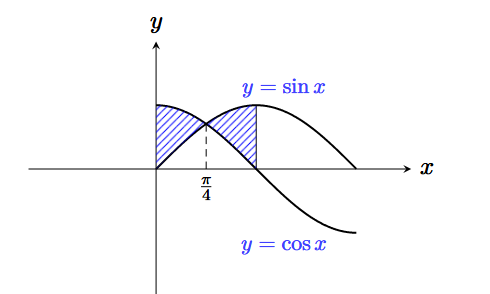
Area = \(\int \limits_0^{\pi/4} (\cos x - \sin x) \, dx + \int \limits_{\pi/4}^{\pi/2} (\sin x - \cos x) \, dx\)
First integral:
\(\int \limits_0^{\pi/4} (\cos x - \sin x) \, dx = [\sin x + \cos x]_0^{\pi/4}\)
\(= \left(\dfrac{1}{\sqrt{2}} + \dfrac{1}{\sqrt{2}}\right) - (0 + 1) = \sqrt{2} - 1\)
Second integral:
\(\int \limits_{\pi/4}^{\pi/2} (\sin x - \cos x) \, dx = [-\cos x - \sin x]_{\pi/4}^{\pi/2}\)
\(= (0 - 1) - \left(-\dfrac{1}{\sqrt{2}} - \dfrac{1}{\sqrt{2}}\right) = -1 + \sqrt{2} = \sqrt{2} - 1\)
Total area = \((\sqrt{2} - 1) + (\sqrt{2} - 1) = 2(\sqrt{2} - 1)\)
Let \(\vec{a} = 2\hat{i} - 3\hat{j} + 4\hat{k}\), \(\vec{b} = \hat{i} + 2\hat{j} - \hat{k}\), and \(\vec{c} = 3\hat{i} + \hat{j} + \lambda\hat{k}\) be the co-terminal edges of a parallelepiped whose volume is 5 units. Then the value of \(\lambda\) is:
Volume of parallelepiped = \(|\vec{a} \cdot (\vec{b} \times \vec{c})| = 5\)
First, compute \(\vec{b} \times \vec{c}\):
\(\vec{b} \times \vec{c} = \begin{vmatrix} \hat{i} & \hat{j} & \hat{k} \\ 1 & 2 & -1 \\ 3 & 1 & \lambda \end{vmatrix}\)
\(= \hat{i}(2\lambda - (-1)) - \hat{j}(\lambda - (-3)) + \hat{k}(1 - 6)\)
\(= (2\lambda + 1)\hat{i} - (\lambda + 3)\hat{j} - 5\hat{k}\)
Now compute \(\vec{a} \cdot (\vec{b} \times \vec{c})\):
\(\vec{a} \cdot (\vec{b} \times \vec{c}) = 2(2\lambda + 1) + (-3)(-(\lambda + 3)) + 4(-5)\)
\(= 4\lambda + 2 + 3\lambda + 9 - 20\)
\(= 7\lambda - 9\)
Given \(|7\lambda - 9| = 5\):
Case 1: \(7\lambda - 9 = 5\) → \(7\lambda = 14\) → \(\lambda = 2\)
Case 2: \(7\lambda - 9 = -5\) → \(7\lambda = 4\) → \(\lambda = \dfrac{4}{7}\)
Since \(\dfrac{4}{7}\) is not among the options, we take \(\lambda = 2\).
Let the line \(\dfrac{x}{4} + \dfrac{y}{2} = 1\) meet the \(x\)-axis and \(y\)-axis at A and B, respectively. M is the midpoint of side AB, and M' is the image of point M across the line \(x + y = 1\). Let point P lie on the line \(x + y = 1\) such that triangle ABP is an isosceles triangle with AP = BP. Then the distance between M' and P is:
From \(\dfrac{x}{4} + \dfrac{y}{2} = 1\), \(A = (4, 0)\) and \(B = (0, 2)\) and the midpoint of the line \(AB,\; M =(2, 1)\).
Given that \(AP = BP\), so the point P lies on the perpendicular bisector of the line \(AB\). Slope of \(AB = \dfrac{2-0}{0-4} = -\dfrac{1}{2}\)
Perpendicular bisector through M has slope 2, its equation is: \(y - 1 = 2(x - 2)\) or \(y = 2x - 3\)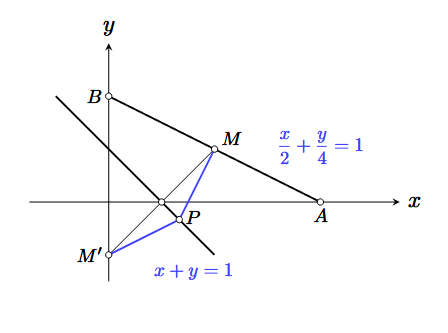
The point P is the intersection of this line with \(x+y=1\). The point P is: \(x = \dfrac{4}{3}\), \(y = -\dfrac{1}{3}\)
If \(M'\) is the mirror image of the point \(M\), then \(PM'=PM\).
The distance \(PM'=PM=\sqrt{\left(\dfrac{4}{3} - 2\right)^2 + \left(-\dfrac{1}{3} - -1\right)^2}\)
\(= \sqrt{\dfrac{16}{9} + \dfrac{4}{9}} = \sqrt{\dfrac{20}{9}} = \dfrac{2\sqrt{5}}{3}\)
There are two coins, blue and red. For the blue coin, the probability of getting heads is 0.99, and for the red coin, it is 0.01. One coin is chosen randomly and is tossed. The probability of getting heads is:
Let \(B\) be the event of choosing the blue coin and \(R\) be the event of choosing the red coin.
Since the coin is chosen randomly: \(P(B) = P(R) = \dfrac{1}{2}\)
Let \(H\) be the event of getting heads. Then:
\(P(H|B) = 0.99\) and \(P(H|R) = 0.01\)
By the total probability theorem:
\(P(H) = P(B) \cdot P(H|B) + P(R) \cdot P(H|R)\)
\(P(H) = \dfrac{1}{2} \times 0.99 + \dfrac{1}{2} \times 0.01\)
\(P(H) = \dfrac{1}{2}(0.99 + 0.01) = \dfrac{1}{2} \times 1 = 0.5\)